Improving Heat Transfer Efficiency (HTE)
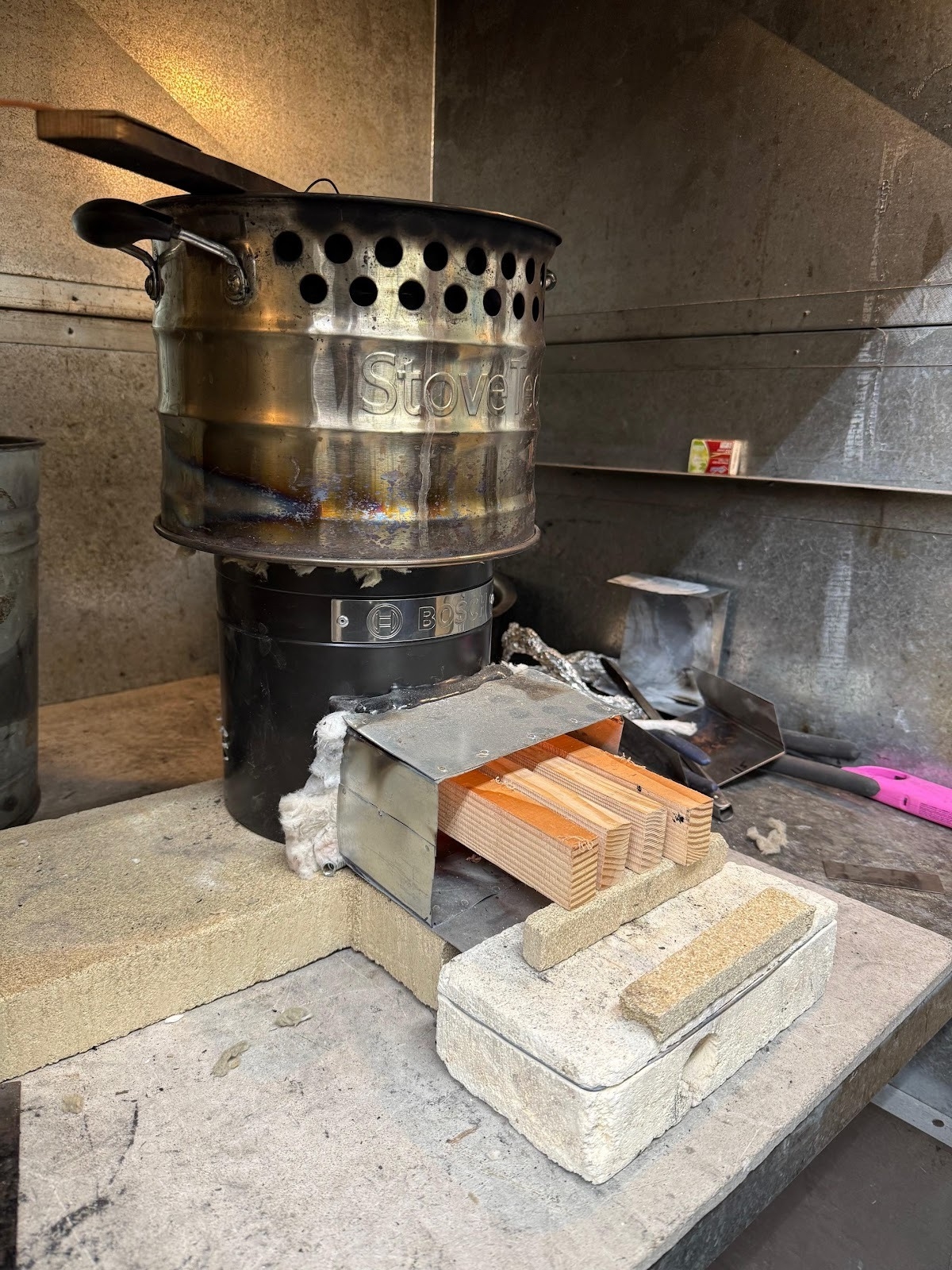
Testing improvements on a Bosch rocket stove
For example, a new Bosch prototype cook stove with Super Pot. Thanks, Osprey Foundation!

HTE Design principles: Increase temperature and velocity of gases, exposed area in pot(s), radiation, proximity of gases to pot(s) without decreasing velocity. Use dry wood. Doubling temperature, velocity and area doubles heat transfer efficiency! Doubling radiation is much more effective!

Wood Moisture Content: This is often a critical variable. Ideally, wood should have a moisture content of less than 20%. Water in the wood must be evaporated before the wood can burn, consuming energy that could go into the food. Burning wood with 30% moisture content can reduce effective heat output by nearly 40% compared to dry wood.

Excess Air Ratio: Too little air into the combustion chamber causes smoke and incomplete combustion. Too much air also cools the gases before they hit the pot, decreasing how much energy enters the food. In natural draft cook stoves, velocity is usually something like one meter per second which is SLOW.

Design: Influences how much of the heat is successfully captured or lost. Dr. Larry Winiarski suggested maintaining constant cross sectional area throughout when designing a stove. A gap of 6mm to 8mm seems to work well in a pot skirt. The narrow channel forces hot gases to “scrub” against the pot surface, thinning the insulating boundary layer of still air.

Materials: High-mass stoves, often used for an hour or so, absorb a significant amount of heat. Using lightweight, insulating materials ensures heat is reflected back toward the pot rather than being “stolen” by the stove.

Bigger Pots: For highest thermal efficiency 1.) Expose as hot as possible gases at 2.) Fastest natural draft velocity 3.) As close as possible to the bottom and sides of 4.) The biggest possible pot. ARC now uses the constant cross sectional area of the stove reduced by 25% to calculate the gap for a pot skirt. We then fine tune prototypes under the emissions hood trying to find a desired compromise between thermal efficiency and emissions of CO and PM2.5.

Increasing HTE

Variable TargetEffect on HTE
Wood Moisture< 20%Increases by reducing energy wasted
Channel GapIn Pot Skirt6mm – 8mmIncreases (~25%) 
InsulationHighIncreases by reducing losses
Pot LidKeep humidity above water at 100%Increases by decreasing heat loss via evaporation
Excess AirKeep Temperatures HotIncreases when not more air than needed is supplied

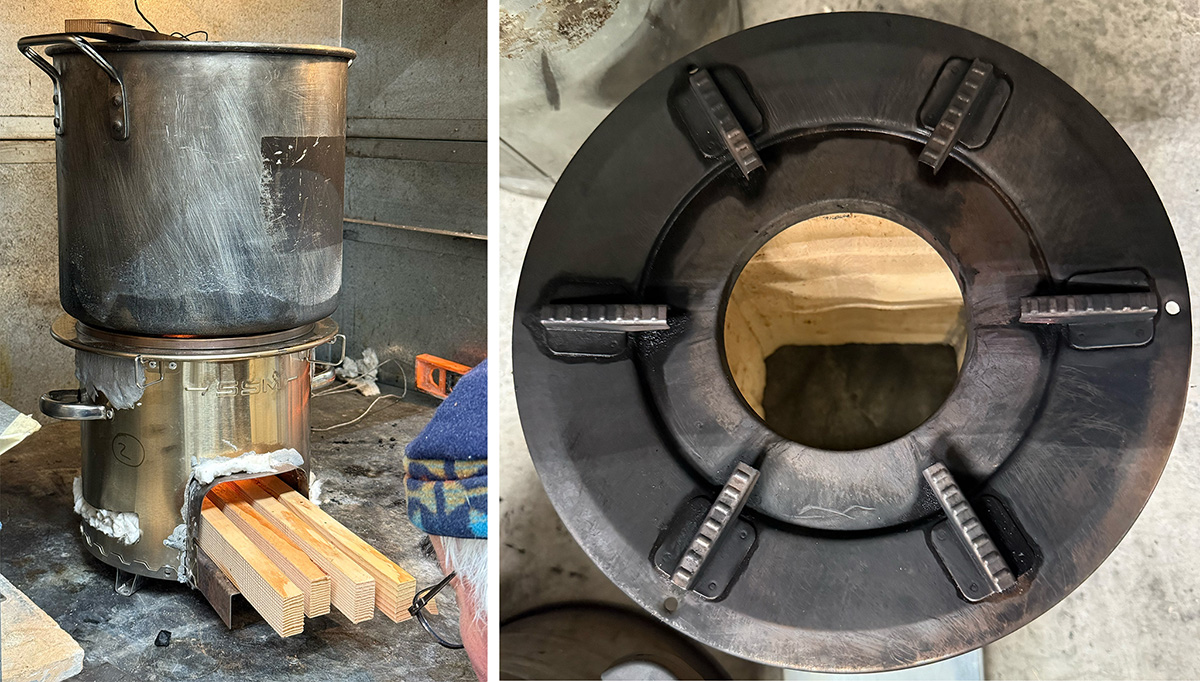
The Stainless Steel Winiarski Stove Top

The Stainless Steel Winiarski Stove Top

The other day, I watched as Dr. Winiarski’s stainless steel stove top (sold by BURN and SSM) helped to force 43% of the heat from a hot fire into a 30cm in diameter flat bottom pot without a pot skirt. 

The improved stove top adds a lot to a stove! It is probably the most cost effective way to start improving a stove. What do we think it does?

  • Maintaining ~0.75 of constant cross sectional area in the stove top may help to thin the boundary layer of still air next to the bottom of the pot so hot molecules in the gases can replace cold molecules close to the bottom of the pot more effectively. 
  • The restricted flow may help to maintain a beneficial air/fuel ratio (elevating temperatures) by decreasing the excess flow of cold air into the combustion chamber.

Evolving heat transfer “rules of thumb”:

  1. Raising the temperature of the gases will increase efficiency. 
  2. Moving hot gases closer to the boundary layer will increase thermal efficiency until gas velocity is slowed. 
  3. Increasing exposed surface area will increase thermal efficiency until gas temperature reaches the temperature of the water in the pot, for example. 
  4. Increasing radiation will improve efficiency. 
  5. Increasing the velocity of the gases will also increase thermal efficiency, making sure that gas temperatures are not reduced by excess velocity.

Thermal Efficiency: How High Can We Go?

From SAMUEL BALDWIN’S “BIOMASS STOVES: ENGINEERING DESIGN, DEVELOPMENT, AND DISSEMINATION,” VITA, 1987

Various stove/pot/skirt combinations are achieving ~ 60% thermal efficiency. 

How high can we go? 

  • Doubling temperature doubles heat transfer efficiency when other factors remain constant.
  • According to Newton’s Law, doubling the surface area doubles the heat transfer.
  • Forcing hot gases to thin the boundary layer of still air next to the surface to be heated (Proximity) effectively increases heat transfer efficiency (as above).
  • Doubling the Velocity of gases ~doubles heat transfer efficiency.
  • Increasing radiation increases heat transfer exponentially. *See chart below.
  • Increasing the view factor helps, too! (That’s the proportion of radiation that contacts the bottom of the pot.)
  • Prasad and others have suggested a correlation between firepower and area.

There may be other important factors?

  • In a modern Rocket stove at high power, the gases can be around 800C and the velocity can be around 1.2 meters per second.
  • Small, dry pieces of wood tend to make hotter fires and gases.
  • Pots have to have sufficient external surface area to achieve 50% thermal efficiency.

In ARC tests of modern Rocket stoves, a pot with an area of around 800cm2 scored 34% thermal efficiency. Increasing the area to around 1000cm2 increased thermal efficiency to about 40%. With the same stove, a pot with 1200cm2 is expected to achieve above 45%. ARC uses 26cm to 30cm in diameter pots with at least 5 liters of water to get closer to 50% thermal efficiency.

Keep in mind that increasing the surface area of the water in a pot also increases the amount of steam emitted, which makes it harder to bring water to full boil in a larger pot (without a lid).

Thermal efficiency, when burning biomass, seems to top out (so far) at around 60%. Perhaps the gases in the channels at the bottom and sides of the pot loose temperature and velocity, resulting in a theoretical upper limit to normal natural draft heat transfer efficiency?

Since doubling velocity ~ doubles heat transfer efficiency it seems likely that if forced draft increased velocity, without reducing gas temperatures, good things might happen?

We’ll give it a try.

From The Woodburner’s Encyclopedia, 1976

Stick Size Matters!

Small sticks make higher temperature gases, better for heat transfer efficiency, but more smoke

Monitoring many fires seems to show that along with density, moisture, etc., the diameter of sticks has a large effect on both heat transfer and combustion efficiency.  

In a Rocket stove without a closing door, there is obviously a lot of cold excess air entering the fire. How do we raise Temperatures without limiting primary air?

Our observations seem to indicate that burning smaller diameter sticks results in more flame/higher temperatures. However, burning smaller diameter sticks also tends to make more smoke. For this reason, it may be that burning small sticks increases thermal efficiency but decreases combustion efficiency.

Conversely big sticks seem to burn slower making less flame, resulting in lower temperatures while making less smoke. Since flame from wood makes smoke, when the wood becomes charcoal, much less PM2.5 is emitted.

The Jet-Flame can burn 2” by 2” sticks and testing shows that PM2.5 gets lower with bigger diameter sticks. The jets of air make the made charcoal very hot and even big sticks stay lit. In a normal Rocket stove without a Jet-Flame, especially with wet wood, only smaller sticks will keep burning. 

The goal is to create as-hot-as-possible gases flowing next to the heat exchanger (pot) while controlling emissions. The size of the sticks does seem to have a significant influence on thermal and combustion efficiency.