Aprovecho
  • Home
  • Our Work
    • Emissions Testing Equipment
    • Lab and Field Testing Services
    • Stove Design and Manufacturing Support
    • Consulting and Capacity Building
  • Resources
    • Newsletters
    • Publications
    • Video Gallery
    • Software
  • About
  • Donate
  • Click to open the search input field Click to open the search input field Search
  • Menu Menu

No More Simmering!

June 10, 2022/0 Comments/in Biomass Alternatives, Thermal Efficiency
A quick internet search for “retained heat cooker” brings up many modern choices.

In 2018, the World Health Organization concluded, “Every day around the world, billions of children are exposed to unsafe levels of air pollution. The result is a global public health emergency.” 

The WHO recommends that a combination of actions may be most effective. Aprovecho has used Retained Heat Cookers (Hayboxes) for decades and we recommend them, especially where beans make up a part of the diet.

Retained Heat Cookers simmer food to completion reducing CO emissions by 56%, PM emissions by 37% and saving 50% of the fuel and time spent cooking. (Test Results of Cook Stove Performance, 2011). When food is simmering, the fire is constantly replacing the heat lost from the pot. If the heat is captured instead, the retained heat in the boiling pot finishes cooking the food. 

In the same way, a drafty and uninsulated house has to have a big fire going all the time to keep the house warm.  The super-insulated, almost airtight house can stay warm for a long time after the fire is extinguished. In Oregon, Haybox homes are called “Super Good Cents” homes.

Once the boiling pot is in the box, food cooks without further attention. Even pinto beans will finish softening if the box, with waterproof R-7 insulation, is almost airtight.  Makes cooking a lot easier, too!
https://aprovecho.org/wp-content/uploads/2022/06/retained-heat-cookers.jpg 423 1297 Kim Still https://aprovecho.org/wp-content/uploads/2015/11/Aprovecho-Logo.png Kim Still2022-06-10 17:16:142022-06-10 17:17:31No More Simmering!
Summertime_Solar_Cooking

Cooking With The Sun

October 22, 2021/0 Comments/in Biomass Alternatives
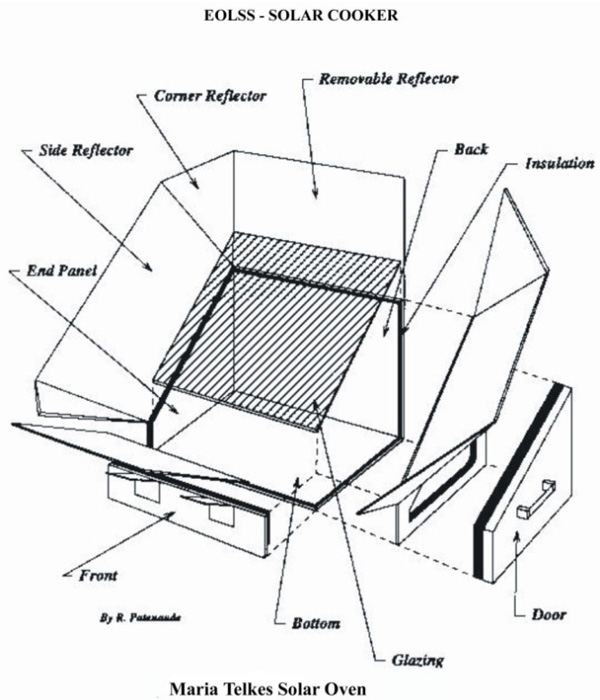
Maria Telkes NYWTS
Summertime_Solar_Cooking


Last week we shared info about retained heat cooking. It’s frequently paired with solar cooking for feeding folks with no earth-generated fuel expenditure at all. But does it work? The cooks at ARC think that it’s great  – in the summer time when we have lots of sunlight.

Our preferred solar oven was invented in 1953 by Mária Telkes. She was a Hungarian-American biophysicist, scientist and inventor who became well known for her work in solar energy. Her many inventions also included a solar home heating system and solar powered water desalinator.

We like Telkes solar cookers that are big enough to generate firepower that is similar to wood burning cookstoves. A solar cooker is so easy to use and so much cleaner! Of course it is different because a Telkes solar cooker is an oven that is outside on the porch of the kitchen. The cook stands in the shade from the roof and the solar cooker basks in the sun. Just point it at the sun, put the food in the oven, and you are free to do everything else.

Here’s how we do the simple math to create a powerful Telkes solar cooker. Let’s say, as rules of thumb, that:

  1. There are about 250 BTUs in a square foot of sunshine per hour.
  2. There are approximately 8,600 BTU in a pound of wood. Remember, wood is stored solar energy.
  3. Therefore it takes a solar oven with about 34 square feet of intercepted sunlight to equal the cooking power of one pound of wood burned in an hour.
  4. In a solar oven with the firepower of one pound of wood (burned in an hour) the intercepted sunlight should be about 6′ by 6′. This is the measurement at the top edges of the solar reflectors – the widest part of the cooker.
  5. About 1/3 of the energy cooks the food and about 2/3rds of the energy is lost. 
  6. In our 6′ by 6′ solar oven, 3,000 BTUs would boil 2 gallons of water in about an hour. The light weight pot is black, it has a tight lid, the oven is well insulated, and airtight. The glass is double glazed. The losses are minimized and the solar gain is optimized with large reflectors on all sides. Large amounts of food can be made every sunny day without using up any earthly resources. 

In our experience, solar cookers are great when they are big enough to do the cooking task in a reasonable amount of time. ARC cooks have used them in the summer to cook lunch and dinner for 20 people and it’s nice to have a no-fuss oven that needs little tending. Solar cooking is certainly more comfortable when cooks don’t have to deal with a hot fire on summer days. At the Aprovecho farm, the staff have used stored solar energy in the winter (biomass) and direct solar energy (sunlight) in the summer for cooking, heating water, etc.

Of course, everything is dependent on sunlight.

https://aprovecho.org/wp-content/uploads/2016/03/Summertime_Solar_Cooking.jpg 700 600 Kim Still https://aprovecho.org/wp-content/uploads/2015/11/Aprovecho-Logo.png Kim Still2021-10-22 13:48:282021-10-22 13:48:31Cooking With The Sun

Retained Heat Cooking

October 13, 2021/0 Comments/in Biomass Alternatives
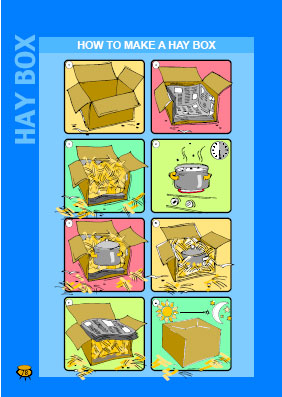
Use moisture proof insulation! Wet insulation doesn’t work well. Illustration from solarcooking.org 

While at ARC we focus on how to cook most efficiently with biomass, it is good to remember that some cooking can continue without consuming fuel. A retained heat cooker (RHC), also known as a Haybox, is a great way to save on fuel for appropriate cooking tasks such as simmering rice or beans.

How does a retained heat cooker (RHC) help when cooking? When food simmers, the fire replaces the constantly lost heat from the pot. If the heat were not lost but captured instead, then less fuel would be needed for cooking. Placing the pot of boiling food in an insulated container keeps the food hot enough to simmer it to completion. In the same way, a drafty and uninsulated house has to have a big fire in the heating stove going all the time to keep the house warm. Even if no fire is lit, the super-insulated, almost airtight house can stay warm for a long time.

After a pot of food boils, the contents are close to 100°C. When the hot pot is placed in a super-insulated, almost airtight box, the food finishes cooking, because the stored heat stays in the food. Once the pot is in the box, food cooks without further attention. The retained heat cooker, saves time, effort, and fuel, freeing the cook from long hours of watching the slow fire when simmering food.

Approximately 50% savings in time and fuel savings can be expected. The rice or stew won’t burn and the cook can make dessert! Because the fuel is only used for boiling food, cooking with a Haybox creates much less pollution, helping to clean up the air in the kitchen. In tests of 18 stoves, using a retained heat cooker reduced, on average, CO emissions by 56% and PM emissions by 37% . (Test Results of Cook Stove Performance, 2011)

RHCs have been used for hundreds of years. They can save time and effort that can be devoted to other tasks. The attraction begins with convenience. The fuel savings and decrease in harmful emissions add to the benefits of retained-heat cooking. More information on Hayboxes can be found in the EPA’s “Guide to Designing Retained Heat Cookers.”

https://aprovecho.org/wp-content/uploads/2021/10/10.13.21-ZHAPHaybox.jpeg 397 282 Kim Still https://aprovecho.org/wp-content/uploads/2015/11/Aprovecho-Logo.png Kim Still2021-10-13 13:24:012021-10-13 13:24:03Retained Heat Cooking
Search Search

Latest Newsletters

  • To Lower Emissions, Add AirAugust 12, 2026 - 3:46 pm
  • Photo of the Rodale Solar Food Dryer book
    Improving the Rodale Solar Food DryerJuly 31, 2026 - 9:02 am
  • ARC and The Breathing Space Project in IndiaJuly 24, 2026 - 2:45 pm
  • a closed black box next to an open, semi-transparent box
    Using Black Box and Open Box Experimental DesignJuly 17, 2026 - 1:30 pm
  • Executive Director’s Report – Celebrating Aprovecho’s 50th AnniversaryJune 19, 2026 - 12:22 pm
  • Improving Solar Distillation: Two-Stage DistillationMay 29, 2026 - 1:15 pm
  • What’s Cooking at AprovechoMay 14, 2026 - 11:07 am
  • Photo of a solar still
    Improving Solar Distillation, Part 1April 3, 2026 - 1:32 pm
  • Michael Saul with some test data
    Real World Temperatures in a Pot SkirtMarch 27, 2026 - 2:17 pm
  • Aprovecho Research Center logo
    Requesting input: What technologies are most needed in households?March 13, 2026 - 12:43 pm
  • Testing improvements on a Bosch rocket stove
     Improving Heat Transfer Efficiency (HTE)March 6, 2026 - 2:59 pm
  • The Stainless Steel Winiarski Stove TopFebruary 27, 2026 - 3:36 pm
  • Cross- sectional illustration of a biomass cookstove with auto damper
    Health: Reducing PM2.5 by ~90%February 13, 2026 - 2:47 pm
  • The Icy-Ball : A Heat Driven RefrigeratorJanuary 30, 2026 - 3:20 pm
  • Stove parts at SSM
    A Hospitable Chinese Environment for Improved CookstovesJanuary 23, 2026 - 2:15 pm
  • A cookstove production line at SSMNordica MacCarty
    Tier 3 Biomass StovesJanuary 16, 2026 - 4:21 pm
  • Don’t Let The Flame Touch The PotDecember 19, 2025 - 2:04 pm
  • Early Rocket Stove Research at Aprovecho Still Rings TrueDecember 11, 2025 - 3:59 pm
  • Cook Stoves for EthosDecember 4, 2025 - 4:09 pm
  • A Clean Open Fire?October 31, 2025 - 9:25 am

Archives

Aprovecho Research Center

Mailing: PO Box 1175, Cottage Grove, OR 97424, USA

Visit: 76132 Blue Mountain School Road, Cottage Grove, OR 97424, USA
541-767-0287
info@aprovecho.org

© Copyright - Aprovecho Research Center | Digital Partner: Wildwood SEO
Scroll to top Scroll to top Scroll to top