A Hospitable Chinese Environment for Improved Cookstoves
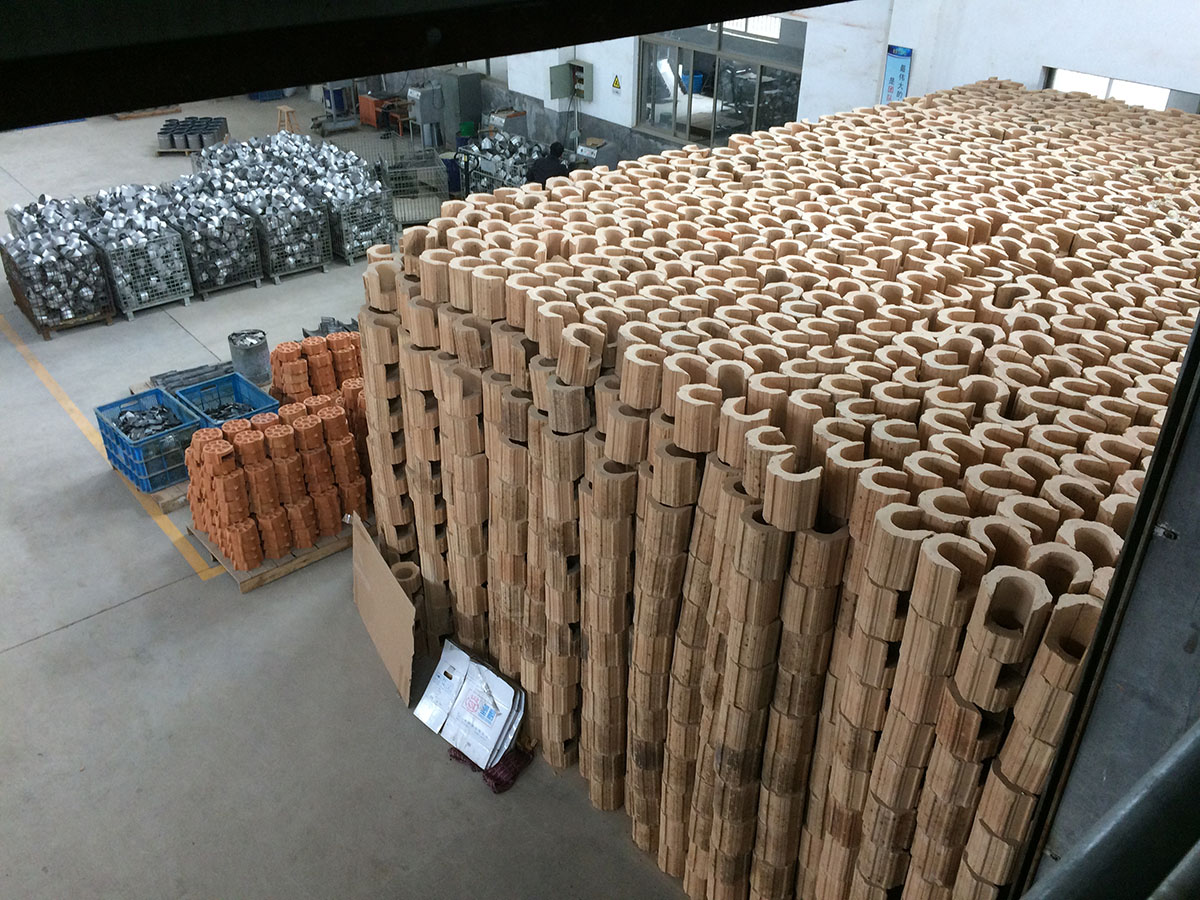
Stove parts at SSM
Ceramic combustion chambers and other stove parts stockpiled at SSM

Information summarized via Google AI:

In 2026, the Chinese carbon market (CCER) is generally a more hospitable environment for cookstove projects—defined as traditional improved biomass stoves that lack advanced digital monitoring—compared to UN or Western voluntary markets. 

While international markets now demand costly digital “metering” and stricter methodologies, the Chinese domestic market offers more flexibility for simpler projects. 

  • Protection from VCM Volatility: Traditional cookstove projects in Western markets are currently facing a “crisis of quality”. Large-scale studies in 2025 found that older projects likely over-credited by 900%, causing Western buyers to avoid them. 
  • The Chinese CCER market provides a sheltered environment where domestic compliance entities can still utilize these credits without the same level of global reputational risk.
  • Methodological Lag: While Western markets are shifting to metered and measured standards (e.g., Gold Standard’s new digital tools), China’s revamped CCER scheme allows for traditional improved efficiency stoves that fit into its broader “dual control” carbon and energy policies.
  • Price Floor: In 2026, “old-fashioned” credits in the global voluntary market have struggled to trade above $3.30/tCO2e. In contrast, CCERs are expected to maintain a higher floor ($10+) due to scarcity and mandatory offset needs within the Chinese ETS.

Tariffs

Recently many African countries removed tariffs on Chinese biomass cookstoves dramatically reducing cost to consumers. A widespread trend toward zero-rating clean cooking technologies has emerged to meet energy access goals. While China has eliminated tariffs on imports from 53 African nations, this does not automatically remove the duties African countries charge on Chinese-manufactured goods. 

Recent Policy Changes (2026)

Several African nations have implemented specific exemptions for clean energy equipment: 

Sierra Leone

: Under the 2026 Finance Act, the government has officially approved zero import duties on a wide range of clean cooking technologies, including improved biomass stoves and solar cookers.

Cameroon

: Effective in 2026, Cameroon has introduced customs exemptions for biofuel equipment, including industrial machinery used to produce pellets and eco-charcoal, to curb deforestation.

Kenya and Tanzania

These nations were identified in early 2026 as having the greatest improvement in clean cooking policy coverage, frequently utilizing tax incentives and duty remissions to lower costs for consumers. 
Tier 3 Biomass Stoves

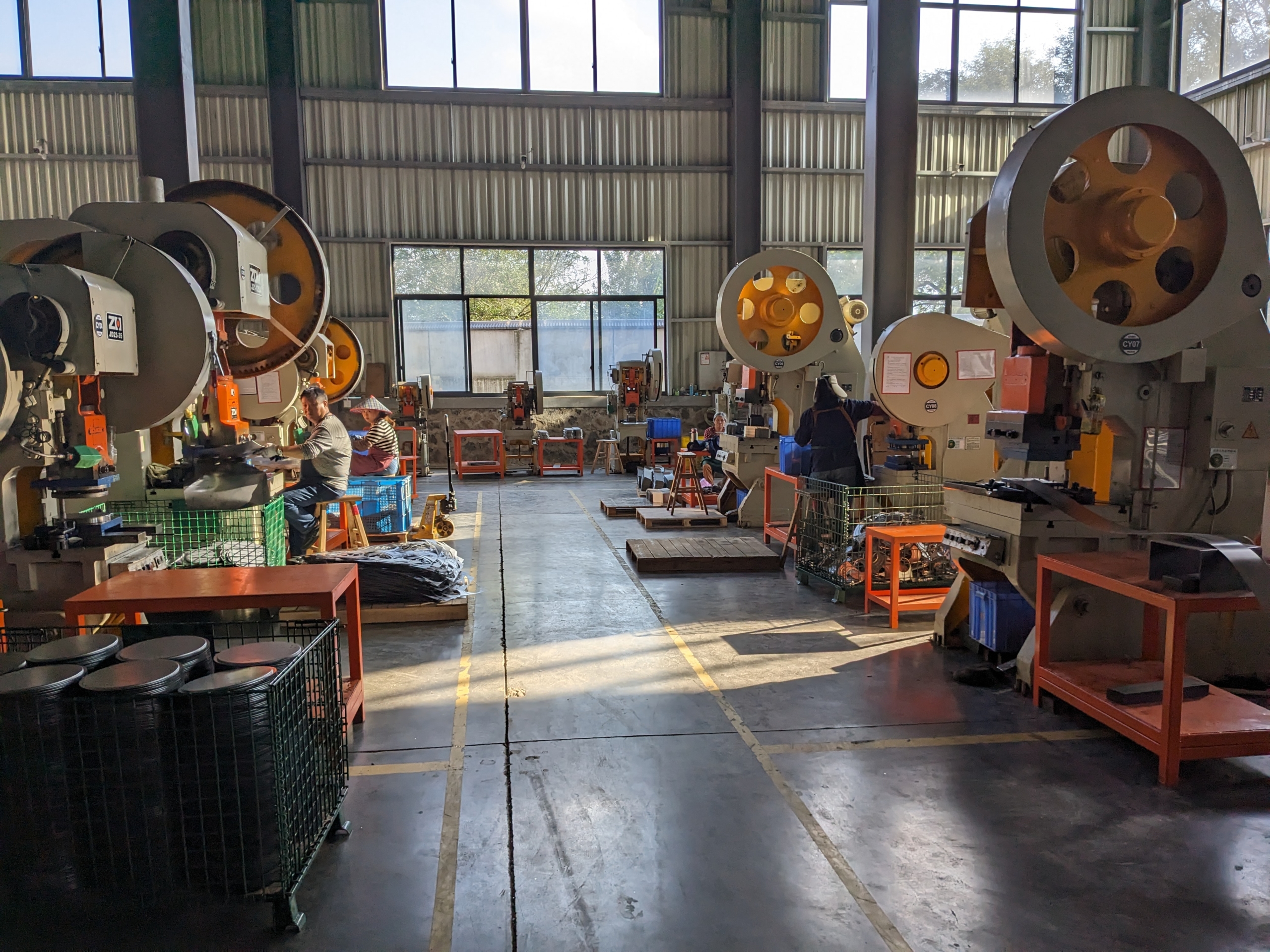
Photo of sheet metal machines factory in China
Biomass cookstoves are mass produced at Shengzhou Stove Manufacturer

To reach multiple, interlinked Sustainable Development Goals, the UN advises that “the share of the population mainly using improved cooking solutions like low-emission biomass stoves reaching Tier 3* or better needs to increase to 35 percent by 2030.” (ACHIEVING UNIVERSAL ACCESS AND NET-ZERO EMISSIONS BY 2050: A Global Roadmap for Just and Inclusive Clean Cooking Transition, United Nations, 2023)

Well, that would be a very welcome change. The stove community has been trying to bring improved stoves into use for decades. Luckily, we are starting to know a lot more about how to improve stoves and increase market share: To make Tier 3 stoves successfully compete with traditional stoves. Much better stoves must be as loved by cooks while they make profit for factories, distributors, retailers, and, if lucky, for carbon developer and markets.

It may be that the most important missing link has been that, without carbon revenue, Tier 3 stoves have been too expensive. However, since the prices of avoided tons of CO2 have been fluctuating, a lot of folks have been exploring ways to sell Tier 3 biomass stoves without this subsidy.

Over the years, stakeholders (including the DOE, Shell Foundation, the European Union) have commented that substantial price reductions are possible by using less expensive materials, with design changes, more efficient production at scale, tariff reductions, decreases in the cost of transportation, and distribution with higher volume sales. As 2026 begins, the combination of factors seems to be bringing market driven Tier 3 (or even Tier 4) stoves closer to reality. 

Getting better products in use is occurring on a massive scale globally.

Let’s include good stoves.

*Biomass cookstove Tiers of Performance range from Tier 0 (worst) to Tier 5 (best). They are determined by using a standard test sequence (ISO 19867) that establishes international comparability in measurement of cookstove emissions and efficiency. Tiered Metrics include thermal efficiency, and levels of CO, CO2 and PM2.5.

Carbon Credits and Fuel Savings?

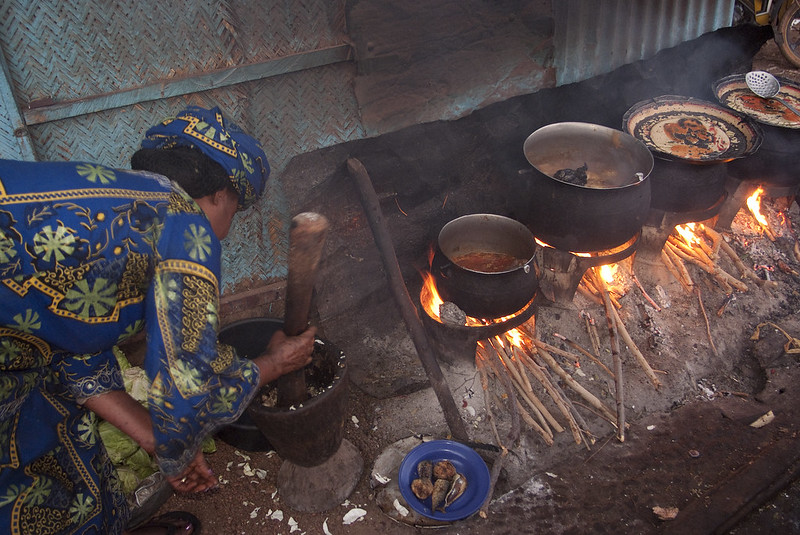
Photo from TREEAID on Flickr

Looking at the photo it is easy to imagine why field-testing is needed to show whether an intervention is actually saving fuel. Real life is complicated and is not replicated in a lab.

The use of a Water Boiling Test to determine if new stoves are saving fuel has historically been questionable. WBT’s tend to underestimate fuel use compared to field tests. (Hernández, 2014; Teune et al., 2020, Bayer et al., 2013).

Water Boiling Tests are great for international stove comparisons when variables are controlled. WBTs are also useful to investigate how stoves might be improved and to experiment with iterative changes that could improve heat transfer and combustion efficiency.

Luckily, we were assured at ETHOS 2025 that only field tests would be used from now on to calculate fuel savings for carbon credits.

When data from field testing was replaced with lab-based results it was such an obvious mistake!

Of course, any type of testing needs to be done carefully by a third party.

No More Carbon? 

The popular Jiko stove, photo by AIDG on Flickr

With carbon prices low and support apparently shifting, perhaps thinking about market-based improved cook stoves is increasingly interesting?

In the Millennium Villages studies, a high-end retail price of something like $10 was recommended to sell stoves directly into the market. (Adkins, Tyler, al, 2010)

What can be accomplished in stoves already being sold without raising prices?

  • For instance, the pot supports in the Jiko shown above can be too high for optimal heat transfer efficiency 
  • The door needs to be tight fitting to effectively simmer food
  • Perhaps the combustion chamber is too big, wasting fuel?
  • Small changes in the refractory ceramic material used in the combustion chamber can double durability
  • A low cost pot skirt effectively reduces time to boil and fuel used to cook

On the other hand, Rocket stoves or even forced draft TLUDs could theoretically be made for ~ $10, if metal was replaced by refractory ceramic or similar materials.

ARC is looking into this.  

Sound interesting to anyone?

 “To him that will, ways are not wanting.” (George Herbert, 1640)

Increased Air Exchange Rate Protects Health

Sunken pot, 50% thermal efficiency cook stove with chimney

When (oh, when!) will PM2.5 be included in carbon offset methodologies? 

Who can blame stove manufacturers for selling high thermal efficiency/low combustion efficiency stoves when protecting health is not financially rewarded? 

Factories can only sell what the market demands even when they manufacture better stoves. Manufacturers, like SSM, already have slightly more expensive, much cleaner burning stoves ready to go. 

Including PM2.5 in carbon revenue might go a long way to help projects pay for higher combustion efficiency stoves.  

PM 2.5 needs to be reduced by ~ 90% to protect health in kitchens with 15 air exchanges per hour. The needed % reduction is halved when air exchange rates are doubled. This may be the most cost effective way to protect health? Cooking outdoors with an estimated 60 air exchange rates per hour is very effective in reducing exposure.When cooking inside, perhaps a durable stove with improved combustion efficiency and a chimney would help the large percentage of cooks who, for many reasons, continue to cook with biomass?

Clean Burning: Increased Carbon Revenue?

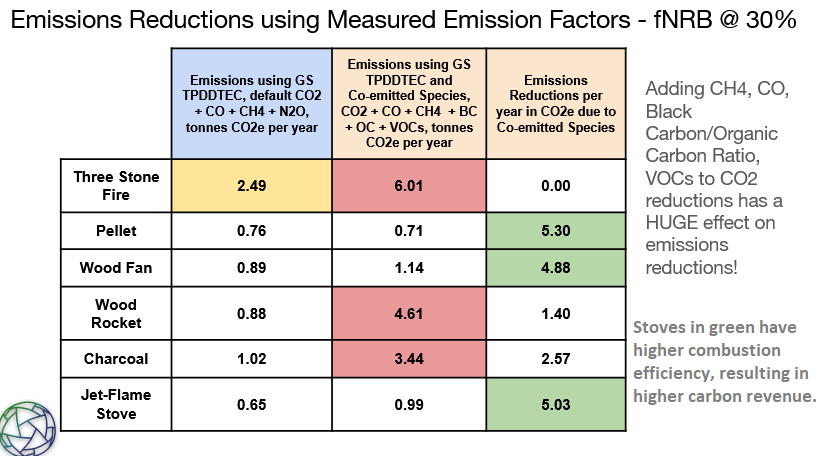
Using the ISO testing protocols, Champion (2021)* reported energy emission factors (g/MJ) from the Three Stone Fire, a forced draft Pellet Stove, a forced draft Wood Fan stove, a natural draft Rocket stove and a charcoal stove. ARC added results from a Jet-Flame stove. Using the estimates of global warming potential from the Gold Standard 2017 Methodology** we started to develop a feeling for how various stoves might address climate change.

The calculations suggest that the Three Stone Fire could be a lot worse for climate when Black Carbon and short-term climate forcers are included in offset calculations. At the same time, forced draft stoves appear to have the potential to generate increased emissions reductions (and higher carbon revenues). 

*Champion, Wyatt M., et al. “Cookstove Emissions and Performance Evaluation Using a New ISO Protocol and Comparison of Results with Previous Test Protocols.” Environmental Science & Technology, 2021, 55, (22), 15333-15342. DOI: 10.1021/acs.est.1c03390

**https://globalgoals.goldstandard.org/standards/412_V1.1_ICS_SLCP_Black-Carbon-and-Co-emitted-Species-due-to-the-replacement-of-less-efficient-cookstoves-with-improved-efficiency-cookstoves.pdf

Lab Tests: Cooking and Heating Stoves

Unfortunately, although introductions to lab tests warn that results do not predict actual performance, the recent use of lab data to earn carbon credits has made an unfortunate error more commonplace. For decades, introductions to lab tests have warned that only field-testing can determine actual efficiency, emissions, effectiveness, market validity, etc. The World Health Organization based their stove standards aimed at protecting health on field-testing for this reason. 

Lab tests are helpful when comparing performance to understand how fire might be more useful. Starting with the 1985 International Standards, test users were advised not to use lab data to predict actual performance. While improving other carbon methodologies, using field-testing to estimate reductions would dramatically improve the accuracy of offsets.  

Carefully performed lab tests tend to overestimate fuel efficiency and underestimate emissions. This has landed cook stoves and heating stoves in serious controversy. A lab tested Tier 4 cookstove can be Tier 2 in real life – or mistaken for a flowerpot. My first Rocket stoves were often used for this important function in Mexico. 

A lab tested 2 g/hr PM heating stove often emits a lot more smoke when the harmful pollutant is measured from chimneys in houses. In an effort to reduce confounding variables, lab tests show closer to optimal performance. Real life human beings tend to operate stoves with less care, wood is wet, life deserves attention, too.

Maybe the test warnings should have been highlighted in green?

International Standards, 1985

(ISO 19867-1)

https://www.iso.org/obp/ui/#iso:std:iso:19867:-1:ed-1:v1:en

Cleaner Burning Biomass Stoves: In Homes!

https://i.pinimg.com/originals/0c/30/11/0c301121de2b7b0f6c4e07e360228e5e.jpg
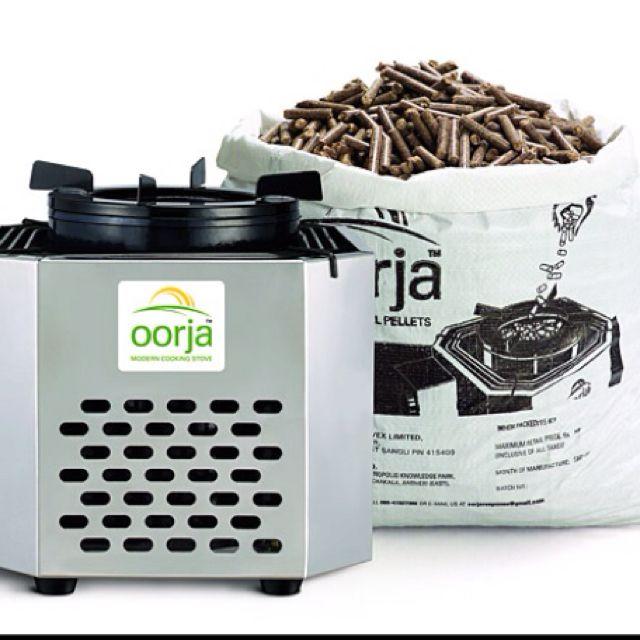
The British Petroleum clean burning Oorja FD-TLUD stove from India

If protecting health and climate are important in stove projects, why not monetize the reductions of health/climate pollutants in carbon-offset projects?

Only the reduction in fuel use earns carbon income now!

With equal heat transfer efficiency, dirty burning stoves earn as much as clean burning stoves.

Dirty burning stoves are less expensive. “Market demand” reinforces the use of biomass stoves with low combustion efficiency.

Why not add income from reductions in CO, PM2.5 and Black Carbon, etc. to carbon projects to get cleaner burning stoves into use?

The approved 2017 Gold Standard Methodology already exists to do this! See: www.goldstandard.org/articles/black-carbon-and-other-short-lived-climate-pollutants