Aprovecho
  • Home
  • Our Work
    • Emissions Testing Equipment
    • Lab and Field Testing Services
    • Stove Design and Manufacturing Support
    • Consulting and Capacity Building
  • Resources
    • Newsletters
    • Publications
    • Video Gallery
    • Software
  • About
  • Donate
  • Click to open the search input field Click to open the search input field Search
  • Menu Menu

No More Carbon? 

February 13, 2025/0 Comments/in Carbon Credits, Charcoal Stoves, Improving Performance

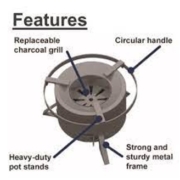
The popular Jiko stove, photo by AIDG on Flickr

With carbon prices low and support apparently shifting, perhaps thinking about market-based improved cook stoves is increasingly interesting?

In the Millennium Villages studies, a high-end retail price of something like $10 was recommended to sell stoves directly into the market. (Adkins, Tyler, al, 2010)

What can be accomplished in stoves already being sold without raising prices?

  • For instance, the pot supports in the Jiko shown above can be too high for optimal heat transfer efficiency 
  • The door needs to be tight fitting to effectively simmer food
  • Perhaps the combustion chamber is too big, wasting fuel?
  • Small changes in the refractory ceramic material used in the combustion chamber can double durability
  • A low cost pot skirt effectively reduces time to boil and fuel used to cook

On the other hand, Rocket stoves or even forced draft TLUDs could theoretically be made for ~ $10, if metal was replaced by refractory ceramic or similar materials.

ARC is looking into this.  

Sound interesting to anyone?

 “To him that will, ways are not wanting.” (George Herbert, 1640)
https://aprovecho.org/wp-content/uploads/2025/02/533788023_ce0db0fd40_c.jpg 600 800 Kim Still https://aprovecho.org/wp-content/uploads/2015/11/Aprovecho-Logo.png Kim Still2025-02-13 18:01:372025-02-13 18:01:38No More Carbon? 

Secondary Air Jets in Charcoal Stoves?

October 27, 2021/1 Comment/in Charcoal Stoves, TLUDs
Typical Charcoal Stove
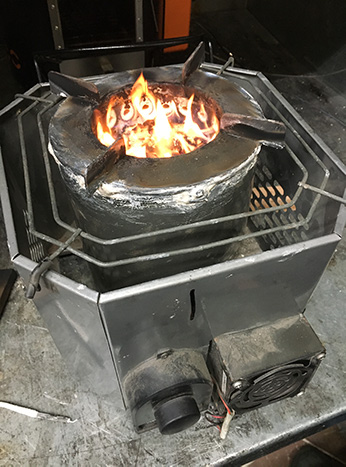
Oorja FD TLUD

Charcoal stoves are batch loaded like TLUDs (top loaded up draft stoves), but they differ greatly in how air flow is used to encourage combustion. A charcoal stove has lots of primary air blowing up into the fuel. A TLUD uses a small amount of primary air to create a relatively constant amount of woodgas that is then combusted by a mixture of secondary air and flame above the fuel bed. The large amount of primary air in a charcoal stove tends to create the fire underneath the fuel, while the secondary air jets in a TLUD concentrate the fire above the batch of fuel.

If a TLUD allowed as much primary air as a charcoal stove into the bottom of the fuel bed, too much wood gas would be made and the TLUD would be smoky. I wonder if charcoal stoves could be patterned after TLUDs? Could a charcoal stove be top lit with jets of secondary air and flame on top of the batch of fuel? Would such an arrangement result in better performance? Would added secondary air in a charcoal stove maintain the fire on top of the fuel that would burn up the woodgas (predominantly CO in a charcoal stove)? Might this increase heat transfer efficiency since the temperatures (convection and radiation) might be hotter?

When Sam Bentson and Ryan Thompson studied how to improve charcoal stoves in the DOE 2011 project, they found that adding pre-heated natural draft jets of air did help to create more flame where it’s needed, right under the pot. Unfortunately, they also experienced that charcoal makes less flame than wood and covering the entire top of the fuel bed with flame (as in a TLUD) is difficult. Forced draft secondary air might be more successful, especially since charcoal stoves are usually short and do not generate needed velocities. To be most effective, the jets of air/fire should meet in the middle of the combustion chamber and cover the entire fuel bed. It seems to be best to use the minimum velocity necessary since too much air only cools the fire (Udeson, D.J., 2019, University of Washington).

We’ll try it and report on the results.

Charcoal Stove Design Principles (Ryan Thompson)

  1. Size the combustion chamber for the required task. Whatever fuel is loaded into the stove will be burned at a rate proportional to the amount of air made available to it. In most cases, more fuel means higher firepower because there is always excess air. For small amounts of food/water, where not much power is required, either load a small amount of fuel into the stove, or use a stove with a small combustion chamber. For cooking lots of food at once, use a stove with a big combustion chamber.
  2. Charcoal stoves can have a high turn-down ratio. If the primary air supplied to a charcoal fire is reduced close to zero, the fuel will still keep burning. When the air supply is increased, the firepower will also increase. Normally there is a spike in CO when the air supply is increased sharply, but it tends to stabilize once the firepower comes back up.
  3. Use pre-heated secondary air jets to burn up the CO. Most charcoal stove designs have air coming in from the bottom and sides of the fuel bowl. The air must pass through the burning charcoal before it gets to the top of the fuel where the CO is being emitted. If hot air is added above the charcoal, it is available to combust the CO. Try to keep the bottom of the batch of charcoal as cold as possible and burn down from the top of the batch of the fuel.
  4. Position the pot close to the charcoal. This maximizes heat transfer from radiation.
  5. Insulate the stove body. Insulate the stove body until a temperature of 620˚C or higher is achieved above the burning fuel. Insulation needs to be lightweight and trap still air. Examples of good insulation are: ceramic fiber, rock wool, wood ash, sheets of foil, etc.
  6. Use small channel gaps between the pot and the stove. The pot can be located very close to the top of the burning charcoal. A skirt with a 6mm channel gap around the pot helps increase the heat transfer efficiency from convection. Both convective and radiative heat transfer are important in a charcoal stove.
  7. Maintain a constant cross sectional area throughout the stove to start the design process and reduce as directed by experimentation under the emissions hood. This will help to keep the velocity of the draft as high as possible.
  8. Supply a large amount of primary air to assure sufficient firepower. Make the primary air door large enough to boil the water quickly. The door can be partially closed to reduce power when desired. The door has to be almost airtight to reduce firepower sufficiently when simmering in a pot with a lid.
https://aprovecho.org/wp-content/uploads/2021/10/10.27.charstove.jpg 328 348 Kim Still https://aprovecho.org/wp-content/uploads/2015/11/Aprovecho-Logo.png Kim Still2021-10-27 14:28:572021-10-27 14:31:57Secondary Air Jets in Charcoal Stoves?
Search Search

Latest Newsletters

  • Photo of the Rodale Solar Food Dryer book
    Improving the Rodale Solar Food DryerJuly 31, 2026 - 9:02 am
  • ARC and The Breathing Space Project in IndiaJuly 24, 2026 - 2:45 pm
  • a closed black box next to an open, semi-transparent box
    Using Black Box and Open Box Experimental DesignJuly 17, 2026 - 1:30 pm
  • Executive Director’s Report – Celebrating Aprovecho’s 50th AnniversaryJune 19, 2026 - 12:22 pm
  • Improving Solar Distillation: Two-Stage DistillationMay 29, 2026 - 1:15 pm
  • What’s Cooking at AprovechoMay 14, 2026 - 11:07 am
  • Photo of a solar still
    Improving Solar Distillation, Part 1April 3, 2026 - 1:32 pm
  • Michael Saul with some test data
    Real World Temperatures in a Pot SkirtMarch 27, 2026 - 2:17 pm
  • Aprovecho Research Center logo
    Requesting input: What technologies are most needed in households?March 13, 2026 - 12:43 pm
  • Testing improvements on a Bosch rocket stove
     Improving Heat Transfer Efficiency (HTE)March 6, 2026 - 2:59 pm
  • The Stainless Steel Winiarski Stove TopFebruary 27, 2026 - 3:36 pm
  • Cross- sectional illustration of a biomass cookstove with auto damper
    Health: Reducing PM2.5 by ~90%February 13, 2026 - 2:47 pm
  • The Icy-Ball : A Heat Driven RefrigeratorJanuary 30, 2026 - 3:20 pm
  • Stove parts at SSM
    A Hospitable Chinese Environment for Improved CookstovesJanuary 23, 2026 - 2:15 pm
  • A cookstove production line at SSMNordica MacCarty
    Tier 3 Biomass StovesJanuary 16, 2026 - 4:21 pm
  • Don’t Let The Flame Touch The PotDecember 19, 2025 - 2:04 pm
  • Early Rocket Stove Research at Aprovecho Still Rings TrueDecember 11, 2025 - 3:59 pm
  • Cook Stoves for EthosDecember 4, 2025 - 4:09 pm
  • A Clean Open Fire?October 31, 2025 - 9:25 am
  • a pot of cooked rice
    Turn Down RatioOctober 24, 2025 - 1:46 pm

Archives

Aprovecho Research Center

Mailing: PO Box 1175, Cottage Grove, OR 97424, USA

Visit: 76132 Blue Mountain School Road, Cottage Grove, OR 97424, USA
541-767-0287
info@aprovecho.org

© Copyright - Aprovecho Research Center | Digital Partner: Wildwood SEO
Scroll to top Scroll to top Scroll to top