
Aprovecho
  • Home
  • Our Work
    • Emissions Testing Equipment
    • Lab and Field Testing Services
    • Stove Design and Manufacturing Support
    • Consulting and Capacity Building
  • Resources
    • Newsletters
    • Publications
    • Video Gallery
    • Software
  • About
  • Donate
  • Click to open the search input field Click to open the search input field Search
  • Menu Menu
Photo of the Rodale Solar Food Dryer book

Improving the Rodale Solar Food Dryer
July 31, 2026/0 Comments/in Improving Performance, Solar Energy
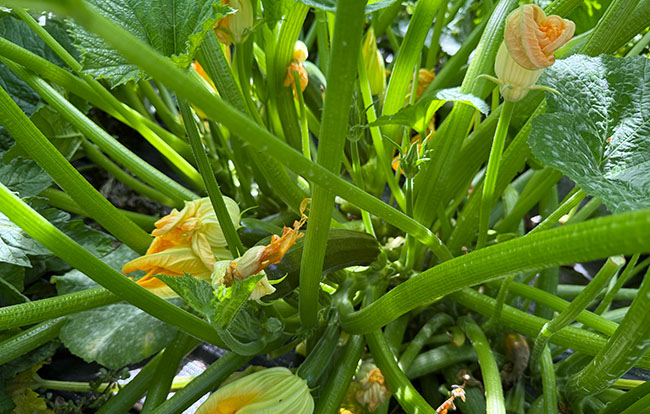
Zucchini in the Aprovecho garden

It’s 5 ft. tall and just never stops pumping them out…

Summertime in the garden at Aprovecho has us eating zucchini every day. We really only planted a couple of plants, but you know how it goes… The fridge can only hold so much and it’s rude to abandon it on doorsteps, so how to solve the excellent problem of garden abundance in an earth-friendly way? A solar powered food dryer and a big bag to store garlicky zucchini chips springs to mind.
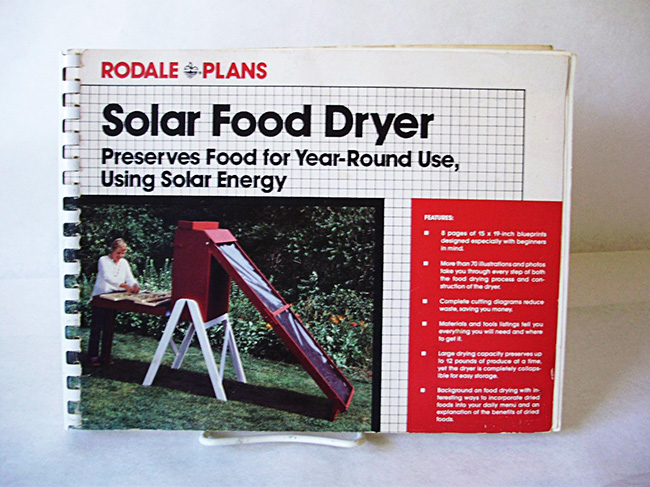
Photo of the Rodale Solar Food Dryer book

The plans for this popular Rodale Solar Food Dryer were first published in 1981. When Dr. Larry Winiarski looked at this design, he called the lab together and taught a great class on dehydration. He taught us that the most important design principle for efficient drying is to remove the moisture as the food releases it. It is often easy to reach the relatively low temperatures needed for drying, ranging from 95°F to 140°F for various fruits and vegetables. Higher than necessary temperatures degrade the quality of dried food.

Larry improved the dryer by:

  • Lowering the solar collector to the bottom of the drying box.
  • Adding a 10’ tall, 8” in diameter black chimney to the top of the box, creating enough draft to remove moist air (more draft than dry air).
  • Making sure that the hot air passed up through the food on screens.
  • Adding a chimney damper to adjust draft velocity, controlling temperatures.
  • In the summer, we covered half the solar collector (too hot!).

These days a simple web search will deliver many different DIY solar dryer designs, so keep these factors in mind when deciding what to build. And for expert guidance on safely preserving foods through dehydration, Oregon State University Extension has lots of resources, as does the National Center for Home Food Preservation and your local Extension Service.
https://aprovecho.org/wp-content/uploads/2026/07/rodale_dryer.jpg 487 650 Kim Still https://aprovecho.org/wp-content/uploads/2015/11/Aprovecho-Logo.png Kim Still2026-07-31 09:02:082026-07-31 09:02:09Improving the Rodale Solar Food Dryer

Improving Solar Distillation: Two-Stage Distillation

May 29, 2026/0 Comments/in Appropriate Technologies, Improving Performance, Solar Energy

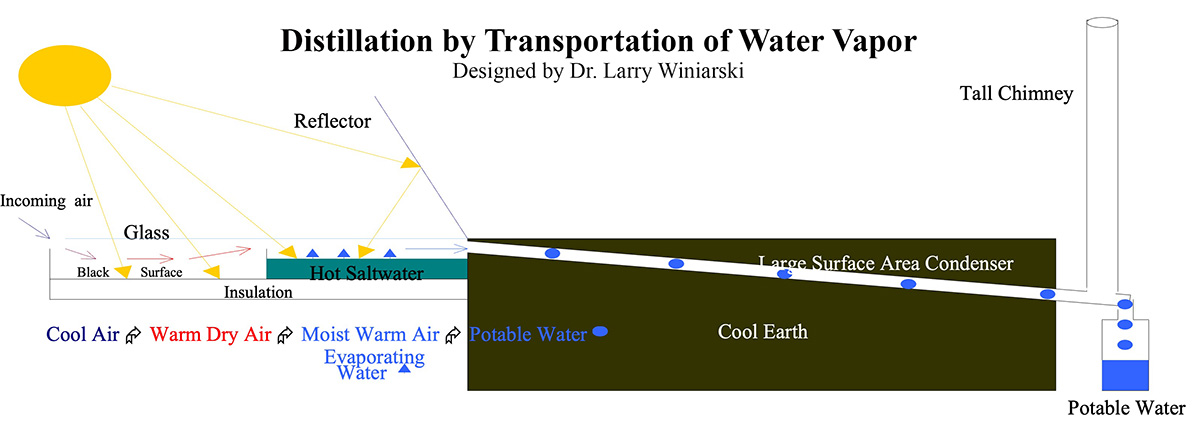
In our recent post “Improving Solar Distillation, Part 1,” we talked about the traditional design for a solar still and pointed out some design weaknesses. Here we show Dr. Larry Winiarski’s suggested improvements to address those problems.

The distillation of brackish water is a two-stage process. Water is encouraged to evaporate and is then condensed. Sealing water inside an airtight vessel results in almost immediate saturation of the inside air. Until the water vapor is condensed, distillation cannot occur. As well, in a classic still, the condensing surface is warm and production of potable water occurs at a significantly reduced rate.

By transporting clean water vapor to a cool condensing surface, Dr. Winiarski addresses this problem. In his design with chimney, ambient air is warmed, improving its ability to absorb water vapor. Condensation then occurs underground, stripping the moving air of moisture. A large, cool surface area results in more effective condensation. A tall chimney acts as the engine, moving warmed air through the system. Air moving up the chimney is dry, after depositing the potable water into a receptacle.

https://aprovecho.org/wp-content/uploads/2026/05/solar_distillation_sm.jpg 422 1200 Kim Still https://aprovecho.org/wp-content/uploads/2015/11/Aprovecho-Logo.png Kim Still2026-05-29 13:15:572026-05-29 13:15:58Improving Solar Distillation: Two-Stage Distillation

The Water Boiling Test, Repeatedly

July 18, 2025/0 Comments/in Improving Performance, International Work, Testing Stoves

In my opinion, the WBT* cannot be used, especially in the lab, to improve a biomass cook stove because all of the important field variables are not represented.

A successful cook stove needs to be evolved from field tests, as we did in Southern India for the Shell Foundation. Cooks in eighteen villages kept on changing the Rocket stove until it was acceptable, useful, and even likable. It took a while but it was a lot of fun and a great introduction to Southern India!

The WBT, with severely limited variables, can be useful in the lab for international comparisons of stove performance. The same pots, same amount of water, same fuel, same procedures and protocols limit the confounding variables in an attempt to isolate the stove as the reason for perceived differences.

As we did in India, both field and lab data can inform stakeholders. The successful stove has to please cooks, retailers, distributors, etc. and, at the same time, meet project goals such as reducing adverse health effects. We used the WBT in the lab and the CCT* in the field. Marketing tests, as suggested by Baldwin (1987) were very important, as well. We learned right away that the stove had to cost ~$5 to capture sustainable market share.

The lab based WBT is best used to inform researchers how stoves might be improved. Then, iterations in prototypes are tried in the field including cost, weight, color, height, firepower, fuel used, etc, etc.

This combined use of the WBT, CCT, and KPT* for stove development was suggested in the International Stove Standards, (1985). 

*Water Boiling Test “The Water Boiling Test (WBT) is a simplified simulation of the cooking process. It is intended to measure how efficiently a stove uses fuel to heat water in a cooking pot and the quantity of emissions produced while cooking.” – The Water Boiling Test Version 4.2.3

*Controlled Cooking Test “The controlled cooking test (CCT) is designed to assess the performance of the improved stove relative to the common or traditional stoves that the improved model is meant to replace. Stoves are compared as they perform a standard cooking task that is closer to the actual cooking that local people do every day.” – CCT version 2.0

*Kitchen Performance Test “The Kitchen Performance Test (KPT) is the principal field–based procedure to demonstrate the effect of stove interventions on household fuel consumption.” -KPT version 3.0

Find out more about testing protocols at cleancooking.org/protocols/

https://aprovecho.org/wp-content/uploads/2025/07/hot-water.png 244 472 Kim Still https://aprovecho.org/wp-content/uploads/2015/11/Aprovecho-Logo.png Kim Still2025-07-18 13:52:012025-07-23 14:06:37The Water Boiling Test, Repeatedly
Cover image of The Winiarski Wood Fired Agricultural Food Dryer

Winiarski: Improving Agricultural Food Dryers

June 20, 2025/0 Comments/in Improving Performance, International Work
Cover image of The Winiarski Wood Fired Agricultural Food Dryer

Sometimes it’s too cloudy for solar drying and a wood-fired dehydrator can help with large scale food preservation. In 2002, Dr. Larry Winiarsk helped farmers in the wet mountainous region of Nicaragua to design and build a prototype wood fired dryer for cacao beans. The ARC publication “The Winiarski Wood Fired Agricultural Food Dryer,” details construction of a rocket-style wood-fired dehydrator.

It’s estimated that the optimal temperature for drying is between 120 and 130 degrees F. Sustained temperatures over 130 degrees can begin to cook the food. (When starting to dry foods it can be most efficient to go up to 150 to 160 F. in the initial stages of drying when lots of moisture will be evaporating out of the food.) 

A successful food dehydrator sustains these temperatures in dry air passing through food at a constant rate with even distribution for a variable period of time, depending on the food being dried. 1.) Hot air temperatures increase the rate of evaporation. 2.) Air flow through the food is equally important.

WHY?

Efficient drying moves the water inside the food into the surrounding air. Wet air cannot absorb more moisture. Hot, dry air picks up the moisture and air flow created by draft replaces moist air with dry air. In a Winiarski food dryer, air is efficiently heated and sufficient airflow of dry air through the food increases the rate of dehydration.  

The food dryer features: a) burning biomass heating air b) is relatively air tight, c) has a large chimney or fan that removes moist air and moves dry air through the food. A large chimney usually creates the draft necessary for sufficient air flow.

https://aprovecho.org/wp-content/uploads/2025/06/Wood-fired-food-dryer-cover.jpg 596 600 Kim Still https://aprovecho.org/wp-content/uploads/2015/11/Aprovecho-Logo.png Kim Still2025-06-20 13:08:182025-06-20 13:12:38Winiarski: Improving Agricultural Food Dryers

Market Driven Stoves

May 30, 2025/0 Comments/in Cleaner Combustion, Improving Performance, International Work, New Publications
Photo by Güldem Üstün on Flickr

One of the biggest mistakes I have made was thinking that I could predict what stove would sell in a market. If only I had always followed Sam Baldwin’s advice and done market testing before manufacturing! In Southern India, as part of the 2003-6 Shell Foundation project, we had outspoken distributors who yelled in meetings that a successful stove had to cost $5, that 5,000 had to fit on a truck, and that it had to be designed by cooks! The stove had to be short so food could be stirred and work well at the low firepower required by villagers around Chennai, toast a chapatti, etc., etc.

When the carbon market crashes, affordable stoves continue to be sold and used. When stoves are purchased the consumer is convinced of their utility. The trick is to try to bring best solutions into marketable products but, luckily, engineers love a challenge!

A pot skirt, SuperPot, constant cross sectional stove top, stick support, keeping a fire hot, can all significantly increase heat transfer efficiency. Even Jet-Flames can be made for around $5. TLUDs can be inexpensive. There are many techniques to improve the market driven stove! 

Check out the new Osprey funded book Improving Biomass Stoves, 2025  for examples?

https://aprovecho.org/wp-content/uploads/2025/05/32122738353_ba434c2aa2_c.jpg 578 799 Kim Still https://aprovecho.org/wp-content/uploads/2015/11/Aprovecho-Logo.png Kim Still2025-05-30 14:08:242025-05-30 14:25:46Market Driven Stoves

No More Carbon? 

February 13, 2025/0 Comments/in Carbon Credits, Charcoal Stoves, Improving Performance

The popular Jiko stove, photo by AIDG on Flickr

With carbon prices low and support apparently shifting, perhaps thinking about market-based improved cook stoves is increasingly interesting?

In the Millennium Villages studies, a high-end retail price of something like $10 was recommended to sell stoves directly into the market. (Adkins, Tyler, al, 2010)

What can be accomplished in stoves already being sold without raising prices?

  • For instance, the pot supports in the Jiko shown above can be too high for optimal heat transfer efficiency 
  • The door needs to be tight fitting to effectively simmer food
  • Perhaps the combustion chamber is too big, wasting fuel?
  • Small changes in the refractory ceramic material used in the combustion chamber can double durability
  • A low cost pot skirt effectively reduces time to boil and fuel used to cook

On the other hand, Rocket stoves or even forced draft TLUDs could theoretically be made for ~ $10, if metal was replaced by refractory ceramic or similar materials.

ARC is looking into this.  

Sound interesting to anyone?

 “To him that will, ways are not wanting.” (George Herbert, 1640)

https://aprovecho.org/wp-content/uploads/2025/02/533788023_ce0db0fd40_c.jpg 600 800 Kim Still https://aprovecho.org/wp-content/uploads/2015/11/Aprovecho-Logo.png Kim Still2025-02-13 18:01:372025-02-13 18:01:38No More Carbon? 

ARC Assists CSIR-Ghana in Capacity-Building 

November 7, 2024/0 Comments/in Improving Performance, Indoor Air Quality, International Work, Testing Stoves

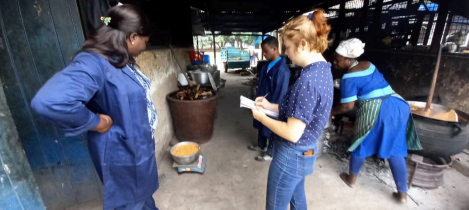
In the first week of October, ARC Research and Development Engineer Jaden Berger visited CSIR-Ghana for capacity building training. The Council for Scientific and Industrial Research (CSIR) is the foremost national science and technology institution in Ghana.

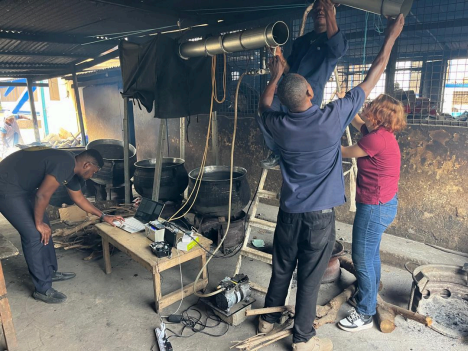
The main focus of the visit was to teach them how to perform field testing using various sensor suites. CSIR was especially focussed on learning to perform KPTs (Kitchen Performance Tests) while using EXACT sensors from Climate Solutions Consulting. We also used other sensors CSIR already had: a PEMS (Portable Emissions Monitoring System) with a portable hood, an IAP (Indoor Air Pollution) meter, and an air quality sensor along with performing UCETs (Uncontrolled Cooking Efficiency Tests) during cooking to determine the efficiency of the stove.

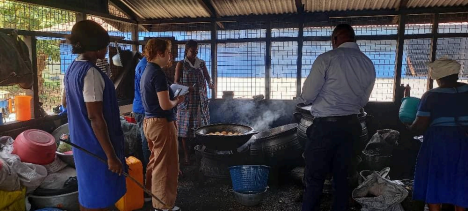
Making observations of how cooks are using stoves.

Setting up a PEMS with a portable hood to measure stove emissions.

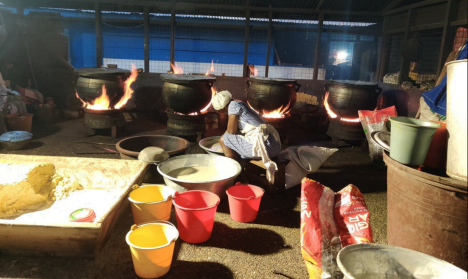
Testing was done at a secondary boy’s boarding school in Accra. The school cooks breakfast, lunch, and dinner for 3,000 students using a variety of improved and unimproved stoves. The stoves identified as the least efficient and highest emitters were the 12 wood stoves and 4 palm kernel stoves. (Palm kernels used to be considered agricultural waste from palm oil production but are now commonly used as fuel.) Several design meetings were held to determine a design that would increase efficiency, clean up emissions, and remove emissions from the room the cooks were in.

Palm kernel stoves in use for breakfast.

Weighing wood for three 24 hour-long KPTs.

Performing UCET measurements.

The next step is for CSIR to finalize a CAD model of the design along with some CFD analysis to predict if the prototype will work. ARC will then virtually meet with CSIR and their manufacturer to finalize the design and begin creating prototypes.

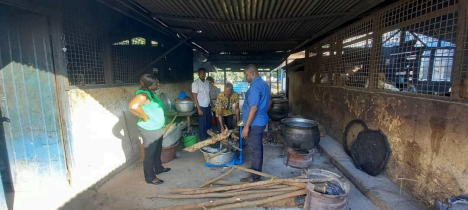
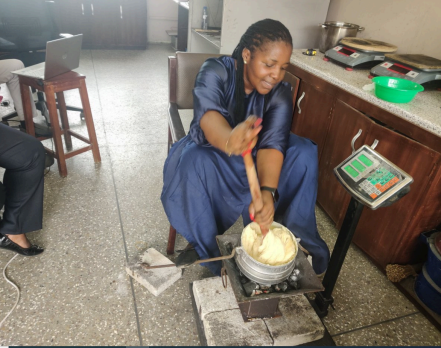
During the second week of the visit, ARC and CSIR worked on wrapping up older projects. This included gathering final data for a charcoal conversion efficiency study, creating a draft of the charcoal conversion efficiency protocol so that it can be published, and developing and using a durability protocol that is more applicable to conditions a stove will have to withstand in Ghana.

Taking measurements for creating a new durability protocol.

Overall, a successful trip with good progress made toward improving health and cooking conditions in Ghana.

https://aprovecho.org/wp-content/uploads/2024/11/Screenshot-2024-11-07-at-4.18.41-PM.png 358 390 Kim Still https://aprovecho.org/wp-content/uploads/2015/11/Aprovecho-Logo.png Kim Still2024-11-07 16:01:042024-11-07 16:20:19ARC Assists CSIR-Ghana in Capacity-Building 

Heat Transfer Efficiency!

August 30, 2024/0 Comments/in Improving Performance

Heat Transfer Efficiency!

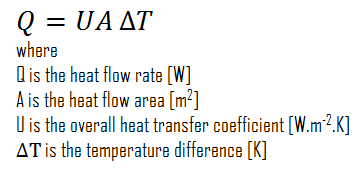
http://nuclear-power.com/wp-content/uploads/overall-heat-transfer-coefficient-equation.png

Wow, heat transfer efficiency is easy to understand! 

Read on…

Raising the Temperature of gases flowing next to the heat exchanger (the pot in a cook stove) is probably the most effective technique in a Rocket stove to increase heat transfer efficiency (use less wood for cooking).

Doubling the Temperature of gases doubles heat transfer efficiency.

Doubling the Area exposes to the gases doubles heat transfer efficiency.

Doubling the Velocity of gases ~doubles heat transfer efficiency.

Doubling Radiation increases heat transfer efficiency to the 4th power.

Increasing the view factor helps, too! That’s the proportion of the radiation strikes the bottom surface of the pot.

A 6mm to 7mm channel gap pot skirt increases heat transfer efficiency by ~ 25%.

Simmering at the needed low firepower can save a lot of fuel, too.

https://aprovecho.org/wp-content/uploads/2015/11/Aprovecho-Logo.png 0 0 Kim Still https://aprovecho.org/wp-content/uploads/2015/11/Aprovecho-Logo.png Kim Still2024-08-30 14:27:352024-08-30 14:27:36Heat Transfer Efficiency!

Appreciating Local Expertise

July 26, 2024/0 Comments/in Cleaner Combustion, Improving Performance, International Work, The Big Picture
https://news.ucar.edu/sites/default/files/news/2012/image-02-sm.jpg
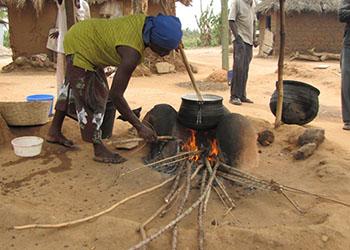
Cooking over an open fire in Ghana. (Photo: Global Alliance for Clean Cookstoves)

Cooks are experts!

Community organizers often say that to be successful the solution has to come from the folks with the problem. Another important factor is to appreciate the culture and long evolved expertise in their technical and social solutions. The women at Rancho San Nicolas, where I lived for eight years, were incredibly skillful at cooking on an open fire and were understandably proud of their abilities when cooking perfect tortillas, fish, beans, soup, etc. At a fish camp, guys who were not cooking every day, had a lot of trouble making anything close to a succulent home cooked meal.

Along with the hundreds of technical skills that made ranching fun, culture made life easier and more beautiful. Ranch culture was at least half of competency and expertise. Laughing at life’s problems made overcoming them much more likely. Religion, nature, the beauty of living outdoors and liking the slow pace were strengths in my friends that I grew to envy and attempted to emulate.

Bringing innovations started with lots of failure. The first Rocket stoves became flowerpots. The first solar cookers became toilet seats and windows. Eventually, ARC appropriate technologists made prototypes that were simply put on public display. Of our many attempts to introduce ‘helpful’ technology, cement rat proof boxes were the biggest success.

We learned a lot more than we taught, starting with listening to our expert hosts. The shorter and higher firepower Rocket stove that has gone viral was created by women in 18 villages in Southern India. Dr. Winiarski had the idea and the cooks made it practical.

https://aprovecho.org/wp-content/uploads/2022/07/7.11.22-Batil-Camp-SuperPot.jpg 591 725 Kim Still https://aprovecho.org/wp-content/uploads/2015/11/Aprovecho-Logo.png Kim Still2024-07-26 16:14:342024-07-26 16:34:21Appreciating Local Expertise

Over the Moon

June 7, 2024/0 Comments/in Fuel Efficiency, Improving Performance, Jet-Flame

A couple of weeks ago, Claudia Truesdell and Shane Washburn from Google’s X – The Moonshot Factory visited us for the day. We made lunch on an earthen Rocket stove and on a metal pot skirt stove with Jet-Flame while doing a field test that generated some numbers. Google’s X was interested in what we have learned since 1976. 

Our staff had various things to share. I found myself explaining how to improve fuel efficiency in high mass stoves. Maybe ~95% of biomass stoves in use are high mass (?), made from earthen mixtures. 40% clay and 60% sand works well, especially when a relatively dry mix is pounded into a form. Metal is hard to find, expensive when purchased, and even stainless steel doesn’t last for a very long time near the fire. Improving earthen stoves might help lots of people.

When we did seminars with the Partnership for Clean Indoor Air, we showed that fuel use could be reduced by a minimum of 30% by:

  • Moving the flame further away from the mass walls.
  • Lowering the pot closer (but not too close) to the fire to increase the temperature of gases contacting the pot .
  • Using a constant cross sectional pot support to increase heat transfer efficiency to the bottom of the pot.
  • Adding an adjustable pot skirt that, especially when tight, forces the hot gasses closer to the sides of the pot.
  • Nowadays, we suggest adding a Jet-Flame to improve both heat transfer and combustion efficiency.
  • Most importantly, as recommended by Mahatma Gandhi, adding a functional chimney!

https://aprovecho.org/wp-content/uploads/2024/06/Untitled-3.jpeg 417 1000 Kim Still https://aprovecho.org/wp-content/uploads/2015/11/Aprovecho-Logo.png Kim Still2024-06-07 13:57:142024-06-24 16:35:56Over the Moon
Search Search

Latest Newsletters

  • To Lower Emissions, Add AirAugust 12, 2026 - 3:46 pm
  • Photo of the Rodale Solar Food Dryer book
    Improving the Rodale Solar Food DryerJuly 31, 2026 - 9:02 am
  • ARC and The Breathing Space Project in IndiaJuly 24, 2026 - 2:45 pm
  • a closed black box next to an open, semi-transparent box
    Using Black Box and Open Box Experimental DesignJuly 17, 2026 - 1:30 pm
  • Executive Director’s Report – Celebrating Aprovecho’s 50th AnniversaryJune 19, 2026 - 12:22 pm
  • Improving Solar Distillation: Two-Stage DistillationMay 29, 2026 - 1:15 pm
  • What’s Cooking at AprovechoMay 14, 2026 - 11:07 am
  • Photo of a solar still
    Improving Solar Distillation, Part 1April 3, 2026 - 1:32 pm
  • Michael Saul with some test data
    Real World Temperatures in a Pot SkirtMarch 27, 2026 - 2:17 pm
  • Aprovecho Research Center logo
    Requesting input: What technologies are most needed in households?March 13, 2026 - 12:43 pm
  • Testing improvements on a Bosch rocket stove
     Improving Heat Transfer Efficiency (HTE)March 6, 2026 - 2:59 pm
  • The Stainless Steel Winiarski Stove TopFebruary 27, 2026 - 3:36 pm
  • Cross- sectional illustration of a biomass cookstove with auto damper
    Health: Reducing PM2.5 by ~90%February 13, 2026 - 2:47 pm
  • The Icy-Ball : A Heat Driven RefrigeratorJanuary 30, 2026 - 3:20 pm
  • Stove parts at SSM
    A Hospitable Chinese Environment for Improved CookstovesJanuary 23, 2026 - 2:15 pm
  • A cookstove production line at SSMNordica MacCarty
    Tier 3 Biomass StovesJanuary 16, 2026 - 4:21 pm
  • Don’t Let The Flame Touch The PotDecember 19, 2025 - 2:04 pm
  • Early Rocket Stove Research at Aprovecho Still Rings TrueDecember 11, 2025 - 3:59 pm
  • Cook Stoves for EthosDecember 4, 2025 - 4:09 pm
  • A Clean Open Fire?October 31, 2025 - 9:25 am

Archives

Aprovecho Research Center

Mailing: PO Box 1175, Cottage Grove, OR 97424, USA

Visit: 76132 Blue Mountain School Road, Cottage Grove, OR 97424, USA
541-767-0287
info@aprovecho.org

© Copyright - Aprovecho Research Center | Digital Partner: Wildwood SEO
Scroll to top Scroll to top Scroll to top