Aprovecho
  • Home
  • Our Work
    • Emissions Testing Equipment
    • Lab and Field Testing Services
    • Stove Design and Manufacturing Support
    • Consulting and Capacity Building
  • Resources
    • Newsletters
    • Publications
    • Video Gallery
    • Software
  • About
  • Donate
  • Click to open the search input field Click to open the search input field Search
  • Menu Menu
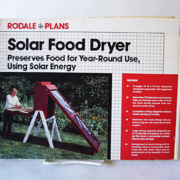
Photo of the Rodale Solar Food Dryer book

Improving the Rodale Solar Food Dryer
July 31, 2026/0 Comments/in Improving Performance, Solar Energy
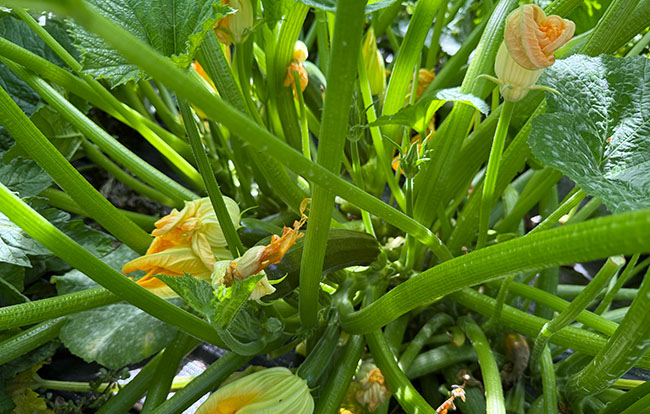
Zucchini in the Aprovecho garden

It’s 5 ft. tall and just never stops pumping them out…

Summertime in the garden at Aprovecho has us eating zucchini every day. We really only planted a couple of plants, but you know how it goes… The fridge can only hold so much and it’s rude to abandon it on doorsteps, so how to solve the excellent problem of garden abundance in an earth-friendly way? A solar powered food dryer and a big bag to store garlicky zucchini chips springs to mind.
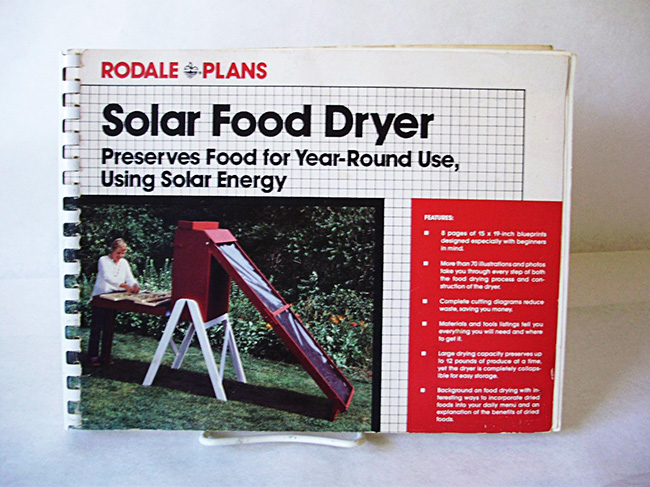
Photo of the Rodale Solar Food Dryer book

The plans for this popular Rodale Solar Food Dryer were first published in 1981. When Dr. Larry Winiarski looked at this design, he called the lab together and taught a great class on dehydration. He taught us that the most important design principle for efficient drying is to remove the moisture as the food releases it. It is often easy to reach the relatively low temperatures needed for drying, ranging from 95°F to 140°F for various fruits and vegetables. Higher than necessary temperatures degrade the quality of dried food.

Larry improved the dryer by:

  • Lowering the solar collector to the bottom of the drying box.
  • Adding a 10’ tall, 8” in diameter black chimney to the top of the box, creating enough draft to remove moist air (more draft than dry air).
  • Making sure that the hot air passed up through the food on screens.
  • Adding a chimney damper to adjust draft velocity, controlling temperatures.
  • In the summer, we covered half the solar collector (too hot!).

These days a simple web search will deliver many different DIY solar dryer designs, so keep these factors in mind when deciding what to build. And for expert guidance on safely preserving foods through dehydration, Oregon State University Extension has lots of resources, as does the National Center for Home Food Preservation and your local Extension Service.
https://aprovecho.org/wp-content/uploads/2026/07/rodale_dryer.jpg 487 650 Kim Still https://aprovecho.org/wp-content/uploads/2015/11/Aprovecho-Logo.png Kim Still2026-07-31 09:02:082026-07-31 09:02:09Improving the Rodale Solar Food Dryer

Improving Solar Distillation: Two-Stage Distillation

May 29, 2026/0 Comments/in Appropriate Technologies, Improving Performance, Solar Energy

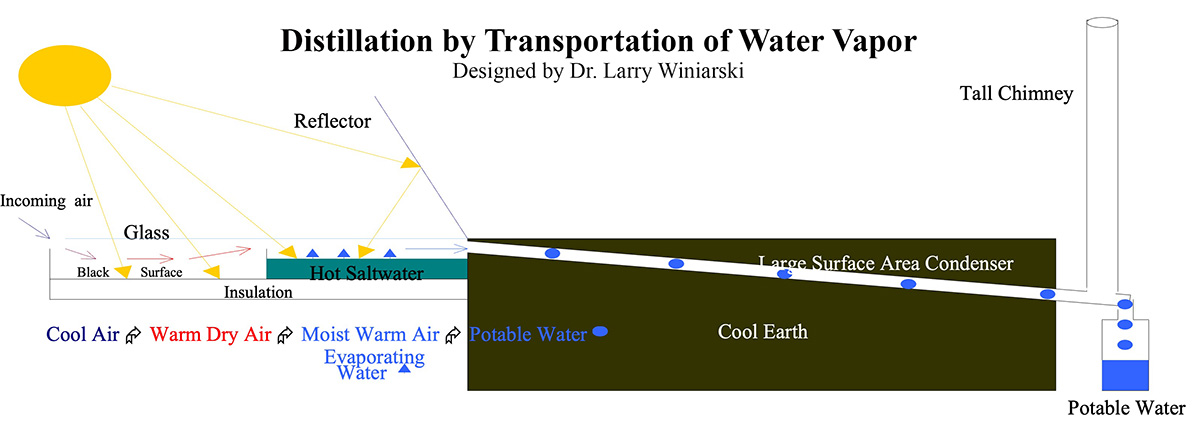
In our recent post “Improving Solar Distillation, Part 1,” we talked about the traditional design for a solar still and pointed out some design weaknesses. Here we show Dr. Larry Winiarski’s suggested improvements to address those problems.

The distillation of brackish water is a two-stage process. Water is encouraged to evaporate and is then condensed. Sealing water inside an airtight vessel results in almost immediate saturation of the inside air. Until the water vapor is condensed, distillation cannot occur. As well, in a classic still, the condensing surface is warm and production of potable water occurs at a significantly reduced rate.

By transporting clean water vapor to a cool condensing surface, Dr. Winiarski addresses this problem. In his design with chimney, ambient air is warmed, improving its ability to absorb water vapor. Condensation then occurs underground, stripping the moving air of moisture. A large, cool surface area results in more effective condensation. A tall chimney acts as the engine, moving warmed air through the system. Air moving up the chimney is dry, after depositing the potable water into a receptacle.

https://aprovecho.org/wp-content/uploads/2026/05/solar_distillation_sm.jpg 422 1200 Kim Still https://aprovecho.org/wp-content/uploads/2015/11/Aprovecho-Logo.png Kim Still2026-05-29 13:15:572026-05-29 13:15:58Improving Solar Distillation: Two-Stage Distillation
Photo of a solar still

Improving Solar Distillation, Part 1

April 3, 2026/1 Comment/in Appropriate Technologies, Solar Energy
Photo of a solar still

A typical DIY solar still. (Image from LSU Ag Center)

In this type of solar still, salt water is put in a sealed box with an angled glass top. As sunlight entering the box heats up the water, it evaporates into fresh water, condenses on the glass top and runs down into a collector.

Dr. Larry Winiarski pointed out that traditional solar stills, as above, have problems:

• Sealing water inside a box results in almost immediate saturation of the air.  

• Until the water vapor is condensed, distillation cannot continue to occur.  

• In a classic still, the glass condensing surface is warm. Effective condensers are supposed to be cold.

To improve production, Larry moved the hot, humid air (EVAPORATION) to a cold surface (CONDENSATION).

He used a chimney to pull air through the system.

In the next post, we’ll check out his most successful design.

https://aprovecho.org/wp-content/uploads/2026/04/solar_still_LSU.jpg 1342 1200 Kim Still https://aprovecho.org/wp-content/uploads/2015/11/Aprovecho-Logo.png Kim Still2026-04-03 13:32:132026-04-03 14:00:08Improving Solar Distillation, Part 1
Search Search

Latest Newsletters

  • Photo of the Rodale Solar Food Dryer book
    Improving the Rodale Solar Food DryerJuly 31, 2026 - 9:02 am
  • ARC and The Breathing Space Project in IndiaJuly 24, 2026 - 2:45 pm
  • a closed black box next to an open, semi-transparent box
    Using Black Box and Open Box Experimental DesignJuly 17, 2026 - 1:30 pm
  • Executive Director’s Report – Celebrating Aprovecho’s 50th AnniversaryJune 19, 2026 - 12:22 pm
  • Improving Solar Distillation: Two-Stage DistillationMay 29, 2026 - 1:15 pm
  • What’s Cooking at AprovechoMay 14, 2026 - 11:07 am
  • Photo of a solar still
    Improving Solar Distillation, Part 1April 3, 2026 - 1:32 pm
  • Michael Saul with some test data
    Real World Temperatures in a Pot SkirtMarch 27, 2026 - 2:17 pm
  • Aprovecho Research Center logo
    Requesting input: What technologies are most needed in households?March 13, 2026 - 12:43 pm
  • Testing improvements on a Bosch rocket stove
     Improving Heat Transfer Efficiency (HTE)March 6, 2026 - 2:59 pm
  • The Stainless Steel Winiarski Stove TopFebruary 27, 2026 - 3:36 pm
  • Cross- sectional illustration of a biomass cookstove with auto damper
    Health: Reducing PM2.5 by ~90%February 13, 2026 - 2:47 pm
  • The Icy-Ball : A Heat Driven RefrigeratorJanuary 30, 2026 - 3:20 pm
  • Stove parts at SSM
    A Hospitable Chinese Environment for Improved CookstovesJanuary 23, 2026 - 2:15 pm
  • A cookstove production line at SSMNordica MacCarty
    Tier 3 Biomass StovesJanuary 16, 2026 - 4:21 pm
  • Don’t Let The Flame Touch The PotDecember 19, 2025 - 2:04 pm
  • Early Rocket Stove Research at Aprovecho Still Rings TrueDecember 11, 2025 - 3:59 pm
  • Cook Stoves for EthosDecember 4, 2025 - 4:09 pm
  • A Clean Open Fire?October 31, 2025 - 9:25 am
  • a pot of cooked rice
    Turn Down RatioOctober 24, 2025 - 1:46 pm

Archives

Aprovecho Research Center

Mailing: PO Box 1175, Cottage Grove, OR 97424, USA

Visit: 76132 Blue Mountain School Road, Cottage Grove, OR 97424, USA
541-767-0287
info@aprovecho.org

© Copyright - Aprovecho Research Center | Digital Partner: Wildwood SEO
Scroll to top Scroll to top Scroll to top