Cooling Fins on a Downdraft Rocket Stove

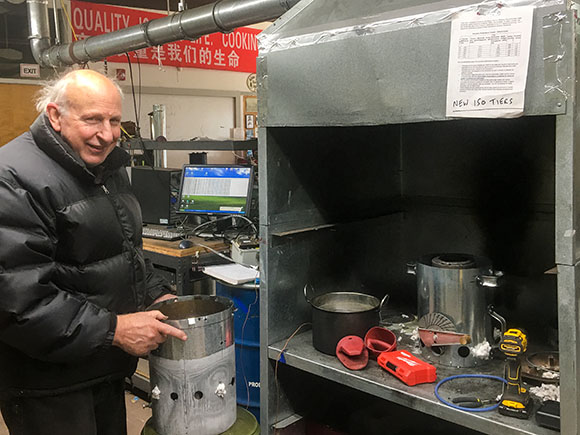
Sam Bentson and a Winiarski designed down-feed downdraft Rocket stove with added cooling fins.

We used to have problems with the upper portion of the sticks catching fire in Dr. Winiarski’s down-feed downdraft Rocket stoves. The draft had to be strong, and the sticks at the right moisture content and size/weight to burn up completely without any smoke back drafting up into the room. The vertical metal feed tube got too hot and could catch the top part of the sticks on fire, overcoming the draft moving into the stove. (Usually something like 3 MPH.)

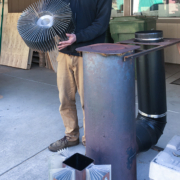
When Sam Bentson and Karl Walter were making a 20 watt thermoelectric generator (TEG) for the EPA SBIR supported Integrated Stove project we had the same problem, until Sam added aluminum cooling fins to the top of the vertical feed tube, as seen above. The team had previously designed and built the cooling fins unit that Sam is holding in the photo to cool the cold side of the TEG. I was amazed how well cooling fins work!

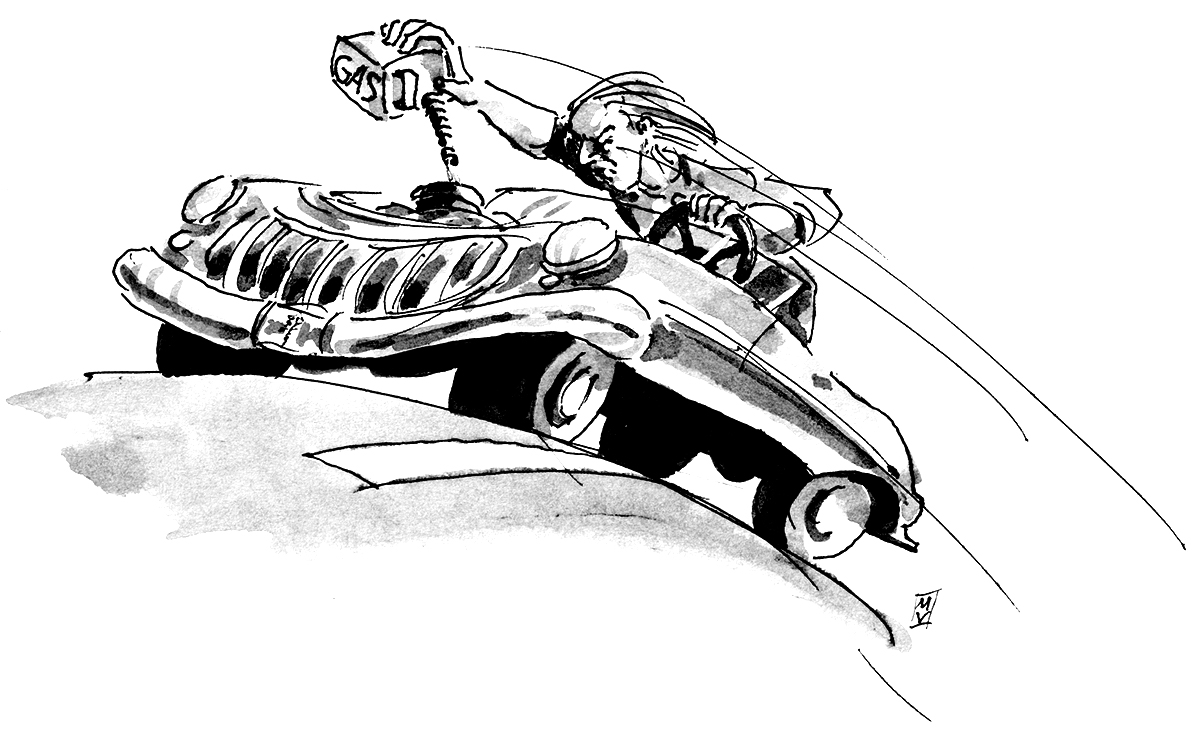
But then I remembered how small the radiators are in automobiles with huge horse powers. I saw that Sam and Karl had added a fan to their radiator to make sure it could dissipate the 1.5 kilowatts running through the hot side of the TEG. Adding fins to parts of a stove that could use more dissipation of heat brings to mind several possible applications: the heat exchanger cylinder in the photo, a chimney that has high exit temperatures, or the outside of a metal combustion chamber to preserve the metal. But I would not use fins where they can get dirty! They don’t work, for example, on the bottom of a cooking pot where soot quickly fills the space between the fins. (I didn’t think of this before we tried it.)

Varying Fan Speed in the SSM Jet-Flame/CQC Stove

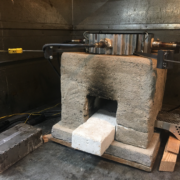
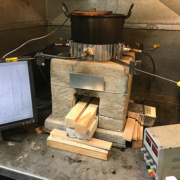
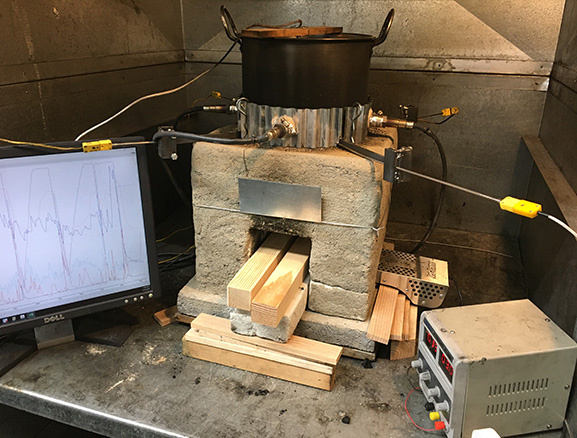
CQC stove set up for testing under the LEMS hood

ARC is investigating how to optimize the performance of the SSM Jet-Flame in the CQC earthen brick stove. Forty six thirty-minute ISO 19867 Water Heating Tests were completed under the LEMS hood at seven fan speeds. Two 4 cm x 4 cm douglas fir sticks were burned side by side. Five liters of water in a seven liter pot were heated, and the CQC pot skirt was used in all tests.

Results

Tier 4 ISO Voluntary Performance Targets:

  • Thermal Efficiency           40% to 49%
  • CO                                     <4.4g/MJd
  • PM2.5                               <62mg/MJd

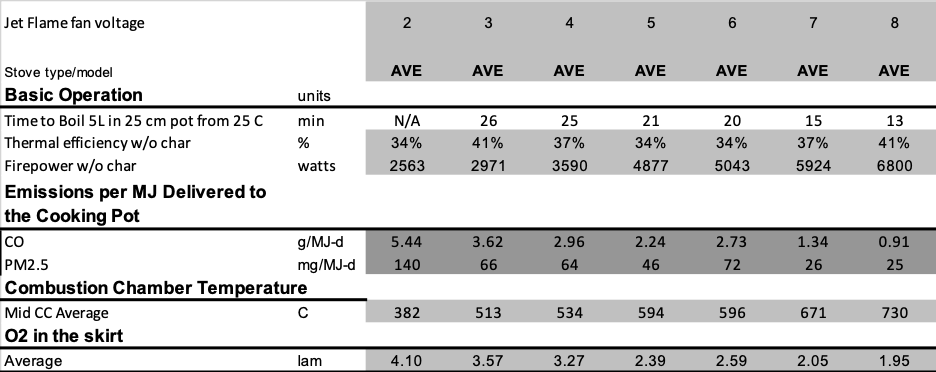
Time to boil: The time to boil decreased with an increase in fan speed.

Thermal efficiency: The thermal efficiency stayed close to 35% in most cases and was higher at 3 and 8 volts (around 40%).

Firepower: The firepower rose to 6.8kW at 8 volts, starting at 2.6 kW at 2 volts.

Emissions of Carbon monoxide: Generally emissions decreased with increasing fan speed.

Emissions of PM2.5: 7 and 8 volts scored the best, at half of the result of 5 volts.

Combustion chamber temperatures: The mid combustion chamber temperatures rose with increases in fan speed from 382C to 730C.

Excess air:  Lambda fell as voltage increased from 4.1 to 1.9.

We recommend that the project do enough field testing to determine what settings are preferable to local cooks, remembering that higher voltages consume more power. In this way, the Jet-Flame/CQC stove can be tailored to regional cooking, keeping in mind the power output and use patterns of the CQC photovoltaic solar system.

Here’s what the flame looks like when varying the voltage:

Making it real!

Kabanyana Murabukirwa Domina and Jean Marie Vianney Kayonga in Rwanda

One of the roles of the ARC engineer is to give accurate technical information to the in-field decision makers who are directing the stove project. The folks on the ground have to make sure that cooks really like the stove, that the price is market based, that manufacturing is arranged for, etc. ARC engineers and the field team work closely together as the project evolves.

A New Project in Rwanda

In Rwanda, Kabanyana and Jean-Marie and their NGO, ENEDOM, are working on a carbon credit supported Jet-Flame project. We met Jean-Marie through the internet and realized that he is well known in the sector. In fact, he knows many of our friends in Africa. Dr. Dan Lieberman at Global Health Labs sent Jean-Marie twenty Jet-Flames, and he showed them around to many of organizations, like the World Bank, that have large projects in the country.

Real World Use Guides Product Improvement

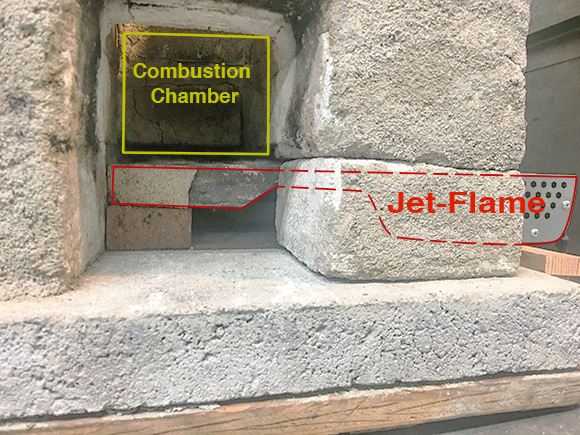
Moving the Jet-Flame to the side of the CQC stove

When we envisioned the Jet-Flame we imagined that it would be inserted into the fuel door of a Rocket stove. Mr. Shen at SSM directed the effort to manufacture the Jet-Flame and it includes a beautiful stainless steel stick support that also protects the fan. However, it only took several weeks of trails for ENEDOM to make a strong recommendation to move the Jet-Flame to the side of the earthen stove. Cooks in their homes were accidentally burning up the cord!

We gratefully thank ENEDOM for helping us make fewer mistakes. It’s another great example of trying to make sure that reality is in the product.

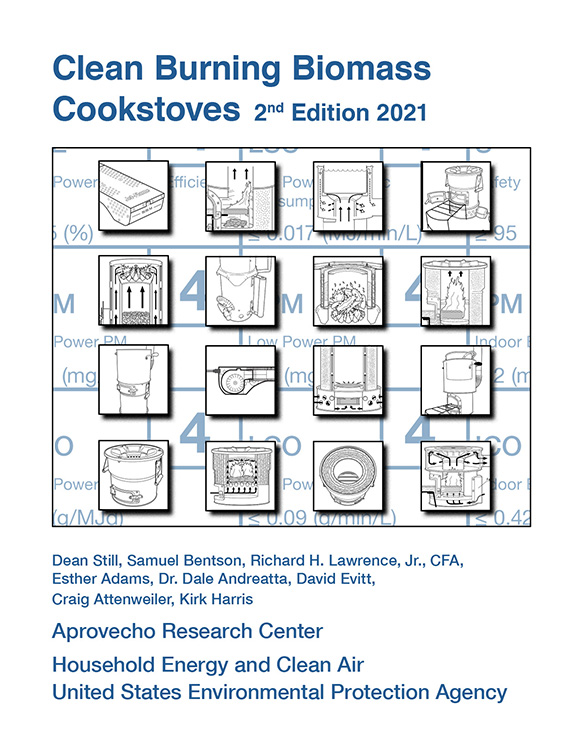
A New Edition of “Clean Burning Biomass Cookstoves”

cover of Clean Burning Biomass Cookstoves 2nd edition
Click here to download the free pdf files

If stoves pollute in the lab, they certainly will in the field. We estimate at least 3 times more. Commercially available biomass cookstoves that meet WHO standards are very rare. ARC continues to be committed to doing research and development to help to get the needed new stoves to market so that field studies will show success in sales, protecting health, saving wood, and making cooks happy. We believe that sharing what we learn is very important! So, we updated our “textbook” and it’s available for free here. The chapters have been updated and rewritten to try and share everything that we have learned in the lab in the last five years.

Enjoy!

Here are some highlights:

  • With clean outdoor air, doubling the air exchange rate halves the concentrations of PM and CO in the kitchen.
  • Using an EPA model of Oakridge, Oregon, the outdoor air concentration of PM2.5 would only be increased from 13.1 μg/m3 to 13.3 μg/m3 if homeowners used an ISO Tier 4 PM2.5 cooking stove.
  • A catalytic converter works well with gases (30-95% reduction of CO) but not with smoke (30-40% reduction of PM2.5) (Hukkanen et al., 2012).
  • We think that the Harris TLUD is perhaps the first “close to optimal” cookstove. It scored 0.7mg/minute PM2.5 with pellets at Lawrence Berkeley National Laboratory. It has a 3 to 1 turn down ratio. Large natural draft static mixers create thorough mixing. Decreasing primary air reduces the rate of reactions (production of wood gas) if the air/fuel mixture becomes too rich. A stationary fan blade spins the flame for longer dwell time. And cooks at ARC love to use it.
  • When carefully tested at ARC, the SSM Jet-Flame in the CQC earthen stove scored Tier 4 for thermal efficiency, CO, and PM2.5.
  • Renewably harvested biomass can be a carbon neutral energy source when burned very cleanly.

We are getting closer to practical solutions! The ones we know about are in the book.

“Going Faster” on ISO 19867

Many years ago, Kirk Smith hired Aprovecho to help Rob Bailis from U. C. Berkeley update and add emissions to the Water Boiling Test in the 1985 International Testing Standards. The Water Boiling Test (WBT) measured in the lab how much wood was used at full power and when simmering water. The writers of the International Testing Standards defined the purpose of the WBT as: “While it does not correlate to actual stove performance when cooking food, it facilitates the comparison of stoves under controlled conditions with relatively few cultural variables.”

The 1985 Kitchen Performance Test (KPT) measured fuel use in actual households, and the Controlled Cooking Test (CCT) was a bridge between the WBT and the KPT. ARC uses the Controlled (or Uncontrolled) Cooking Test to develop stoves with local committees of all stakeholders, as recommended by Sam Baldwin. In this test, locals cook with their own fuel, pots, and cooking practices, hopefully at Regional Testing and Knowledge Centers under the total capture emissions hood. Using the WBT in the lab has been a good tool for ARC to improve heat transfer and combustion efficiency. The cooks, marketers, manufacturers and funders in the project have to make the stove. It must work for users. They are experts.

We now use the new, updated Water Heating Test (ISO 19867) to improve heat transfer and combustion efficiency in the lab and it’s great. We are directed to try to use the type of wood, pot, and cooking practices from the intended project location. ISO 19867 also has us test the prototypes at high, medium, and low power to learn more about performance. As said, there are many other variables that can only be learned from the local cooks and everyone involved in the project. How much the can stove cost, that chapatis have to be toasted in the fuel door, that cooks in southern India sit cross legged so the stove must be pretty short, etc. is information that is obviously necessary and field based. The idea is that lab tests inform the prepared mind of the engineer who then works hand in glove with the project stakeholders in their location to make an effective product.

Kelsey Bilsback from Colorado State University advised that lots of times stoves in actual use are operated at exceedingly high fire powers. We agree! When applicable we use very high power (and relatively untended fires with sticks gathered from the forest). We are trying to find out whether a biomass stove burning found fuels can be clean burning at the equivalent of 85 MPH.

Thanks, Kelsey! Good idea!

We won the Tibbets Award!

ASAT, the for-profit arm of Aprovecho, has been awarded a prestigious Tibbetts Award by the US Small Business Administration. The Tibbets Award is given for demonstrating significant economic and social impact from the R&D funding provided by SBIR (Small Business Innovation Research) grants. ASAT received EPA SBIR grants that enabled the research and development of:

  • The Jet-Flame that increases combustion efficiency (costs around $11). See: www.Jet-Flame.com
  • An air cooled thermoelectric generator (water cooling is hard to install).
  • A low cost, easily cleaned electrostatic precipitator (90% reduction of soot).
  • The Integrated Stove. See: www.ssmstoves.com/project/m55/

We partnered with the Gates funded Global Health Lab to develop the Jet-Flame. They have recently supported sending Jet-Flame samples worldwide.

The clean combustion of biomass adds homegrown power to the energy mix here in the USA and in other countries. Without the EPA SBIR this would not have happened! To learn more about the Tibbets Award, visit tibbetsawards.com.

New Video: Rocket Stove 2021 – LEMS+ Realtime Combustion Analysis

Watch what happens with PM2.5, CO2, Oxygen and more during a wood burning stove test in this real-time video from Apro’s Laboratory Emissions Monitoring System. The LEMS provides a display of what’s being recorded by the various sensors in the stove being tested, and in the emissions hood. In this video, Dean Still gives an overview of what the five lines on screen represent, and how they relate to each other as the fire progresses.

For more info about Aprovecho’s emissions monitoring systems, see aprovecho.org/portfolio-item/emissions-equipment.

Inventor’s Pride: Watch Out!

Almost perfect!

Having unbiased villagers or Dr. Jim Jetter test Aprovecho’s Lorena stove might have helped to reduce our embarrassment when again and again the open fire was proven to be much more fuel efficient! Inventor’s pride is a well-known human frailty. Creating a truth-telling team including all the folks concerned with a stove project helps to address the inventor who is doing what feels natural and right, but can be misguided. It happens at ARC frequently!

The ARC team has found that an engineer/researcher may know more about the thermodynamics of a stove, but the expertise of cooks, manufacturers, distributors, retailers, and funders in the stove project need to be included in the decision making process from start to maturity. Test, test, test!

As Dr. Kirk Smith said, “You get what you inspect, not what you expect”.

Our advice is to test everything frequently from all angles and try to respond to problems without inventor’s pride. It’s not easy! Cognitive dissonance messes up judgement all the time. 

It’s easy to think, “I am intelligent, and make good decisions.” Admitting a mistake can threaten that image of self. It can be really hard to hear someone say, “Man, that Lorena stove is terrible! How could you have been so dumb?”

At Apro, we strive to use criticisms as a tool for improvement. Taking time to assess and define the problems, and consulting with our team about how to make improvements, moves us forward towards a more successful outcome.

New Video: Rocket Stove 2021 – Pot Skirts to Increase Heat Transfer

In this video, Dean Still explains why a pot skirt – a sheet of metal wrapped around the cooking pot – is a simple yet important way to improve the fuel efficiency of a rocket stove. He also explains how to calculate the appropriate distance between the skirt and the pot. Stay tuned to the end of the video to find out who is causing all the ruckus in the background…

Helpful references:

simplified diagram of constant cross sectional area
Simplified drawing of the concept of constant cross sectional area.

This is a very simplified illustration of what “constant cross-sectional area” means. The top circle represents the cross-sectional area of a stove riser. The bottom ring shows the same area translated into the space around a pot. It’s important to keep the cross-sectional area that the hot gasses flow through consistent, so they don’t slow down. Hot, fast flowing gasses transfer heat most efficiently. 

graph helps calculate proper skirt gap for best heat transfer efficiency
Chart for calculating channel gaps, from Dr. Samuel Baldwin’s “Biomass Stoves: Engineering Design, Development, and Dissemination.” 1987, Volunteers in Technical Assistance.

This is the chart for determining efficient channel gaps, explained towards the end of the video. It was developed by Dr. Samuel Baldwin in 1987.

Here is the Ten Stove Design Principles poster referred to in the video. Many more helpful documents are also linked on the Publications page.

Fluidized Bed Combustion, Top Lit up Draft, and the Jet-Flame

The Jet-Flame was developed from combustion concepts used in fluidized beds and TLUDs.

Fluidized Bed

fluidized bed combustion diagrams

“In its most basic form, fuel particles are suspended in a hot, bubbling fluidity bed of ash and other particulate materials (sand, limestone etc.) through which (under air) jets of air are blown to provide the oxygen required for combustion or gasification. The resultant fast and intimate mixing of gas and solids promotes rapid heat transfer and chemical reactions within the bed.”   https://en.wikipedia.org/wiki/Fluidized_bed_combustion

Top Lit Up Draft

diagram explaining how a top loaded up draft stove works

The TLUD uses under air flowing up through the fuel to transport wood gas into the hot layer of charcoal and flame above the fuel assisting more complete combustion efficiency.

Cleanly Starting the Jet-Flame

High velocity under air jets blow up into the lit charcoal placed on top of small sticks of wood. When the charcoal and wood are on fire, long pieces of wood are pushed into the made charcoal to start a Rocket Jet-Flame without making visible smoke. The sticks of wood are burned at the same rate as the continual production of charcoal creating a cleaner combustion process related to a fluidized bed and the TLUD.

sticks and charcoal start to combust in a rocket stove

Charcoal over wood is lit.

bed of charcoal in rocket stove

The charcoal becomes superheated with jets blowing up into the pile.

sticks burning in rocket stove

After 30 seconds, long sticks of wood are pushed against the burning charcoal creating flame.