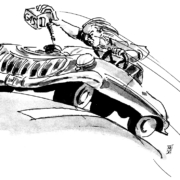
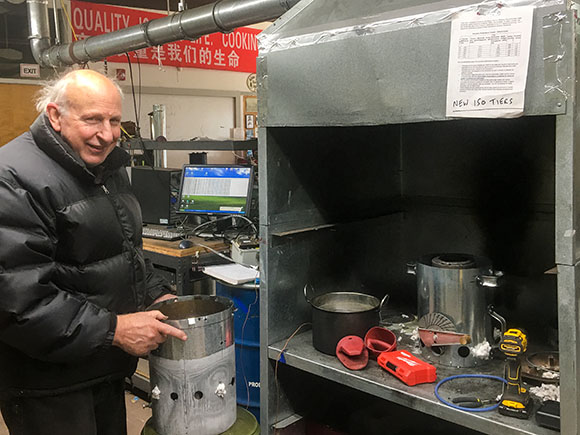
Yesterday, two fine fellows who manufacture stoves in southern Oregon visited our lab. One of the very competent guys had just installed a Corvette engine in a Jaguar, for fun.
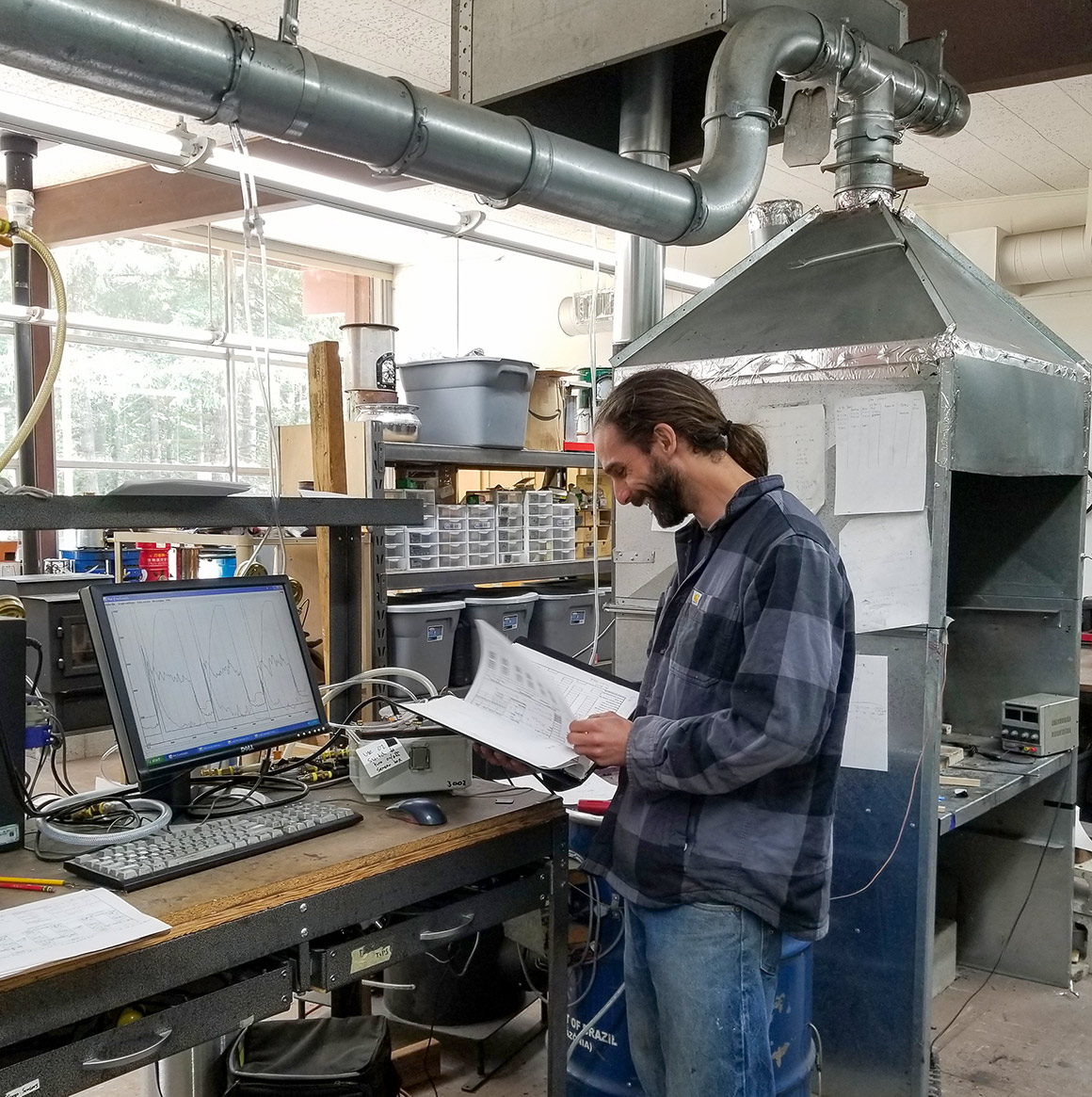
We quickly got on the same page when the ARC staff showed them how an emission hood (with both real time and gravimetric measurements) enables quick experiments to improve performance and achieve clean burning.
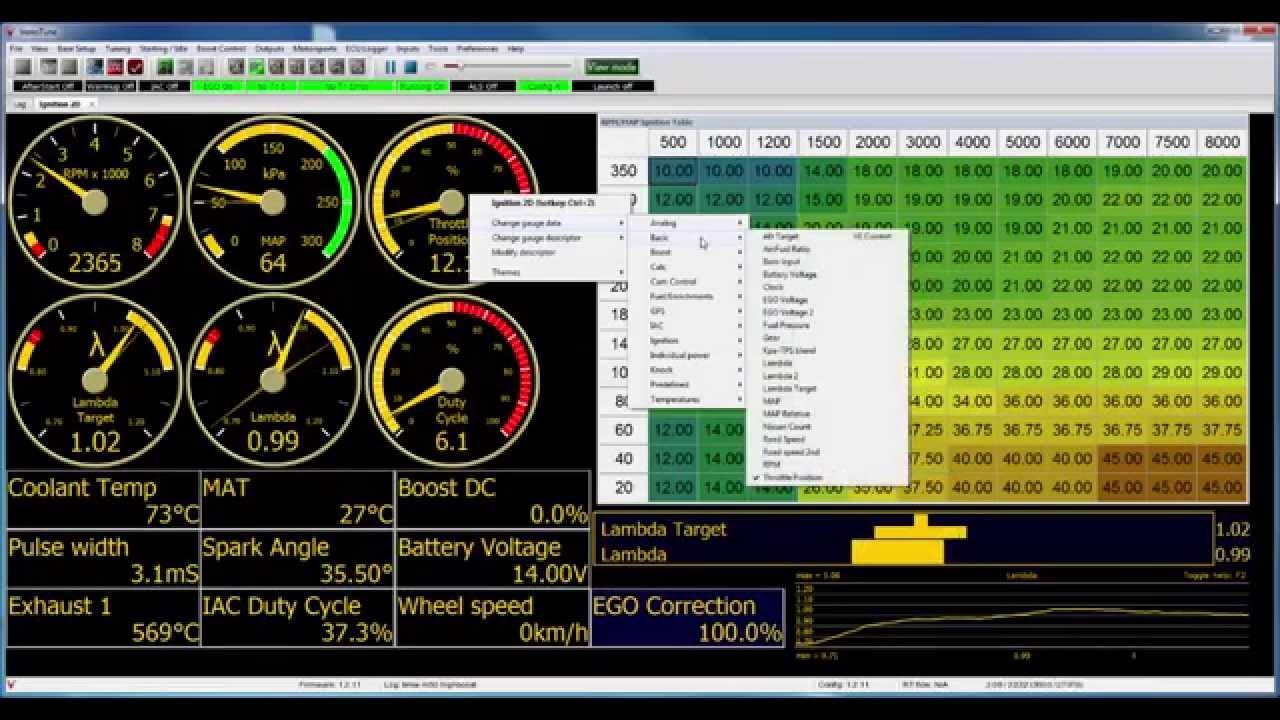
Anyone involved with racing (or fixing cars) knows how a computer helps to tune a modern car. The biomass emission hood allows folks to tune stoves like race cars.
Testing for development means that the testing of a manufactured product will have known results.
You win the race.
https://aprovecho.org/wp-content/uploads/2021/02/vroom.jpg7341200Kim Stillhttps://aprovecho.org/wp-content/uploads/2015/11/Aprovecho-Logo.pngKim Still2023-06-08 15:11:482023-06-08 15:11:49Emission Testing: Tuning a Stove Like a Race Car
General Manager Sam Bentsen is happy about some LEMS test results.
Why test a stove?
Most of the time, our lab uses testing for product
development. If we did not test a stove prototype we would be guessing whether
it met expectations. Testing in the lab gets us ready for the field testing of
prototypes. Then, customers take the prototype and make it work. The factory
and distributors frequently ask for design changes as the product gets closer
to shelves. From initial design to market usually takes about a year of
testing/iteration/development.
Recently, a factory in Africa asked us to design a $10
wholesale, pellet burning forced draft TLUD prototype that achieves Tier 4 for
thermal efficiency, CO, and PM2.5. The stove has to last ten years with
scheduled maintenance and require as low wattage as possible.
We had tested the Oorja several times during surveys of commercially available stoves. ARC published the results in books and papers trying to inform the public how stoves compare on various measures of performance. We were trying to make available a Consumer’s Report on stoves (see list below). We knew that the Oorja stove met the Tier rankings and that it used a high mass, low cost, durable combustion chamber. We tried a castable refractory in the lab and we also found several manufacturers that make inexpensive ceramic combustion chambers.
The factory wants a high-powered stove to meet the
needs of cooks in their region. Protecting health is also a major concern.
Delivering a design that can be made for $10 is also very important. All the
interconnected partners in the business plan have to make a healthy profit to
bring a “Tier 4” technology to the public. The designer is only the first step
in a web of stakeholders.
After all of the necessary parts were combined in the
lab, testing with the LEMS (Laboratory Emissions Monitoring System) started.
Many iterations were needed to get close to optimal performance. Adjusting the
primary and secondary air at high power took experimentation. In several weeks
of daily testing, the prototype was repeatedly achieving best scores. A CAD
drawing was made and the design was sent to the factory. The factory is making
their version of the stove, we will test it here and make adjustments if needed,
and then field testing of the prototypes will begin, including home trails and test
sales in stores.
Does it sound like a lot of work? The payback to know,
rather than guess, that the product can be successfully sold. It’s great to
make data based decisions, and a careful approach attracts investment. Failing
miserably with products we loved (and lost money on) has made ARC consider
external input carefully, especially from field testing.
Kirk Harris tests his newest TLUD design under the Laboratory Emissions Monitoring System (LEMS) hood.
Having an emissions hood allows ARC to make more detailed observations. We try to do one ISO 19867 test every day, establishing an in-house culture of data driven inquiry. Now, having a hood isn’t necessary for creating amazing stoves. Larry Winiarski, Tom Reed, Paul Anderson, Kirk Harris, and many other people have spent happy hours tweaking prototypes that then worked better and better. But when you get to the point where it’s hard to see the smoke, visual inspection doesn’t work as well. In the modern world, health requirements are violated by fairly invisible amounts of PM2.5. Of course, the same thing goes for CO which is odorless and invisible.
That’s why we offer free access to serious stove developers. Kirk Harris recently visited the lab to tune up his latest TLUD. We have a nice, warm cabin for him and daily access to one of our two emissions hoods. The cafeteria is open and Kirk brings food to prepare. If we are lucky, we hear him playing his flute. Dale Andreatta makes an almost annual visit and then likely climbs some mountain and goes somewhere to watch trains.
Steps of scientific
inquiry
Complete
background research into the topic
Observe
the natural process
Make
a hypothesis based on the observations and test it
We’ve recently added 4 oxygen sensors and 4 temperature probes to the data generated every second for greater depth of detail. Detailed observations help to see if one set of information had an effect on another. For example, when temperatures rose at 3” up from the floor of the combustion chamber did CO or PM2.5 change at the same time? Was a significant effect on CO or PM2.5 seen above a certain temperature? What happened with the temperature probe data taken at 4” up from the floor? And more and more. The process of learning is data driven which makes a black box theorist happy.
In so many ways, the detailed observation of what is happening in a biomass stove is in its infancy. Establishing a culture of daily data generation at our lab (3 hours) is getting us closer to having “observed the natural process.” And, it’s Christmas fairly frequently when a statistically significant relationship is observed.
https://aprovecho.org/wp-content/uploads/2015/11/Aprovecho-Logo.png00Kim Stillhttps://aprovecho.org/wp-content/uploads/2015/11/Aprovecho-Logo.pngKim Still2021-03-31 16:48:412021-03-31 16:48:44Detailed Observations with the LEMS Emissions Hood
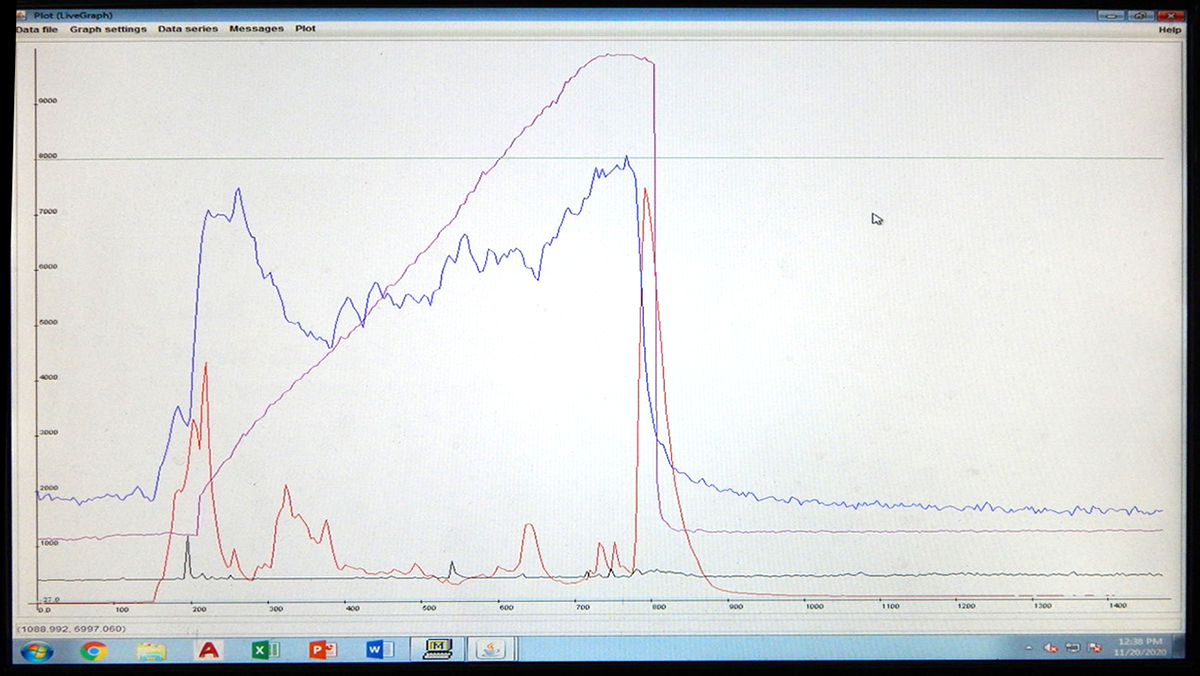
Watch what happens with PM2.5, CO2, Oxygen and more during a wood burning stove test in this real-time video from Apro’s Laboratory Emissions Monitoring System. The LEMS provides a display of what’s being recorded by the various sensors in the stove being tested, and in the emissions hood. In this video, Dean Still gives an overview of what the five lines on screen represent, and how they relate to each other as the fire progresses.
David Evitt, ASAT COO, and Sam Bentson, ARC GM, have been adding capacity to the Laboratory Emissions Monitoring System (LEMS). So far, four oxygen sensors, temperature probes in the fire and under the pot, and a velocity sensor give us a clearer picture of what’s going on in a stove. Knowing PM2.5, CO, CO2, and firepower at the same time, combined with the improved testing protocols in ISO 19867, is making us more confident that iterative improvement can be accomplished relatively quickly.
During a test, the LEMS screen shows real time emission rates of CO2 (blue line), CO (red line), and PM2.5 (black line).
Starting in early December, Dean Still and a research assistant will be doing 20 tests per week to create an optimized forced draft insert that cleans up the combustion of found biomass fuels and improves thermal efficiency in open fires, high mass, and Rocket stoves. A screen in the hood showing real-time data helps reduce the needed repetitions to achieve statistical confidence. The 90% confidence interval has to be less than 1/3 of the range of the Tier that contains the conservative bound of the confidence interval. When Tier Confidence Interval Range is equal to or less than 0.33, the number of tests is deemed sufficient to meet the Aprovecho data repeatability quality standard (seven to nine tests each for high, medium, and low power are usually sufficient).
David is in grad school with Dr. Nordica MacCarty at Oregon State University and the ARC lab is supplying them with information. We’ll keep you in the loop as we make discoveries. Part of the goal is to keep the optimized insert as close to a $10 wholesale price as possible.
Here we go! Eco-Science marching forward!
https://aprovecho.org/wp-content/uploads/2020/11/11.20.20-screen.jpg6761200Kim Stillhttps://aprovecho.org/wp-content/uploads/2015/11/Aprovecho-Logo.pngKim Still2020-11-20 15:20:352020-11-20 15:20:38Designing an Optimized Forced Draft Insert
Aprovecho’s General Manager Sam Benston recently returned from a trip to Rwanda, where he helped to set up a new ISO compliant cookstove lab. Here are some photos and information from Sam about his work there:
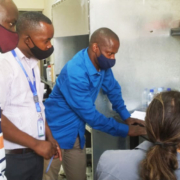
I was installing the LEMS (Laboratory Emissions Monitoring System) and PEMS (Portable Emissions Monitoring System) and the rest of the new ISO 19867 cookstove laboratory at the Rwanda Standards Board in Kigali. The lab started as an empty room full of equipment in boxes. I trained the laboratory staff on the set-up and use of the equipment for cookstove evaluations according to ISO 19867. Shortly after I left there was a Grand Opening to celebrate on the ISO’s World Standards Day. Here is a twitter link with photos: https://twitter.com/REMA_Rwanda/. Our new PEMS with the battery powered gravimetric system is visible.
The PEMS is visible here at the launch of the Cook Stove testing lab in Kigali. Photo via @REMA_Rwanda
Aprovecho provides a turnkey cookstove testing laboratory which is useful for cookstove performance certification, design, and basic research. The lab is centered around the ARC manufactured LEMS. It consists of a gas and particle analyzer with a pump and filter PM2.5 sampler, an emissions collection hood, and a dilution tunnel. The LEMS is the result of 20 years of development that started due to the lack of affordable and easy to use equipment suitable for cookstove emissions monitoring.
Testing a stove under the newly installed LEMS hood.
Aprovecho develops its equipment as the need arises during research and development activities that occur in its laboratory. Aprovecho’s ability to commission the other instruments that makeup a cookstove testing laboratory is the result of a similar depth of experience.
Mr. Bernard Kabera and colleagues training to use the new stove lab equipment.Sam Bentson trains Mr. Bernard Kabera and colleagues to use the new stove lab equipment.
It was remarkable to observe how the Rwandan people have protected themselves against COVID. It was a great honor to be part of their community at this time.
–Sam Bentson
https://aprovecho.org/wp-content/uploads/2020/10/10.23.20.rwanda-2-1.jpg5621000Kim Stillhttps://aprovecho.org/wp-content/uploads/2015/11/Aprovecho-Logo.pngKim Still2020-10-23 15:06:272020-10-23 15:06:29Setting Up a New Lab in Rwanda
Testing was designed to occur before manufacturing. 42 years after the International Standards were published, how many stove projects are spending a year or two in their project areas to make sure that the cooks love the intervention and that it decreases pneumonia before starting to make stoves?
Testing the Efficiency of Wood Burning Cookstoves: International Standards was published in 1985 and was the result of three international conferences. The purpose was to describe three tests that would enable stove projects to create interventions that met their goals. Testing was intended to happen before manufacturing to make sure that the stove and the entire intervention (a lot more than the stove!) works to save fuel, decrease pneumonia, protect kids from burns, or whatever is important in the context.
Using stove testing after the stove is manufactured to see if project goals are met is a great idea, too. But, bringing a stove into a village without good information showing what is needed in the cultural context to accomplish goals is obviously foolish. The WBT, CCT, and KPT were designed to result in reliable data to try to make sure that project was proven, before dissemination of the stove, to be successful.
The recent pneumonia study in Malawi showed that the new stove was used less than 1/3 of the time for cooking. Prior studies using the WBT, CCT, UCT, KPT, etc. with emission equipment could have been used to create a successful intervention that then would have been followed up to analyze results. This approach uses testing to identify the interwoven factors involved in the design of a useful medical intervention. When ARC created a Rocket stove for the Shell Foundation project in India it took about a year with months spent in villages (and in the lab) to discover what made both cooks and funder satisfied. We were trying to make sure that the consumer would love and buy the product and that it was significantly improved before it was made available on the market.
https://aprovecho.org/wp-content/uploads/2015/11/Aprovecho-Logo.png00Sam Bentsonhttps://aprovecho.org/wp-content/uploads/2015/11/Aprovecho-Logo.pngSam Bentson2017-03-02 15:12:352017-03-02 15:13:03Testing Stoves: Before Not After
https://aprovecho.org/wp-content/uploads/2015/11/Aprovecho-Logo.png00Sam Bentsonhttps://aprovecho.org/wp-content/uploads/2015/11/Aprovecho-Logo.pngSam Bentson2016-12-12 14:40:372016-12-12 14:40:37Updates to LEMS Processing Software and Instructional Video
https://aprovecho.org/wp-content/uploads/2015/11/Aprovecho-Logo.png00Sam Bentsonhttps://aprovecho.org/wp-content/uploads/2015/11/Aprovecho-Logo.pngSam Bentson2016-11-25 16:51:302016-11-25 16:51:30Support the Regional Testing and Knowledge Center Internship Program
https://aprovecho.org/wp-content/uploads/2015/11/Aprovecho-Logo.png00Sam Bentsonhttps://aprovecho.org/wp-content/uploads/2015/11/Aprovecho-Logo.pngSam Bentson2016-07-07 13:07:402016-07-07 13:08:14Filtering PM2.5 and meeting ISO requirements for the LEMS