Aprovecho
  • Home
  • Our Work
    • Emissions Testing Equipment
    • Lab and Field Testing Services
    • Stove Design and Manufacturing Support
    • Consulting and Capacity Building
  • Resources
    • Newsletters
    • Publications
    • Video Gallery
    • Software
  • About
  • Donate
  • Click to open the search input field Click to open the search input field Search
  • Menu Menu

Iterative Development: Addressing Health & Climate Change

December 26, 2024/0 Comments/in New Product, Testing Stoves

Iterative Development: 

Addressing Health & Climate Change

http://plume.ams3.digitaloceanspaces.com/wp-content/uploads/2020/10/Iterative-design-1500x787.jpg

Thanks to the Osprey Foundation, ARC just finished building a new heating stove lab and we are experimenting with how to make very clean burning home heating stoves. The intended price points are considerably lower than higher emission stoves currently for sale. Zero Green Premium products cost less than the dirty technology products they replace. 

ARC uses the Iterative Development process (see above) to create market viable products. Dr. Sam Baldwin started us on this path in 1987. He described how to develop and disseminate improved cook stoves with simultaneous lab and field-testing in his important book: http://www.newdawnengineering.com/website/library/Papers+Articles/Biomass%20Stoves,%20Engineering%20Design,%20Development%20and%20Dissemination,%20Samuel%20Baldwin%201987.pdf

We change one variable at a time in a prototype and test the result under the emissions hood that collects and records the amounts of climate gases and Black Carbon. Usually ~50 iterations result in a closer to optimal stove. The new Osprey Health and Climate Heating Stove Lab is set up to do 3 to 6 iterations per week. Lab staff includes Travis Volpe who builds, tests and changes prototypes. The prototype is thoroughly field-tested, as well.

Clean burning for cooking and heating stoves!

https://aprovecho.org/wp-content/uploads/2024/09/zero-green.jpeg 450 400 Kim Still https://aprovecho.org/wp-content/uploads/2015/11/Aprovecho-Logo.png Kim Still2024-12-26 17:30:142024-12-26 17:30:15Iterative Development: Addressing Health & Climate Change

Aprovecho Announced as a Winner of the Wood Heater Design Challenge

September 7, 2023/0 Comments/in Cleaner Burning Technologies, Cleaner Combustion, New Product, News

The U.S. Department of Energy (DOE) Bioenergy Technologies Office (BETO), in collaboration with Brookhaven National Laboratory (BNL), Lawrence Berkeley National Laboratory (LBNL), and the Alliance for Green Heat, today announced the winning teams for the Wood Heater Design Challenge (WHDC). 

Aprovecho Research Center, from Cottage Grove, Oregon, came in second place and won $25,000 with a novel burn pot, airflow configuration, and sensor package for pellet heaters. Davidon Industries from Warwick, Rhode Island was awarded first place for their mechanically automated, combustion-air control technology for cordwood heaters. Kleiss Engineering from Cloverdale, Indiana, won the third-place prize with a smart wood stove heater.

“Embracing innovation allows us to challenge existing norms, push boundaries, and discover new solutions that can reshape the entire industry,” said Dr. Valerie Sarisky-Reed, Director of BETO. “Wood stove research is part of DOE’s overall strategy to develop affordable bioenergy technologies and convert our nation’s renewable resources into fuels, power, products and in this case, more efficient wood stoves for homeowners.”

Aprovecho, Davidon, and Kleiss were selected from nine teams competing at the Wood Heater Technology Slam in September 2022. Teams pitched new wood stove ideas to retailers, the public, and experts, who assessed which stoves were the most innovative, efficient, and offered the greatest market potential. The three finalist teams moved forward to the testing phase of the competition, which was held this past spring at BNL in Upton, New York.

Read the full press release on the DOE Website. Learn more about the BETO-funded Wood Heater Design Challenge.

https://aprovecho.org/wp-content/uploads/2014/08/Aprovecho-Favicon.png 120 120 Kim Still https://aprovecho.org/wp-content/uploads/2015/11/Aprovecho-Logo.png Kim Still2023-09-07 18:31:512023-09-08 16:46:24Aprovecho Announced as a Winner of the Wood Heater Design Challenge
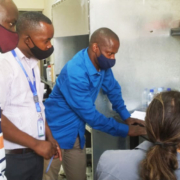
Sam Bentson trains Bernard Kabera and colleagues to use the new stove lab equipment

Setting Up a New Lab in Rwanda

October 23, 2020/0 Comments/in International Work, LEMS, New Product

Aprovecho’s General Manager Sam Benston recently returned from a trip to Rwanda, where he helped to set up a new ISO compliant cookstove lab. Here are some photos and information from Sam about his work there:

I was installing the LEMS (Laboratory Emissions Monitoring System) and PEMS (Portable Emissions Monitoring System) and the rest of the new ISO 19867 cookstove laboratory at the Rwanda Standards Board in Kigali. The lab started as an empty room full of equipment in boxes. I trained the laboratory staff on the set-up and use of the equipment for cookstove evaluations according to ISO 19867. Shortly after I left there was a Grand Opening to celebrate on the ISO’s World Standards Day. Here is a twitter link with photos:  https://twitter.com/REMA_Rwanda/.  Our new PEMS with the battery powered gravimetric system is visible.

The PEMS is visible here at the launch of the Cook Stove testing lab in Kigali
The PEMS is visible here at the launch of the Cook Stove testing lab in Kigali.
Photo via @REMA_Rwanda

Aprovecho provides a turnkey cookstove testing laboratory which is useful for cookstove performance certification, design, and basic research. The lab is centered around the ARC manufactured LEMS. It consists of a gas and particle analyzer with a pump and filter PM2.5 sampler, an emissions collection hood, and a dilution tunnel. The LEMS is the result of 20 years of development that started due to the lack of affordable and easy to use equipment suitable for cookstove emissions monitoring.

Testing a stove under the new LEMS hood.
Testing a stove under the newly installed LEMS hood.

Aprovecho develops its equipment as the need arises during research and development activities that occur in its laboratory. Aprovecho’s ability to commission the other instruments that makeup a cookstove testing laboratory is the result of a similar depth of experience.

Bernard Kibera and colleagues training to use the new stove lab equipment
Mr. Bernard Kabera and colleagues training to use the new stove lab equipment.
Sam Bentson trains Bernard Kibera and colleagues to use the new stove lab equipment
Sam Bentson trains Mr. Bernard Kabera and colleagues to use the new stove lab equipment.

It was remarkable to observe how the Rwandan people have protected themselves against COVID. It was a great honor to be part of their community at this time.

–Sam Bentson

https://aprovecho.org/wp-content/uploads/2020/10/10.23.20.rwanda-2-1.jpg 562 1000 Kim Still https://aprovecho.org/wp-content/uploads/2015/11/Aprovecho-Logo.png Kim Still2020-10-23 15:06:272020-10-23 15:06:29Setting Up a New Lab in Rwanda
Sam Bentson and David Evitt with the new Jet-Flame

A Tier 5 Rocket Stove

September 17, 2020/0 Comments/in Cleaner Burning Technologies, New Product, Rocket Stoves
Sam Bentson and David Evitt with the new Jet-Flame
Sam Bentson, ARC Lab Manager, and David Evitt, ASAT COO, developed the Jet-Flame with Shengzhou Stove Manufacturer and Dr. Dan Lieberman and Dr. Mike Barbour at the Gates funded Global Health Labs

The cast iron Jet-Flame sends 30 jets of pre-heated air up into the burning charcoal and wood in an open fire, sand/clay stove, or in a Rocket stove. It is patterned after industrial burners that position jets of primary air underneath the fuel bed to clean up combustion. Both Underfeed Stokers and Fluidized Bed Boilers use primary air that enters the fuel bed from underneath the fire.

The Jet-Flame stove accessory
The Jet-Flame

In 2013, with DOE funding, ARC built a bottom-air-only prototype stove and has been experimenting with improving the technique, resulting in the Jet-Flame combustion chamber accessory manufactured by SSM in China. There are several advantages in a bottom-air-only approach. The jets of air flow into the fuel bed from holes in the floor of the combustion chamber. Since the pre-heated air flows vertically, back-drafting out of the fuel door in a Rocket type stove is easier to overcome. The jets of air super-heat the charcoal layer underneath the sticks of wood. The hot jets of air emerge from the charcoal and pierce the laminar flames emitted by the wood creating turbulent eddies that stir up the flames to enhance the speed of mixing and combustion. The turbulent combustion zone creates short, intense flames that burn the fuel more completely before they cool off too much to sustain combustion. The increased velocity of the higher temperature flue gases also improves heat transfer efficiency.

Winiarski sunken pot Rocket stove with chimney
Winiarski sunken pot Rocket stove

When the Winiarski sunken pot Rocket stove with chimney is combined with the Jet-Flame the increase in combustion efficiency results in a truly improved stove with the ability to protect health. Since the stove and chimney do not leak in lab tests the stove does not emit fugitive emissions into the kitchen. The stove achieves all ISO 19867 Tier 5 ratings for both thermal efficiency and emissions of CO and PM2.5.

In 2004, ARC was hired by the Shell Foundation to bring the Rocket stove to India. Protecting health was a component of the project. Unfortunately, the natural draft Rocket stove was not clean enough burning to accomplish the task. Higher temperatures and a lot more mixing were needed. We wish that, when asked for a health protecting stove, we had been this far along. It has taken a while to make some progress. 

Test results of the Jet-Flame with a vented Rocket stove.
Test Results of the vented (with chimney) sunken pot Rocket with Jet-Flame
https://aprovecho.org/wp-content/uploads/2020/09/09-17-NL-SamDavid.jpg 552 640 Kim Still https://aprovecho.org/wp-content/uploads/2015/11/Aprovecho-Logo.png Kim Still2020-09-17 16:29:162020-09-17 16:52:53A Tier 5 Rocket Stove
Search Search

Latest Newsletters

  • Photo of the Rodale Solar Food Dryer book
    Improving the Rodale Solar Food DryerJuly 31, 2026 - 9:02 am
  • ARC and The Breathing Space Project in IndiaJuly 24, 2026 - 2:45 pm
  • a closed black box next to an open, semi-transparent box
    Using Black Box and Open Box Experimental DesignJuly 17, 2026 - 1:30 pm
  • Executive Director’s Report – Celebrating Aprovecho’s 50th AnniversaryJune 19, 2026 - 12:22 pm
  • Improving Solar Distillation: Two-Stage DistillationMay 29, 2026 - 1:15 pm
  • What’s Cooking at AprovechoMay 14, 2026 - 11:07 am
  • Photo of a solar still
    Improving Solar Distillation, Part 1April 3, 2026 - 1:32 pm
  • Michael Saul with some test data
    Real World Temperatures in a Pot SkirtMarch 27, 2026 - 2:17 pm
  • Aprovecho Research Center logo
    Requesting input: What technologies are most needed in households?March 13, 2026 - 12:43 pm
  • Testing improvements on a Bosch rocket stove
     Improving Heat Transfer Efficiency (HTE)March 6, 2026 - 2:59 pm
  • The Stainless Steel Winiarski Stove TopFebruary 27, 2026 - 3:36 pm
  • Cross- sectional illustration of a biomass cookstove with auto damper
    Health: Reducing PM2.5 by ~90%February 13, 2026 - 2:47 pm
  • The Icy-Ball : A Heat Driven RefrigeratorJanuary 30, 2026 - 3:20 pm
  • Stove parts at SSM
    A Hospitable Chinese Environment for Improved CookstovesJanuary 23, 2026 - 2:15 pm
  • A cookstove production line at SSMNordica MacCarty
    Tier 3 Biomass StovesJanuary 16, 2026 - 4:21 pm
  • Don’t Let The Flame Touch The PotDecember 19, 2025 - 2:04 pm
  • Early Rocket Stove Research at Aprovecho Still Rings TrueDecember 11, 2025 - 3:59 pm
  • Cook Stoves for EthosDecember 4, 2025 - 4:09 pm
  • A Clean Open Fire?October 31, 2025 - 9:25 am
  • a pot of cooked rice
    Turn Down RatioOctober 24, 2025 - 1:46 pm

Archives

Aprovecho Research Center

Mailing: PO Box 1175, Cottage Grove, OR 97424, USA

Visit: 76132 Blue Mountain School Road, Cottage Grove, OR 97424, USA
541-767-0287
info@aprovecho.org

© Copyright - Aprovecho Research Center | Digital Partner: Wildwood SEO
Scroll to top Scroll to top Scroll to top