
Aprovecho
  • Home
  • Our Work
    • Emissions Testing Equipment
    • Lab and Field Testing Services
    • Stove Design and Manufacturing Support
    • Consulting and Capacity Building
  • Resources
    • Newsletters
    • Publications
    • Video Gallery
    • Software
  • About
  • Donate
  • Click to open the search input field Click to open the search input field Search
  • Menu Menu

Tag Archive for: ESP

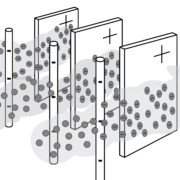
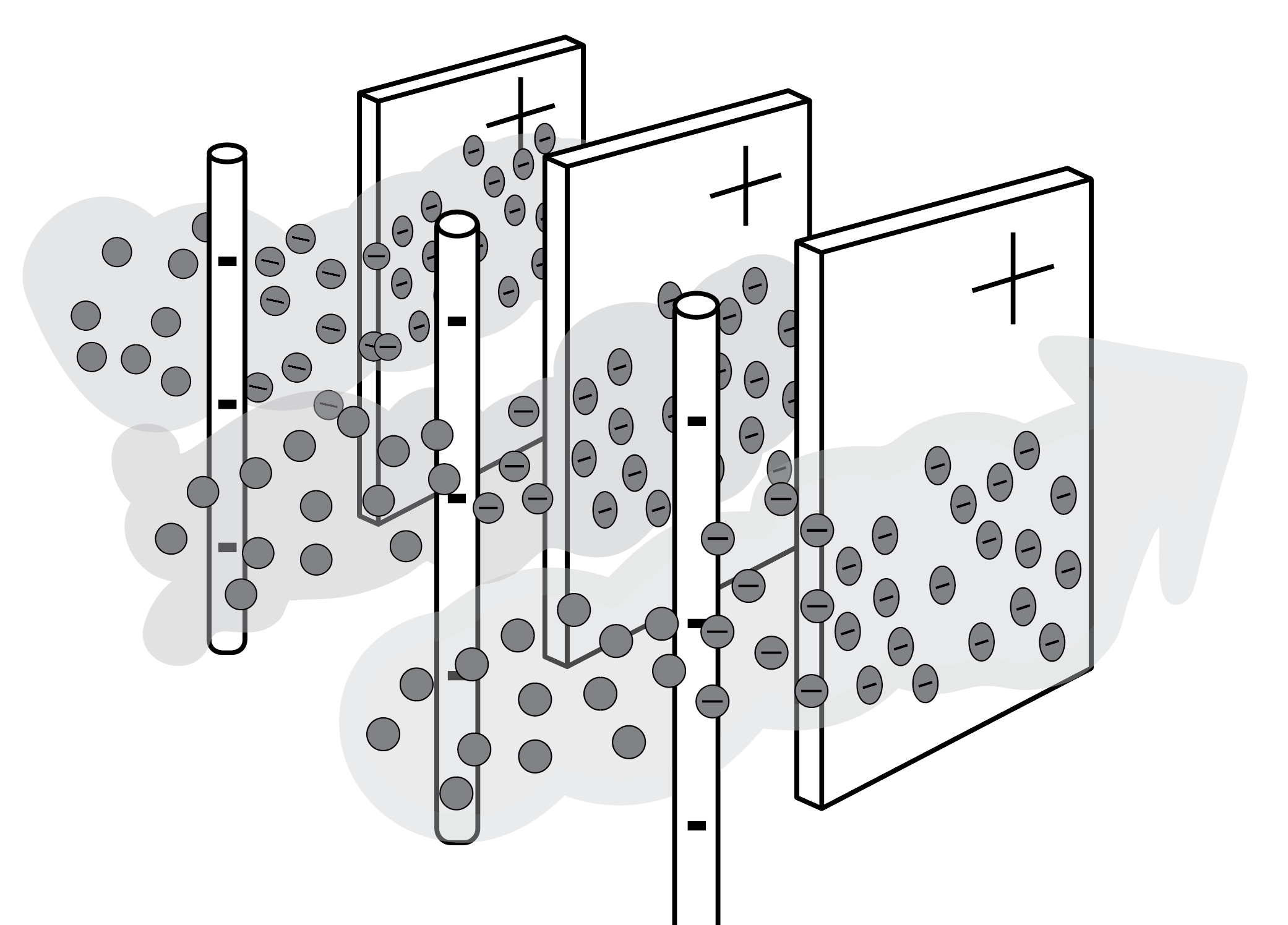
Illustration of how an electrostatic precipitator works

Post Combustion Reduction of PM2.5
February 16, 2022/0 Comments/in Cleaner Burning Technologies
Illustration of how an electrostatic precipitator works
Electrostatic Precipitation: Smoke particles are negatively charged and attracted to positively charged metal plates that are automatically cleaned.

Both automobiles and the biomass industry rely on improving combustion efficiency and post combustion reduction of PM2.5 to achieve “clean burning.” It’s really hard to rely on the combustion chamber to burn up enough of the harmful smoke to protect health, especially in large scale applications. Of course, all efforts should be made to be as efficient as possible. The goal is to burn up everything! In cookstoves, with limited space and a pressing need to be affordable, the problem becomes more acute.

Biomass heating stoves are larger and can cost a lot more than cookstoves. Industrial technologies are even less constrained. For decades, home heaters have tried catalysts to reduce emissions. Factories have used a wider array of technologies including filtration, catalysts, and electrostatic precipitation. Chapter 8 in “Clean Burning Biomass Cookstoves, 2nd edition, 2021” includes explanations of these technologies. 

Generally, filtration can work very well to capture dust and smoke with reported efficiencies of up to 99% (Frisky, et al., 2001). Catalytic converters are placed into the hot exhaust path where temperatures are hot enough (above 426°C). They work well with CO (30% to 95%) but not so well to remove PM2.5 (30% to 40%) (Hukkanen, et al., 2012). The Swiss electrostatic precipitator (ESP) called the OekoTube has been measured to reduce PM2.5 by 80.2% to 97.7% (Brunner, et al., 2018). However, as in industrial uses, routine cleaning is necessary to remove creosote and other coatings that interfere with proper function. Unlike filters and catalytic converters, the low wattage ESP does not reduce the draft in the stove, which could be potentially advantageous. 

ARC has been experimenting with post combustion of PM2.5 since 2017 as a result of the EPA SBIR funded work to create a clean burning biomass heating stove. We believe that if ESP is to be useful, automatic self-cleaning must be included, as in some industrial products. The hope is to invent super clean combustion but it’s great that post combustion approaches already exist. On the other hand, forced draft mixing, which is relied upon for combustion efficiency in industry, is largely missing in both cookstoves and residential biomass heaters. Perhaps its addition will be sufficient to reach the goals of protecting health and carbon neutral fuel use with renewably harvested biomass?

https://aprovecho.org/wp-content/uploads/2022/02/ESP-illustration.png 1496 2082 Kim Still https://aprovecho.org/wp-content/uploads/2015/11/Aprovecho-Logo.png Kim Still2022-02-16 18:31:212022-02-16 18:53:06Post Combustion Reduction of PM2.5
Search Search

Latest Newsletters

  • Photo of the Rodale Solar Food Dryer book
    Improving the Rodale Solar Food DryerJuly 31, 2026 - 9:02 am
  • ARC and The Breathing Space Project in IndiaJuly 24, 2026 - 2:45 pm
  • a closed black box next to an open, semi-transparent box
    Using Black Box and Open Box Experimental DesignJuly 17, 2026 - 1:30 pm
  • Executive Director’s Report – Celebrating Aprovecho’s 50th AnniversaryJune 19, 2026 - 12:22 pm
  • Improving Solar Distillation: Two-Stage DistillationMay 29, 2026 - 1:15 pm
  • What’s Cooking at AprovechoMay 14, 2026 - 11:07 am
  • Photo of a solar still
    Improving Solar Distillation, Part 1April 3, 2026 - 1:32 pm
  • Michael Saul with some test data
    Real World Temperatures in a Pot SkirtMarch 27, 2026 - 2:17 pm
  • Aprovecho Research Center logo
    Requesting input: What technologies are most needed in households?March 13, 2026 - 12:43 pm
  • Testing improvements on a Bosch rocket stove
     Improving Heat Transfer Efficiency (HTE)March 6, 2026 - 2:59 pm
  • The Stainless Steel Winiarski Stove TopFebruary 27, 2026 - 3:36 pm
  • Cross- sectional illustration of a biomass cookstove with auto damper
    Health: Reducing PM2.5 by ~90%February 13, 2026 - 2:47 pm
  • The Icy-Ball : A Heat Driven RefrigeratorJanuary 30, 2026 - 3:20 pm
  • Stove parts at SSM
    A Hospitable Chinese Environment for Improved CookstovesJanuary 23, 2026 - 2:15 pm
  • A cookstove production line at SSMNordica MacCarty
    Tier 3 Biomass StovesJanuary 16, 2026 - 4:21 pm
  • Don’t Let The Flame Touch The PotDecember 19, 2025 - 2:04 pm
  • Early Rocket Stove Research at Aprovecho Still Rings TrueDecember 11, 2025 - 3:59 pm
  • Cook Stoves for EthosDecember 4, 2025 - 4:09 pm
  • A Clean Open Fire?October 31, 2025 - 9:25 am
  • a pot of cooked rice
    Turn Down RatioOctober 24, 2025 - 1:46 pm

Archives

Aprovecho Research Center

Mailing: PO Box 1175, Cottage Grove, OR 97424, USA

Visit: 76132 Blue Mountain School Road, Cottage Grove, OR 97424, USA
541-767-0287
info@aprovecho.org

© Copyright - Aprovecho Research Center | Digital Partner: Wildwood SEO
Scroll to top Scroll to top Scroll to top