Early Rocket Stove Research at Aprovecho Still Rings True

Early Rocket Stove Research at Aprovecho Still Rings True

A summary of Global Modeling and Testing of Rocket Stove Operating Variations, Nordica A. Hudelson, K.M. Bryden, Dean Still Department of Mechanical Engineering, Iowa State University, Aprovecho Research Center, 2001
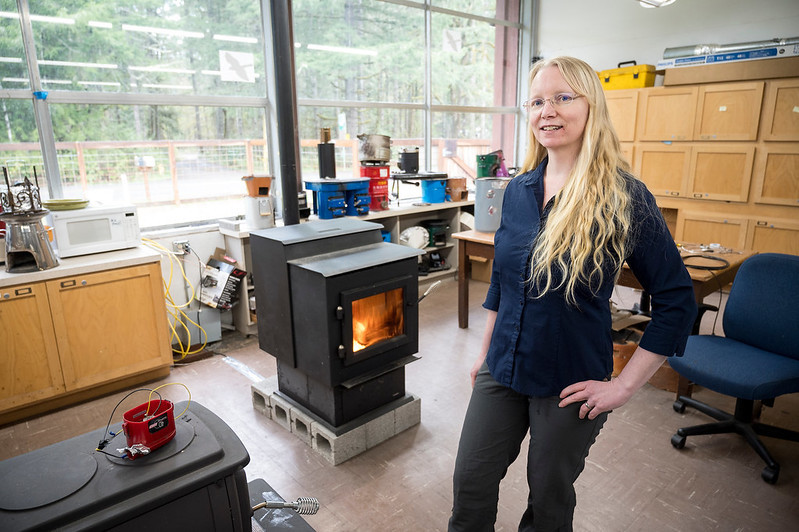
Photo: Karl Maasdam/OSU Foundation

In the summer of 2000, Aprovecho’s current Executive Director Nordica MacCarty spent a couple of months doing a series of 50 rocket stove tests. Nine variations of the basic rocket stove were tested, changing several parameters. The goal of this research was to determine the location and magnitude of heat losses from stoves to inform better design of efficient stoves. Her conclusions and recommendations are still valid twenty-four years later. 

From the paper:

Several important stove design parameters were varied for efficiency and loss comparisons. 

  1. The stove inlet diameter was an important factor… The chimney height had a drastic impact on the heat radiation from the flames to the pan. 

The most basic result of this series of three tests per stove shows that smaller inlets and shorter chimneys are more efficient, shown in the following chart: It should be noted that the smaller inlet stoves took a much longer time period to reach boiling than those with larger inlets. Thus while they are technically more efficient, they may not be ideal for field distribution as a stove will not be used if it does not perform according to the users expectations. 

  1. The gap between the top of the stove and the bottom of the pan influenced how much heat from the flue gasses and flames was transferred to the pan. 

The stove top to pan gap was varied from a standard of 1” down to ½” and then ¼” for comparison on the 4.5” diameter stoves. An almost linear change in efficiency was observed, increasing by about 9% when the gap was reduced from 1” to ¼”. An important consideration, however, is that the ¼” gap sometimes caused the fire to burn out the top front of the feed magazine because not enough air was able to be drawn through the decreased gap to create the proper draft.

  1. The amount of insulation in the stove influenced how long it took to heat up the stove and thus affected the efficiency. 

An unexpected discovery from these experiments is the effect of insulation on the efficiency of the rocket stove. First, it was shown that adding perlite insulation increases efficiency by about 2 to 5 percent over an uninsulated 4.5” diameter stove. However, super insulating the stove with two layers of fiberglass blanket insulation does not increase efficiency, but instead caused performance to actually decrease by as much as 3% for the 9” high stove. This is most likely due to the fact that adding fiberglass insulation increases the mass of the stove, thus it takes a longer time frame to heat up the stove and insulation.

  1. The use of a skirt around the pan increased heat transfer around the perimeter of the pan. 

It was shown that use of a skirt has the most profound impact on stove efficiency. The 4.5” diameter stoves with a 1” stove to pan gap were each run first without a skirt, then with a ¼” gap uninsulated skirt, then a ¼” gap insulated skirt, and finally a tight insulated skirt. Addition of the uninsulated skirt caused efficiencies to increase by 10%, and insulating that skirt caused an additional 10% rise! The stove with 9” chimney rose from 21% to 39% simply by use of an insulated skirt.

Losses 

Heat losses in different forms from different areas of a stove should be minimized in order to maximize the amount of heat transferred to the water. On average for all tests, convection accounted for 77%, radiation for 12%, and storage for 11% of total losses from the stove. For the pan, convection accounted for 92% of the losses, radiation for 6%, and storage for about 2%. 

Conclusions and Recommendations 

This series of fifty tests on varying operating setups of the rocket stove showed the following: 

A smaller inlet diameter results in higher efficiency, lower combustion gas losses, higher stove and pan losses, higher percent oxygen remaining, and lower air-fuel ratios. 

A shorter chimney results in higher efficiency, slightly lower combustion gas losses, higher stove and pan losses, lower percent oxygen, and a lower air-fuel ratio. 

Medium (perlite) insulation provides the highest efficiency and combustion gas losses, while increasing levels of insulation generally decreases stove and pan losses, percent oxygen, and airfuel ratios. 

Decreasing stove to pan gap increases efficiency, decreases combustion gas losses, increases stove and pan losses, and decreases percent oxygen and air-fuel ratios.

Use of a skirt with increasing degrees of tightness and insulation increases efficiency, decreases combustion gas losses, decreases stove and pan losses, decreases percent oxygen, and decreases air-fuel ratios. 

Thus, an ideal Rocket stove theoretically would have a small inlet, short chimney, perlite insulation, a small stove to pan gap, and an insulated skirt to provide maximum efficiency, minimal losses, and more complete combustion of the fuel.

Stick Size Matters!

Small sticks make higher temperature gases, better for heat transfer efficiency, but more smoke

Monitoring many fires seems to show that along with density, moisture, etc., the diameter of sticks has a large effect on both heat transfer and combustion efficiency.  

In a Rocket stove without a closing door, there is obviously a lot of cold excess air entering the fire. How do we raise Temperatures without limiting primary air?

Our observations seem to indicate that burning smaller diameter sticks results in more flame/higher temperatures. However, burning smaller diameter sticks also tends to make more smoke. For this reason, it may be that burning small sticks increases thermal efficiency but decreases combustion efficiency.

Conversely big sticks seem to burn slower making less flame, resulting in lower temperatures while making less smoke. Since flame from wood makes smoke, when the wood becomes charcoal, much less PM2.5 is emitted.

The Jet-Flame can burn 2” by 2” sticks and testing shows that PM2.5 gets lower with bigger diameter sticks. The jets of air make the made charcoal very hot and even big sticks stay lit. In a normal Rocket stove without a Jet-Flame, especially with wet wood, only smaller sticks will keep burning. 

The goal is to create as-hot-as-possible gases flowing next to the heat exchanger (pot) while controlling emissions. The size of the sticks does seem to have a significant influence on thermal and combustion efficiency.

Durability Testing at SSM

SSM manufactured rocket stoves with fires burning in them
Year-long durability testing with real fires

I just returned to the Oregon lab from a two-week visit to Shengzhou Stove Manufacturer. The next few newsletters will be about SSM and progress made. There’s a lot to talk about! SSM has sold over 5 million stoves and the factory is a wonderful place to visit. 

SSM started testing stoves for durability twenty-four hours a day (three eight hour shifts at a nearby farming community) three years ago. The farmers keep fires going in eight SSM stoves and the tests continue for one year of each stove. That’s 8, 860 hours.

It’s great that SSM has been doing long term, real life testing of their stoves. Previously, tests in a kiln with wet, salted pieces of metal resulted in confusing estimates of durability. In 2017, M.P. Brady and T.J. Theiss shocked the stove world by showing that in a wet, salty, hot kiln even very expensive metals were not long lasting. (Energy for Sustainable Development 37 (2017) 20–32, “Alloy Corrosion Considerations in Low-Cost, Clean Biomass Cookstoves for the Developing World”, Michael P. Brady, et al.).

The SSM testing is being written up. It seems to show much longer durability of various combustion chamber metals when real fires are used. Full details to follow.

Rocket Bread Ovens

I ran across this old video when exploring Rocket stoves on YouTube. It is great to have both peer reviewed journal articles and places like YouTube. I hope that our publications library at aprovecho.org includes, perhaps even combines, helpful information from both academia and the field.

We baked with a high mass bread oven for years at the Aprovecho campus. We bragged about it. It was only when Dr. Winiarski built a Rocket bread oven next to the old stove that we experienced the differences. Then, it took less than a week for baking to switch to the Rocket oven. No more throwing logs into a mud/sand cave for hours to try to get up to temperature! Why try to heat up a thousand pounds of mud when you want to make 20 pounds of bread?

Larry’s Rocket oven got to 400°F in about 30 minutes and used hand fulls of twigs to bake enough bread for the hungry eco-scientists. I loved the Rocket bread ovens and helped Larry to build them in Mexico. We learned a lot from Larry including that using a new stove was a lot more convincing that talking about it. Why not let the new oven or stove speak for itself.  Then stand aside and watch when folks like it enough to improve the prototype? 

So nice to let the experts (the cooks) tune the cooking functions of a stove! So nice to empower their hard won expertise! So appropriate to sit back and learn.

Mixing with Primary and Secondary Jets of Air

https://tse1.mm.bing.net/th?id=OIP.R4SW_2vN8wfW-9688ssYKgHaGL&pid=Api&P=0&h=220

Regardless of the velocity of secondary air, flow rate, or the angle at which air is injected into the fire, secondary air tends to lower the temperature of gases. Researchers have found that injecting secondary air into the side of the flame in a Rocket stove results in most effective mixing.*

The Jet-Flame, on the other hand, blows primary air jets up into the bed of made charcoal below the burning sticks of wood, creating a “mini blast furnace.” The jets of primary air increase the temperature in the charcoal, frequently resulting in higher temperatures in the combustion chamber. The mixing function is up into the fire, not into the side as with secondary air jets.

Boman et al., 2005 report that temperatures of 850C or above are needed for close to complete combustion in short residence times, as in a cookstove. Since excess air lowers temperatures, using the minimal volume of air in secondary air jets to achieve thorough mixing seems preferable. Researchers have recommended that the jets should penetrate into the middle of the flame but not enter into each other. (*Lefebvre and Ballal, 2010; Udesen, 2019; Vanormelingen and Van den Bulck, 1999).

Unfortunately, raising the temperature of pre-heated secondary air by a lot more than ~ 100C seems to be difficult. Cookstove combustion chambers are usually small, limiting the area exposed to high temperatures. The heat transfer efficiency is much lower from degraded temperatures further from flame.

 Residence time and temperature are easily measured. However, “thorough mixing” has not been defined and is not yet measured in our experiments. We infer that the woodgas/air/flame was thoroughly mixed when the emissions of PM2.5 and CO are close to zero as measured with the LEMS emissions hood. 

Metering!

https://tse4.mm.bing.net/th?id=OIP.ZMZNB-1RV2n1N_yxvJ7wzgHaH1&pid=Api&P=0

Watching a Rocket stove or a pellet stove (as above), it becomes obvious that metering the fuel is a primary factor in achieving close to complete combustion. When too much fuel is introduced into the combustion chamber, the emissions of smoke increase almost immediately.

For the clean burning of biomass, the controlled metering of fuel seems to be as necessary as it is in the engine of an automobile. The rate of reactions (how fast the solid biomass is being converted into wood gas) is then matched with the corresponding amounts of Time, Temperature, and Turbulence required to minimize CO and PM2.5.

ARC has added Metering to Time, Temperature, and Turbulence while unsuccessfully searching the thesaurus for a synonym that starts with the letter T. Maybe someone can succeed where we have failed?

African Mud Stoves with Chimneys

Damon Ogle was the Technical Director here at ARC

Damon Ogle and the ARC staff have a long history, starting in Central America and Mexico, listening to folks praising their stoves with chimneys. There are now millions of beautiful Latin American kitchens in which the dangerous smoke is transported out of the house, as it is in the USA/Europe. The Rocket stove can be about 50% more fuel-efficient compared to the open fire, so about half the smoke is made. But that is not good enough to protect health inside a home.

Although health-protecting chimneys are seen in Latin America and India, it’s rare to see chimneys in Africa.  

One simple African stove with chimney is seen above. A sunken pot (or pots) sits down near the fire exposing its bottom and sides to the flame. The pot seals into the hole and the smoke flows up the chimney, not into the lungs of the cook and her children. 

Since 1976, ARC has continued to work with local communities worldwide to try to save fuel and protect health. Trying to protect climate requires very clean combustion and we’re working on that, too.

50% Thermal Efficiency Depends on Several Factors Including the Surface Area of the Pot

Illustration from The Smithsonian’s explanation of how a boundary layer works 

A boundary layer of still air on the bottom and sides of a pot keeps the hot gases from actually contacting the surface and is a dominant factor in heat transfer efficiency.

  1. According to Newton’s Law, doubling the surface area doubles the heat transfer when the temperature and velocity of the gases are constant.
  2. In a Rocket stove at high power, the gases can be around 800C and the velocity can be around 1.2 meters per second.
  3. Keeping a constant cross-sectional area in the pathway the gasses take through the stove is important. Reducing the constant cross-sectional area channels under and around the sides of a pot to 0.75 of that area helps to keep the gases hot and flowing at highest velocity.
  4. The 0.75 cross sectional channels encourage the gases to thin the boundary layer increasing heat transfer.
  5. Pots have to have sufficient external area to achieve 50% thermal efficiency.
  6. In recent tests of optimized Rocket stoves, a pot with an area of around 800cm2 scored 34% thermal efficiency. Increasing the area to around 1000cm2 increased thermal efficiency to about 40%. In the same stove, a pot with 1200cm2 can be expected to result in above 45%. We use 26cm to 30cm in diameter pots with at least 5 liters of water to get closer to 50% thermal efficiency.
  7. Keep in mind that increasing the surface area of the water in a pot also increases the amount of steam, which makes bigger pots harder to bring to full boil without a pot lid.
  8. Thermal efficiency, when burning biomass, tops out (so far) at around 55%. The gases in the channels at the bottom and sides of the pot loose temperature and velocity resulting in an upper limit to heat transfer efficiency. 
  9. Raising the temperature and velocity of the gases will increase efficiency.

Secondary Air in TLUDs and Rocket Stoves

https://stoves.bioenergylists.org/stovesdoc/Reed/Pics%20in%20files.jpg
Forced draft mixing with 2nd air jets in Dr. Tom Reed’s WoodGas Stove at around 1,000C

Forced draft mixing with preheated jets of primary air reduced emissions of PM 2.5 by around 90% in our stove tests with the Jet-Flame. Would adding secondary air jets further decrease emissions?

Secondary Air Works in TLUDs

Lefebvre, Vanormelingen, and Udesen examined secondary air jets air in cylindrical combustion chambers and describe most successful patterns of penetration depth. Jet penetration lengths approaching the middle of a cylindrical combustion chamber resulted in a maximum reduction of PM2.5 emissions. An increase in the number of jets created more thorough mixing. It was important to have the jets meet in the middle, but with minimal necessary force, to ensure highest temperatures and highest velocity of hot gases to the pot.

Forced draft secondary air jets can decrease the upward draft in a cylinder. Jets of air aimed horizontally into the flame most efficiently create mixing. But even when aimed upwards toward the pot they create a ‘roof of air’ that slows the draft by creating a high-pressure front.

Regardless of the velocity of secondary air flow rates, or the angle at which air is injected into the combustion chamber, supplying secondary air also tends to significantly lower the temperature. For this reason, using a minimal amount of air was found to be best. There is a reported balance resulting in optimized mixing, draft, residence time, and temperature. (Lefebvre, 2010) (Vanormelingen, 1999) (Udesen, 2019)

How Do We Add Secondary Air Successfully to Rocket Stoves?

One obvious difference between TLUDs and Rocket stoves is the large fuel door in the side of the Rocket stove. A TLUD is an open topped cylinder with a small amount of primary air entering the batch of fuel from below the packed fuel bed. In the TLUD, the fuel is initially dropped into the cylinder, while in a Rocket stove horizontal sticks are pushed into the combustion zone through a fuel door. The pressure/volume of secondary air jets introduced into a Rocket stove may be limited because the high-pressure front can create a backdraft that sends smoke out of the fuel door.

Supported by funding from The Osprey Foundation, ARC is currently experimenting to determine: 1.) How much pre-warming can be achieved and 2.) What is the most effective pressure/volume for secondary air jets in a forced draft Rocket stove.

How To Make An Institutional Stove With Chimney

https://tse4.mm.bing.net/th?id=OIP.tR-juYhOLOvthnEU_gOqKgAAAA&pid=Api&P=0
Dr. Mouhsine Serrar and the Rocket institutional stove designed by Dr. Larry Winiarski

There are at least three ways to make institutional stoves with chimneys, all of which work well and save fuel and decrease emissions. Here they are:

  1. Shell Foundation supported the making of an eight-part video, a step by step guide to making a 50 to 100 liter institutional Rocket stove, with a heat resistant metal Rocket combustion chamber. It is a great stove with lots of successful field testing but it costs the most to construct because heat resistant metals like 410 stainless or FeCrAl are increasingly expensive. The super insulated combustion chamber requires these types of metal. 304 stainless will not last. https://youtu.be/VdhLWMW7IXA
  2. Cooking With Less Fuel: Breathing Less Smoke shows how to make the same institutional stove using bricks for the Rocket combustion chamber. Construction details can be found at aprovecho.org in the publications section. The book was written with the World Food Program in Rome. This is a less expensive stove that is slightly less fuel efficient at cold start but lasts longer and is easier to make in places where 410 stainless and FeCrAl are not available.
  3. Making a VITA style institutional stove without a Rocket combustion chamber is the least expensive way to create an institutional stove. The open fire under the pot is supported on a grate and the hot gases flow up the inside of the skirt, down the outside of the skirt and exit out the chimney placed below the bottom of the pot as in the Rocket stoves shown above. You can find a video we made about constructing the VITA stove at: https://aprovecho.org/video-gallery/

Lots of manufacturers do not use the chimney but we think that protecting health is very important. We try to follow Don O’Neals advice (HELPS International) to always include chimneys whenever possible, imagining our mothers cooking and getting ill from exposure to the harmful emissions without the protection of the chimney.