Aprovecho
  • Home
  • Our Work
    • Emissions Testing Equipment
    • Lab and Field Testing Services
    • Stove Design and Manufacturing Support
    • Consulting and Capacity Building
  • Resources
    • Newsletters
    • Publications
    • Video Gallery
    • Software
  • About
  • Donate
  • Click to open the search input field Click to open the search input field Search
  • Menu Menu

A Recent History of the Rocket Stove: 2011-2015

August 25, 2022/0 Comments/in Rocket Stoves, The Big Picture
Dr. Samuel Baldwin

In 2011, Dr. Samuel Baldwin at the Department of Energy (who wrote the Bible on cook stoves in 1987) organized a two-day 100 person conference to identify how cook stoves could be improved and manufactured. Key recommendations were:

  •  At least 90% emissions reduction and 50% fuel savings are appropriate initial targets for biomass cook stoves. 
  • Multiple stove designs will be needed to accommodate a variety of cooking practices, fuels, and levels of affordability.
  • Technical R&D should guide and be guided by field research, health, social science, and implementation programs. At every stage, laboratory and fieldwork should be integrated into an iterative cycle of feedback and improvement.
  •  The cost and performance tradeoffs associated with the use of processed versus unprocessed fuels should be explored. While processed fuels can improve stove emissions and efficiency, the processing adds additional costs and these fuels may require a fuel distribution system.

From 2013-2015, ARC received a grant from DOE and spent three years establishing a baseline of stoves in use and then improved five types of stove prototypes with the iterative development process using the LEMS emission hood. The lab testing showed how combustion and heat transfer could be improved in those five types of stoves with the hope that field testing would evolve useful products that use less fuel and make less smoke. A book was written: Clean Burning Biomass Cookstoves, (2015) available on the publications page. The book was updated in 2021.

https://aprovecho.org/wp-content/uploads/2016/03/Sidefeed-1.jpg 276 187 Kim Still https://aprovecho.org/wp-content/uploads/2015/11/Aprovecho-Logo.png Kim Still2022-08-25 14:44:172022-08-25 15:13:36A Recent History of the Rocket Stove: 2011-2015

A Recent History of the Rocket Stove: 2009

August 19, 2022/0 Comments/in International Work, Rocket Stoves, Testing Stoves, The Big Picture

In 2009, The New Yorker published an article about the Rocket stove entitled Hearth Surgery: The quest for a stove that can save the world. One year later, USAID funded field tests in Africa showed that the insulated Rocket stove was not cleaner burning than the open fire. The Rocket with skirt saved 40% of the fuel to cook and emissions were only reduced by that amount.

Not a Planet Saver, yet!

The insulated Rocket combustion chamber raised temperatures but as Dr. Winiarski realized at the time, flame, air, and gases were not adequately mixed to achieve sufficient combustion efficiency. Larry knew that the Rocket was smoky but it was simple to make and with a pot skirt saved fuel. He wanted to provide folks with a stove that was helpful and he realized that it wasn’t perfect.

Larry’s idea went viral worldwide and continues to be a favorite on the internet and in many low- and middle-income countries. Millions of Rocket stoves are manufactured and sold yearly by factories large and small.

Going viral is great but can have a downside especially when the initial products are not technically mature. It’s normal for first generation products to be improved as time goes by. The process of development continues in 2022.

https://aprovecho.org/wp-content/uploads/2016/03/Sidefeed-1.jpg 276 187 Kim Still https://aprovecho.org/wp-content/uploads/2015/11/Aprovecho-Logo.png Kim Still2022-08-19 13:25:292022-08-19 14:02:59A Recent History of the Rocket Stove: 2009

Learning From The Field, Part 2

July 1, 2022/0 Comments/in Climate Change, Rocket Stoves, Testing Stoves, The Big Picture

The Field Informs the Lab

In Part 1, we gave examples of how field studies can provide unpleasantly surprising results. Rocket stoves were designed to make a little less smoke and use substantially less fuel. So when the rocket stove was field tested by USAID the inventor, Dr. Larry Winiarski, was not surprised that the stove still made smoke. But the ARC team was surprised that it was not a real improvement over the open fire.

In 2011 the goals for cookstoves published by the Department of Energy asked that a stove use 50% less fuel and make 90% less PM2.5 to protect health when used indoors. Now in 2022 stoves are also supposed to address climate change, which means emitting less PM2.5 and hopefully making less than 8% black carbon. Field tests show that we need to make more improvements to meet these specific goals.

How are these reductions achieved in the lab?

  1. Use a chimney to reduce in-home concentrations of CO and PM2.5.
  2. In lab tests, approximately 850°C gases need to flow in tight channel gaps around the pot(s) to reduce the fuel used to cook by about 50%.
  3. Molecular mixing at 850°C (0.2 second residence time) can achieve something like a 90% reduction of PM2.5 (requires forced draft in a Rocket stove).
  4. This mixing reduces greenhouse gas emissions by about the same amount.

Natural-draft and forced-draft TLUD stoves burning pellets and forced draft Jet-Flame stoves burning dry sticks without bark get close to these reductions in the lab. Unfortunately, they frequently do not yet meet these goals in the field.

The lab has to move into the field to learn if current technology can accomplish modern goals. Let’s go!

Next week in Part 3: sometimes field tests show success.

https://aprovecho.org/wp-content/uploads/2022/05/threestonepreference.jpg 1121 1200 Kim Still https://aprovecho.org/wp-content/uploads/2015/11/Aprovecho-Logo.png Kim Still2022-07-01 15:57:102022-07-01 16:07:42Learning From The Field, Part 2

Cooking Outdoors as a Health Intervention

June 10, 2022/0 Comments/in Indoor Air Quality, The Big Picture, Women & Children's Health
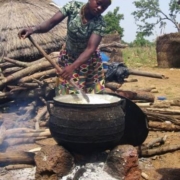
Cooking over an open fire in Ghana. (Photo: Global Alliance for Clean Cookstoves)

The air in a kitchen has to be very clean to protect women and children from multiple diseases. Unfortunately, moderate amounts of smoke seem to damage health almost as much as higher concentrations. 

As exposure rises from zero, the chance that a child will get pneumonia increases sharply and then levels off so that indoor air with 200μg/m3 PM2.5 is almost as dangerous as air at 400μg/m3 (Burnett et al., 2014). The World Health Organization Intermediate Guideline for PM2.5 is 35μg/m3.

In order of effectiveness, when cooking in a kitchen, health interventions seem to be:

  1. Venting smoke up a functional chimney.
  2. Increasing the fresh air entering the kitchen to dilute smoke and gases. (When the outdoor air is clean and the air exchange rate is doubled, the indoor air pollution is reduced by half.)
  3.  Burning up almost all of the smoke in the stove.

 Unvented Rocket stoves, and other ‘moderately clean burning’ stoves (such as a carefully tended open fire with pot skirt), emit much too much smoke and gas to protect health in houses. 

Cooking outside, especially upwind of the fire in a bit of breeze, is highly effective in lowering harmful concentrations of PM2.5.

Cooking outside seems to be a first choice intervention, when applicable. Even ‘moderately clean burning biomass stoves’ can be used when the cook is upwind of the fire in a bit of a breeze, meeting the WHO Intermediate Guideline for PM2.5. 

Of course, cooking with a low emission stove is preferable, when possible!

https://aprovecho.org/wp-content/uploads/2021/05/ghana-practical-stove.jpg 500 375 Kim Still https://aprovecho.org/wp-content/uploads/2015/11/Aprovecho-Logo.png Kim Still2022-06-10 17:57:592022-06-10 17:58:01Cooking Outdoors as a Health Intervention

Mistakes!

May 20, 2022/0 Comments/in The Big Picture

When Dean Still came to Aprovecho in 1989, Dr. Larry Winiarski asked him to compare the thermal efficiency of the Lorena stove and the Three Stone Fire. The testing revealed a problem for the ARC staff when our Lorena used three times more fuel than a carefully operated open fire! 

It’s surprising to learn how efficient a three stone fire can be!

Half of the staff, who had written books about the Lorena and taught thousands of people about their invention, were never convinced that a problem existed. The other half were embarrassed and became fervent believers in Dr. Kirk Smith’s famous saying that “You get what you inspect, not what you expect.”

Making a public mistake pushed a reconstituted ARC to proceed more slowly, to challenge speculation, and to try to generate reliable data. We learned that a lot of local knowledge is required to take successful products to market. Evidence can help to overcome inventors’ pride, cognitive dissonance, and the financial cost of changing directions. At the same time, inventor’s pride, cognitive dissonance, and the cost of changing direction also influence decision making.

https://aprovecho.org/wp-content/uploads/2022/05/threestonepreference.jpg 1121 1200 Kim Still https://aprovecho.org/wp-content/uploads/2015/11/Aprovecho-Logo.png Kim Still2022-05-20 15:06:202022-05-20 15:06:21Mistakes!

Learning from the Three Stone Fire

May 6, 2022/0 Comments/in The Big Picture
Traditional three stone fire
Use of traditional three stone fire in one Rakhine village.  ©FAO/Myanmar

As with any tool, the skill of the operator determines how well the work is accomplished. It takes years to learn how to use a hammer or shovel. The Three Stone Fire can be effective and clean or it can be very dirty and wasteful. In some kitchens, large fires use a lot of wood and make a great deal of smoke. Small fires are also made that cook food relatively cleanly. 

Watching indigenous experts cook with fire has led to a better understanding of improved biomass fuel use. Cooks who are trying to conserve wood tend to burn the wood at the tip of the stick making flames. Knowledgeable cooks only need a small, hot fire close to the pot to boil water. 

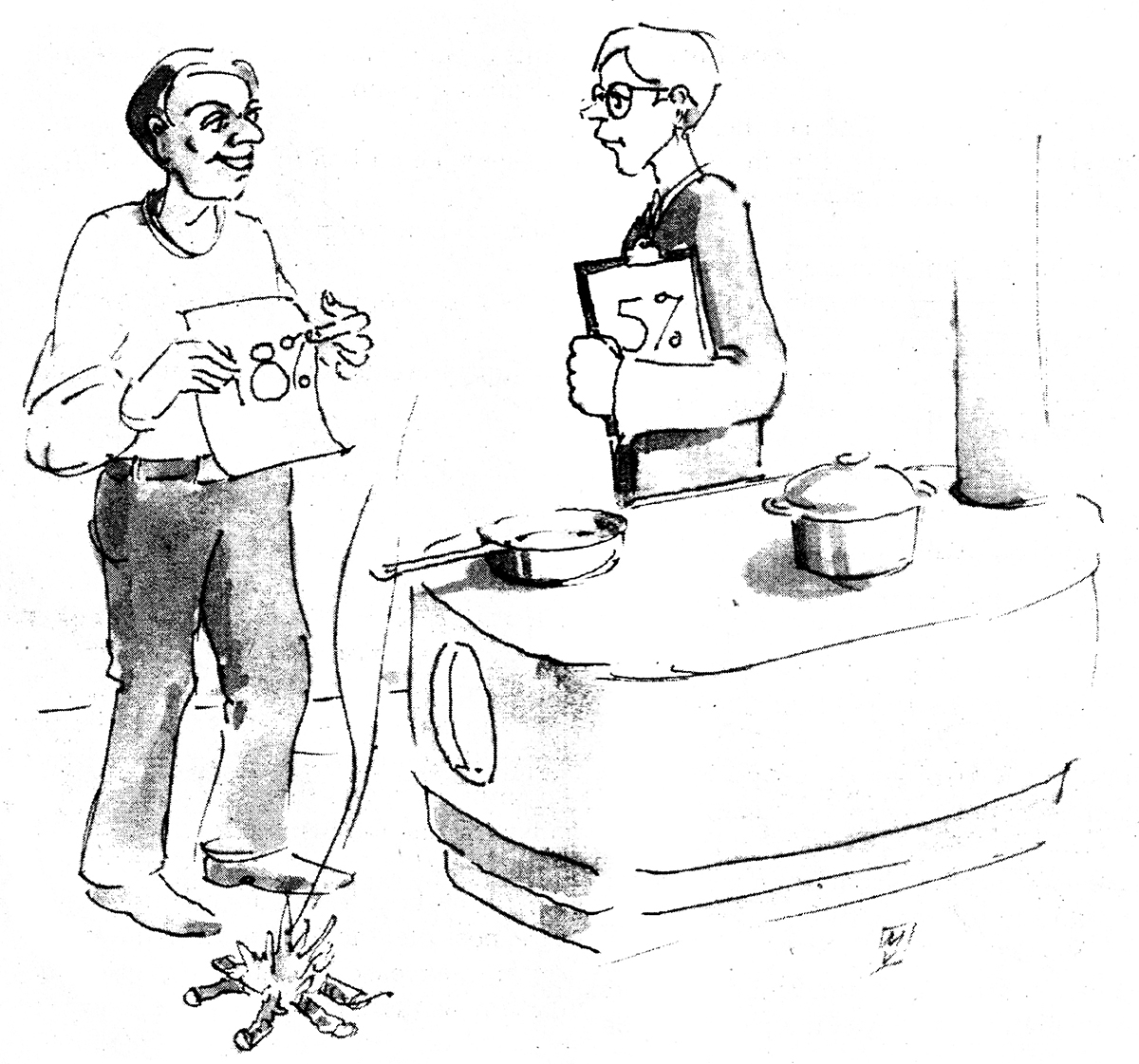
Improving upon a well-made Three Stone Fire has been more difficult than expected. Learning from expert users helped teach engineers how to make better stoves. Well-constructed Three Stone Fires protected from the wind and tended with care, score between 20% and 30% thermal efficiency. Open fires made with moister wood and operated with less attention can score as low as 5%. 

When Tami Bond achieved 33% thermal efficiency with a Three Stone Fire, ARC started to depend on the pot skirt with a 6mm channel gap to help folks use less fuel to cook food. Expertise with the Three Stone Fire is an important skill that empowers the cook and has to be respected.

https://aprovecho.org/wp-content/uploads/2021/12/12-8-fire-with-pot.jpg 236 316 Kim Still https://aprovecho.org/wp-content/uploads/2015/11/Aprovecho-Logo.png Kim Still2022-05-06 18:07:152022-05-06 18:26:21Learning from the Three Stone Fire
Smoggy NYC, photo by urbanfeel on flickr

Health and Emission Rates of PM2.5

April 14, 2022/0 Comments/in The Big Picture
Smoggy NYC, photo by urbanfeel on flickr
photo by urbanfeel on flickr

Several articles have pointed out that using biomass-heating stoves can result in health problems in densely populated areas. We are working with friends at the EPA to think about how we might define PM2.5 emission rates for residential biomass heating stoves that would protect health in densely populated cities. 

When the population density goes up (more people are generating pollution), the emission rate has to go down (the stoves have to be cleaner).

What emission rate for PM2.5 would protect personal health if 1/3 of the folks in New York City replaced the natural gas used for residential heating with biomass?

Very roughly, using an EPA outdoor air pollution model, a biomass-generated PM2.5 emission rate of around 0.3g/h looks like it might work in NYC. That’s the emission rate of a good pellet stove.

To accurately make predictions, a model of the air circulation in a city can be generated. Great for planning. For a description of the EPA model, see Chapter 5 “Protecting Health” in Clean Burning Biomass Cookstoves, 2021.

https://aprovecho.org/wp-content/uploads/2022/04/530910048_e498f40f2f_c.jpg 533 799 Kim Still https://aprovecho.org/wp-content/uploads/2015/11/Aprovecho-Logo.png Kim Still2022-04-14 14:34:042022-04-14 14:34:07Health and Emission Rates of PM2.5

ETHOS is Great!

January 25, 2022/0 Comments/in Conference, The Big Picture

Yesterday morning I was on an ETHOS panel discussing stoves, health and climate change. I loved the discussion and was filled with hope that facing the end of the fossil fuel era might catalyze better use of resources.  Living sustainably has been a dream of mine since I was 15 years old in 1967. Like many people I have been living with this dream for many years in a world that has not been committed to renewable energy.

Aprovecho (started in 1976) has tried to create better understandings of farming, forestry, and appropriate technology (focusing on biomass stoves), and helped me to investigate fire. Working with Dr. Larry Winiarski was a blessing in many ways, especially by showing me the utility of the scientific method.

It was great to be able to direct folks at ETHOS to our 2020 revised book “Clean Burning Biomass Cookstoves” that contains most everything that we’ve learned since the publication in 2015. Download here: Clean Burning Biomass Cookstoves, 2nd Edition, 2021. These newsletters are another “closer to real time” update.

The ETHOS Conference continues online through Friday (Jan. 28). You can see the agenda, watch pre-recorded presentations and register to attend the live seminars/discussions at ETHOS 2022. I think you will find it well worth your while!

-All best, Dean Still, Research Director

https://aprovecho.org/wp-content/uploads/2022/01/ethos-22.jpg 605 1160 Kim Still https://aprovecho.org/wp-content/uploads/2015/11/Aprovecho-Logo.png Kim Still2022-01-25 19:22:552022-01-26 11:19:15ETHOS is Great!

A Multi-tiered Framework for Evaluating Cooking Systems

January 12, 2022/0 Comments/in ISO Standards, The Big Picture
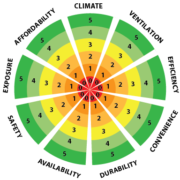
Would it be helpful to evaluate cookstoves with multiple metrics?

ISO 19867-1:2018 is a set of laboratory test protocols for evaluating cookstove performance, published by the International Organization for Standardization. Their Voluntary Performance Targets are a set of baseline criteria defined as tiers – Tier 0 is worst, Tier 5 is best. These ISO Targets measure Thermal Efficiency, Exposure (PM2.5 and CO), Safety, and Durability.

In 2020 The World Bank suggested the addition of Convenience, Availability, and Affordability. Since President Biden recently announced the “end of the fossil fuel era” ARC is adding Climate to the list, resulting in the nice looking mandala seen above.

Is it possible that cookstoves that score well enough on these eight metrics might be more successful interventions? We think that combining technical and contextual measures will help in the design/manufacture/sales of consumer based products. (ARC has called for affordability to be included for decades.)

Since LPG, propane, alcohol derived from fossil fuels, and a large percentage of electric generation emit dangerous amounts of CO2 causing climate change, it may be that clean burning, carbon neutral biomass stoves will rank higher on an “energy ladder,” especially when multiple factors are considered.

https://aprovecho.org/wp-content/uploads/2022/01/improved-pie-chart.2.png 384 387 Kim Still https://aprovecho.org/wp-content/uploads/2015/11/Aprovecho-Logo.png Kim Still2022-01-12 10:33:372022-01-26 11:17:00A Multi-tiered Framework for Evaluating Cooking Systems
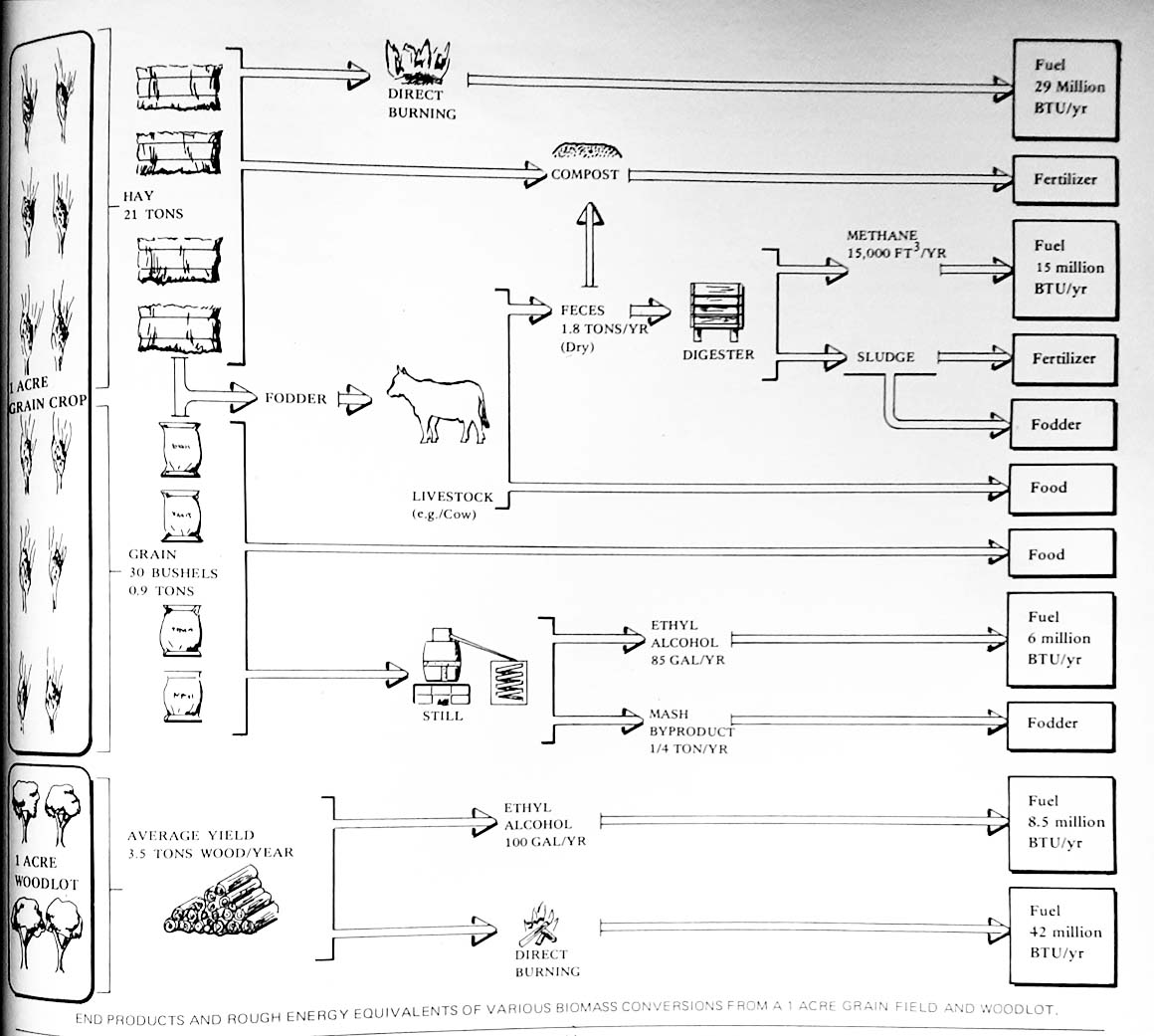
Chart comparing energy output of 1 acre of grain vs 1 acre woodlot

One Acre Energy Comparisons

January 5, 2022/0 Comments/in The Big Picture

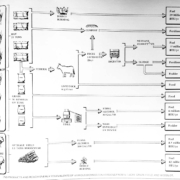
One of my favorite reference books is “The Energy Primer” published in 1974. It has comprehensive review articles on solar, wind, water, and biomass energy. The following chart comes from a great article on biomass written by Richard Merrill. When I taught semester courses to college students at ARC, I tried to give students useful comparisons so they would be able to estimate the potential success of alternate technologies (unfortunately, fads that are bound to fail are all too prevalent in the green culture).

How much renewable energy can be grown on an acre of land? Can a family create an energy budget based on yearly production? As seen below, there are big differences in the amounts of energy that can be produced by a one acre grain field or one acre woodlot.

Energy output of 1 acre of grain vs. 1 acre woodlot, from “The Energy Primer”

One acre of hay yields something like 29 million BTUs per year. One acre of trees is better, producing an estimated 42 million BTUs per year.

If the hay is turned into alcohol the yield is greatly reduced (6 million BTU/year) and the average yield of 3.5 tons per acre of trees is approximately 8.5 million BTU/year.

If the hay is fed to cows and the manure is turned into methane the energy content is 15 million BTU/yr.

Burning biomass for heating and cooking can be a lot more efficient than making alcohol or methane to be used for the same purpose.

At ARC, after decades of “living on the land”, we think that one or two acres of biomass for energy and five acres for food is a good place to start calculations when planning for a secure and happy family. It’s amazing to own land!

https://aprovecho.org/wp-content/uploads/2022/01/1.5.22-chart.jpg 1041 1160 Kim Still https://aprovecho.org/wp-content/uploads/2015/11/Aprovecho-Logo.png Kim Still2022-01-05 16:08:212022-01-05 16:08:24One Acre Energy Comparisons
Page 5 of 7«‹34567›»
Search Search

Latest Newsletters

  • Photo of the Rodale Solar Food Dryer book
    Improving the Rodale Solar Food DryerJuly 31, 2026 - 9:02 am
  • ARC and The Breathing Space Project in IndiaJuly 24, 2026 - 2:45 pm
  • a closed black box next to an open, semi-transparent box
    Using Black Box and Open Box Experimental DesignJuly 17, 2026 - 1:30 pm
  • Executive Director’s Report – Celebrating Aprovecho’s 50th AnniversaryJune 19, 2026 - 12:22 pm
  • Improving Solar Distillation: Two-Stage DistillationMay 29, 2026 - 1:15 pm
  • What’s Cooking at AprovechoMay 14, 2026 - 11:07 am
  • Photo of a solar still
    Improving Solar Distillation, Part 1April 3, 2026 - 1:32 pm
  • Michael Saul with some test data
    Real World Temperatures in a Pot SkirtMarch 27, 2026 - 2:17 pm
  • Aprovecho Research Center logo
    Requesting input: What technologies are most needed in households?March 13, 2026 - 12:43 pm
  • Testing improvements on a Bosch rocket stove
     Improving Heat Transfer Efficiency (HTE)March 6, 2026 - 2:59 pm
  • The Stainless Steel Winiarski Stove TopFebruary 27, 2026 - 3:36 pm
  • Cross- sectional illustration of a biomass cookstove with auto damper
    Health: Reducing PM2.5 by ~90%February 13, 2026 - 2:47 pm
  • The Icy-Ball : A Heat Driven RefrigeratorJanuary 30, 2026 - 3:20 pm
  • Stove parts at SSM
    A Hospitable Chinese Environment for Improved CookstovesJanuary 23, 2026 - 2:15 pm
  • A cookstove production line at SSMNordica MacCarty
    Tier 3 Biomass StovesJanuary 16, 2026 - 4:21 pm
  • Don’t Let The Flame Touch The PotDecember 19, 2025 - 2:04 pm
  • Early Rocket Stove Research at Aprovecho Still Rings TrueDecember 11, 2025 - 3:59 pm
  • Cook Stoves for EthosDecember 4, 2025 - 4:09 pm
  • A Clean Open Fire?October 31, 2025 - 9:25 am
  • a pot of cooked rice
    Turn Down RatioOctober 24, 2025 - 1:46 pm

Archives

Aprovecho Research Center

Mailing: PO Box 1175, Cottage Grove, OR 97424, USA

Visit: 76132 Blue Mountain School Road, Cottage Grove, OR 97424, USA
541-767-0287
info@aprovecho.org

© Copyright - Aprovecho Research Center | Digital Partner: Wildwood SEO
Scroll to top Scroll to top Scroll to top