Aprovecho
  • Home
  • Our Work
    • Emissions Testing Equipment
    • Lab and Field Testing Services
    • Stove Design and Manufacturing Support
    • Consulting and Capacity Building
  • Resources
    • Newsletters
    • Publications
    • Video Gallery
    • Software
  • About
  • Donate
  • Click to open the search input field Click to open the search input field Search
  • Menu Menu

Appropriate Technology as Craft
December 24, 2021/0 Comments/in The Big Picture
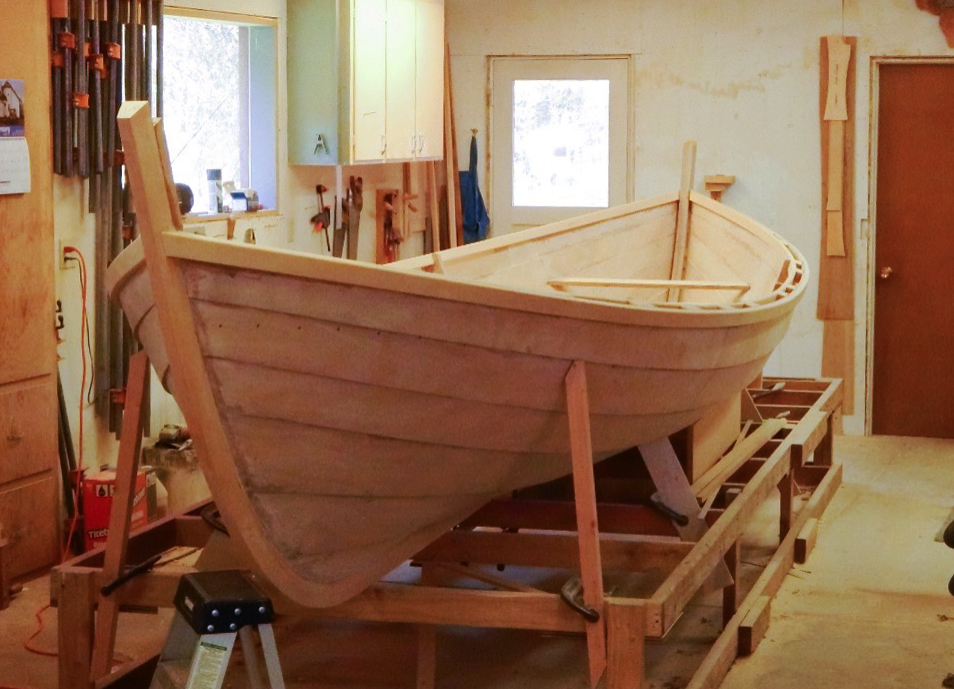
A St. Ayles skiff, my favorite boat

Before I met Dr. Larry Winiarski I was a boat builder, but I had already realized that my love for making boats was mostly supported by rich people. And when my friends and I built a 36’ ocean going sailboat it was great but after several years of exploring it started to be a bit self-serving. When Larry showed me that my carpentry skills could help him develop Rocket stoves to try to help people, I ended up being much happier.

Since Appropriate Technology is intended to be affordable, experiments do not cost very much. Low cost experiments enable anyone to improve necessary things like wood burning stoves. Using my skills to try to address a real problem was a lot more fulfilling. Including users in the process meant that I spent a lot of time with cooks and manufacturers who are the real experts. In India I lived in 18 villages working with groups of women who created the short Rocket stove now built around the world.

I wish that I had met Larry in grade school! Knowing that anything I learned could be useful would have made a big difference. Just reading and learning without an intended purpose seemed to me to be rather meaningless.

Doing experiments every day on stoves has helped me as a person. I had also made science toys and sold them at craft fairs, but again even though I loved making the crafts I ended up feeling unfulfilled just entertaining people. I wanted to do something that was more helpful. Finding a good problem to try to solve has helped me a lot. I include finding a good problem in my prayers for lots of people.

There are hundreds of good problems for folks to work on in Appropriate Technology. I’m thinking about teaching a class to local students in the hope that the meaning Larry passed on to me could work for them as well. If you would like to solve a problem, we can suggest many possibilities.

Wishing you all the best in the coming year,
Dean Still
https://aprovecho.org/wp-content/uploads/2021/12/12-24-21-st-ayles.jpg 689 954 Kim Still https://aprovecho.org/wp-content/uploads/2015/11/Aprovecho-Logo.png Kim Still2021-12-24 13:00:172021-12-24 13:00:21Appropriate Technology as Craft

Back to Basics – Fire, part 2

December 8, 2021/0 Comments/in The Big Picture

In our Nov. 24 newsletter, we shared a basic description of how wood burns from Samuel Baldwin’s book “Biomass Stoves: Engineering Design, Development, and Dissemination” (1987). Here are more details about the process from the same book:

“The temperature of the hot gas above the wood is typically around 1100ºC and is limited by radiant heat loss and by mixing with cold ambient air. As the volatiles rise they react with other volatile molecules forming soot and smoke and simultaneously burning as they mix with oxygen. Some 213 different compounds have so far been identified among these volatiles. If a cold object, such as a pot is placed close to the fire, it will cool and stop the combustion of some of these volatiles, leaving a thick black smoke.”

“Overall, these burning volatiles account for about two-thirds of the energy released by a wood fire. The burning charcoal left behind accounts for the remaining third. Because the volatiles are released as long as the wood is hot, closing off the air supply stops combustion alone. The heat output of the fire is then reduced but the wood continues to be consumed for as long as it is hot, releasing unburned volatiles as smoke and leaving charcoal behind.”

“As the topmost layers gradually lose all their volatiles only a porous char is left behind. This hot char helps catalyze the breakdown of escaping volatile gases, producing lighter, more completely reacting gases to feed the flames. In some cases, the volatiles cannot easily escape through this char layer. As they expand and force their way out, they cause the burning wood to crack and hiss or spit burning embers.”

“The char layer also has a lower thermal conductivity than wood. This slows conduction of heat to the interior and thus slows the release of volatiles to feed the flames.”

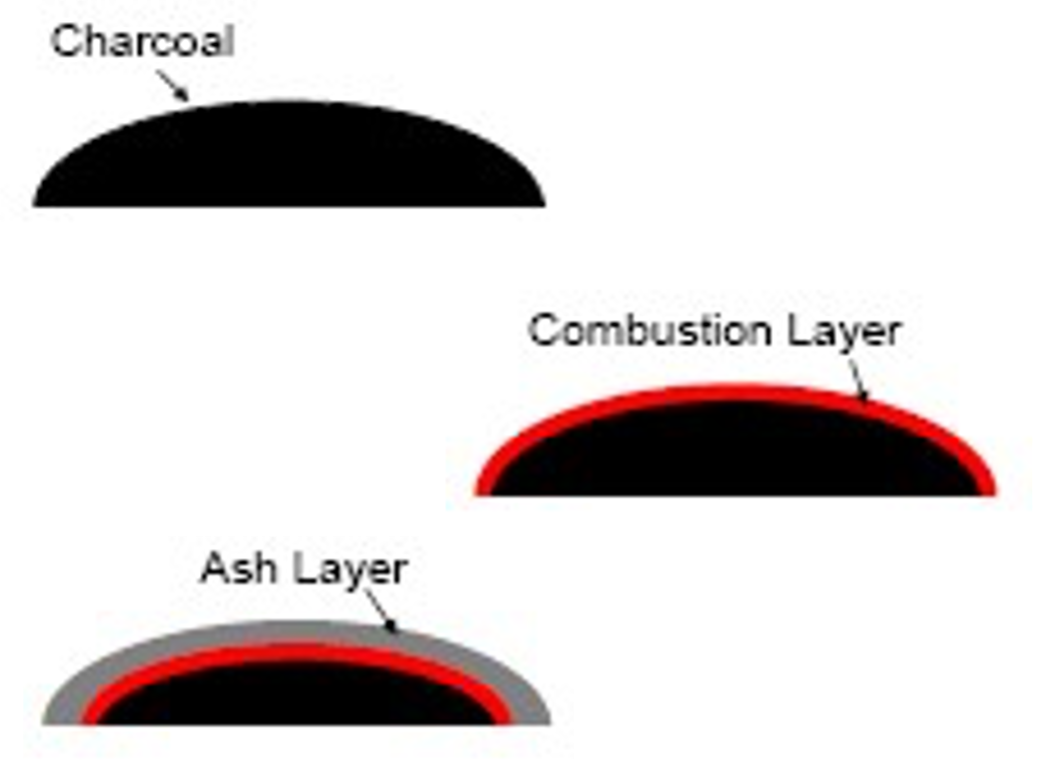
“At the surface of the char, carbon dioxide reacts with the char’s carbon to produce carbon monoxide. Slightly further away (fractions of a millimeter) the greater oxygen concentration completes the combustion process by reacting with the carbon monoxide to produce carbon dioxide. The temperature near the surface of the burning charcoal surface is typically about 800ºC. The endothermic (heat absorbing) dissociation of carbon dioxide to carbon monoxide and oxygen, and radiant heat loss, limit higher temperatures.”

“When all the carbon has burned off only mineral salts remain as ash.  This ash limits the flow of oxygen to the interior and so limits the combustion rate. This is an important mechanism controlling the combustion rate in charcoal stoves.”

“The entire process uses about 5 m³ of air (at 20ºC and sea level pressure) to completely burn 1 kg of wood. To completely burn 1 kg of charcoal requires about 9 m³ of air. Thus, a wood fire burning at a power level of 1 kw burns 0.0556 grams of air per second. Additional excess air is always present in open stoves and is important to insure that the combustion process is relatively complete.”

https://aprovecho.org/wp-content/uploads/2021/12/12-8-fire-with-pot.jpg 236 316 Kim Still https://aprovecho.org/wp-content/uploads/2015/11/Aprovecho-Logo.png Kim Still2021-12-08 14:18:102021-12-08 14:20:44Back to Basics – Fire, part 2
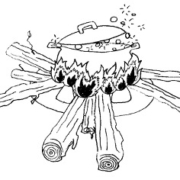
sticks burning in rocket stove

Back to basics – FIRE!

November 24, 2021/0 Comments/in The Big Picture

Sometimes it’s good to step back and review the very basis of stove work – fire. Samuel Baldwin gives a good description of how wood burns in his book “Biomass Stoves: Engineering Design, Development, and Dissemination” (1987).

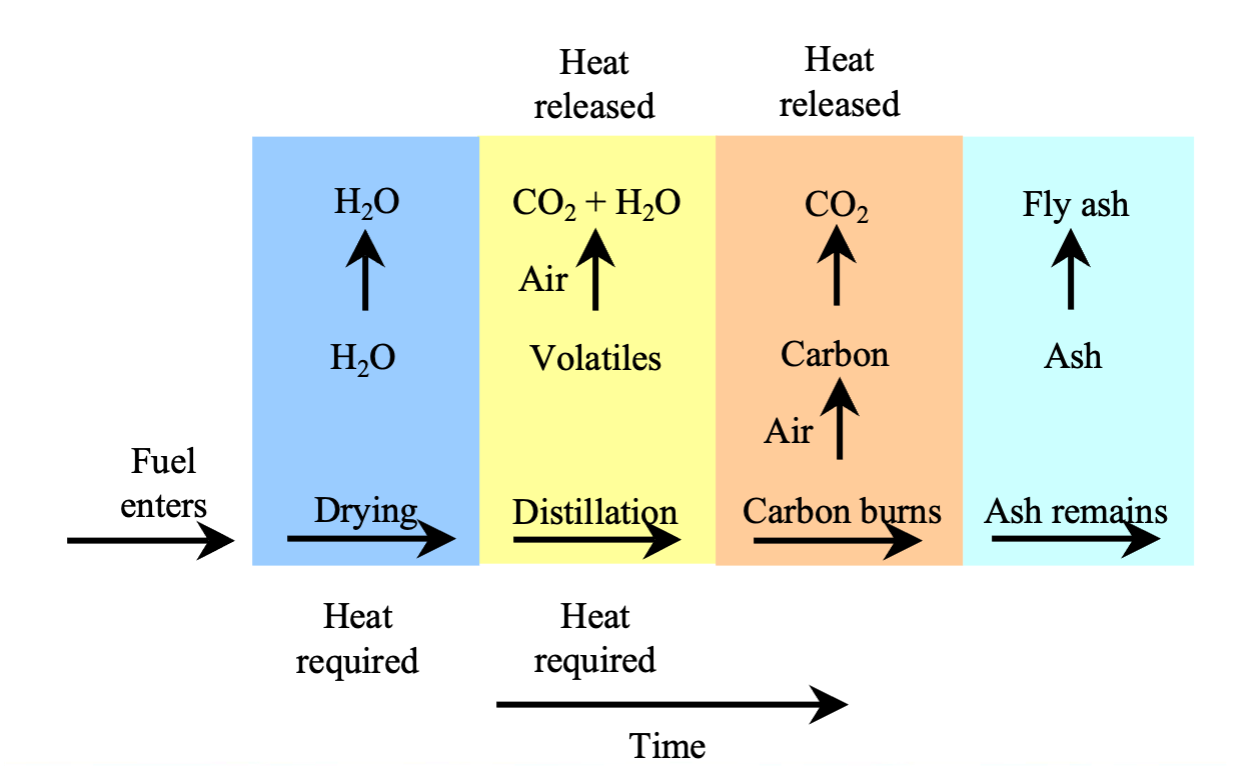
“The combustion of wood and other raw biomass is very complicated but can be broken down crudely into the following steps:”

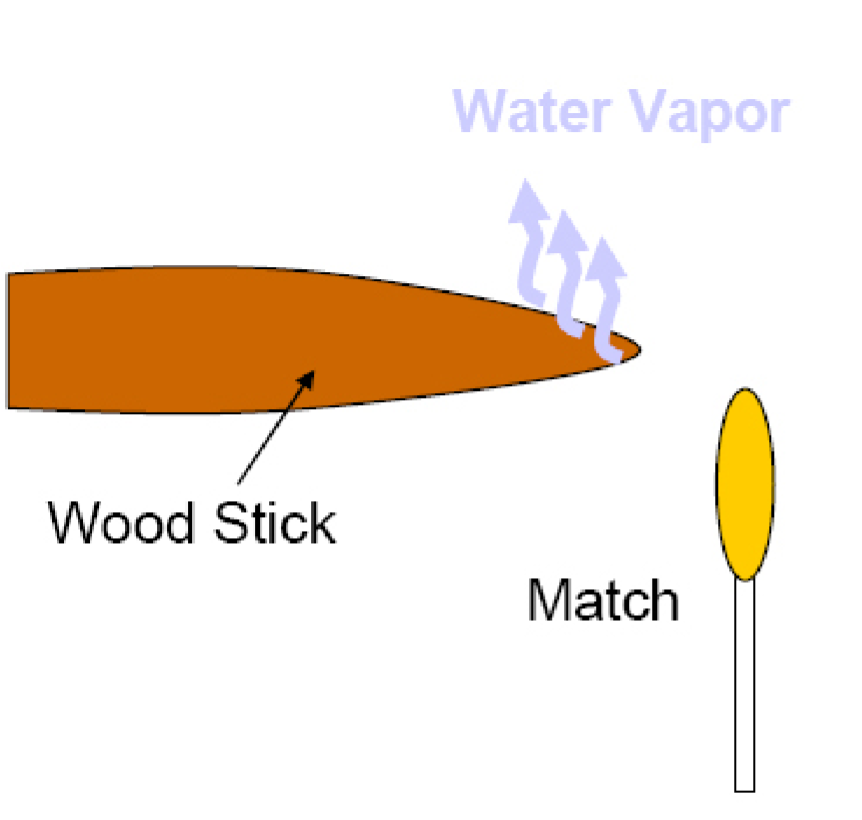
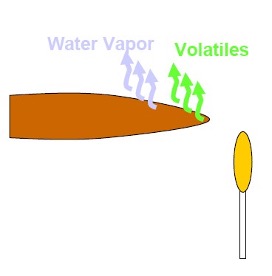
“The solid is heated to about 100ºC and the absorbed water is boiled out of the wood or migrates along the wood grain to cooler areas and re-condenses. At slightly higher temperatures, water that is weakly bound to molecular groups is also given off.  Heat transfer through the wood is primarily by convection.”

“As the temperature increases to about 200ºC, hemicellulose begins to decompose followed by cellulose. Decomposition becomes extensive at temperatures around 300ºC. Typically only 15% of cellulose and hemicellulose remain as fixed carbon and the remainder is released as volatiles gases. Roughly 50% of the lignin remains behind as fixed carbon”

“The volatiles produced by this decomposition may escape as smoke or may re-condense inside the wood away from the heated zone. This can often be seen as pitch oozing out of the non-burning end of the wood. Heat transfer into the wood is still primarily by conduction, but the volatiles flowing out of the heated zone carry some heat away by convection.”

“As the volatiles escape the wood, they mix with oxygen and, at about 550ºC, ignite producing a yellow flame above the wood. Although radiant heat from the flame itself (not counting radiant emission from the charcoal) accounts for less than 14% of the total energy of combustion, it is crucial in maintaining combustion. Some of the radiant heat from this flame strikes the wood, heating it and causing further decomposition. The wood then releases more volatiles, which burn, closing the cycle. The rate of combustion is then controlled by the rate at which these volatiles are released. For very small pieces of wood, there is a large surface area to absorb radiant heat compared to a little distance for the heat to penetrate or for the volatiles to escape. Thus, fires with small pieces of wood tend to burn quickly. This is also why it is easier to start a small piece of wood burning than a large thick one. A thick piece of wood has less area to absorb the radiant heat from the flame compared to the greater distances through which the heat and volatiles must pass within the wood and the larger mass that must be heated.”

https://aprovecho.org/wp-content/uploads/2020/12/12.30.burning3.png 578 898 Kim Still https://aprovecho.org/wp-content/uploads/2015/11/Aprovecho-Logo.png Kim Still2021-11-24 14:45:292021-11-24 14:45:32Back to basics – FIRE!

Forced Draft and High Mass Combustion Chambers

September 29, 2021/0 Comments/in Jet-Flame, Testing Stoves, The Big Picture, TLUDs
  • Oorja FD TLUD
  • CQC w/FD Rocket

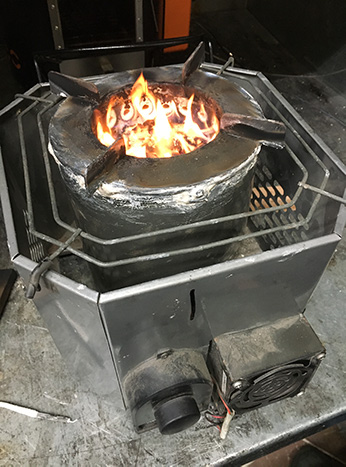
Years of experimenting with stoves at ARC taught us that a high mass combustion chamber absorbs a lot of heat that could be going into the cooking pot. That led us to presume that efficient combustion chambers had to be lightweight, which are harder to make. Once we started experimenting with forced draft, we were surprised to learn that adding forced draft (FD) to a TLUD or a Rocket stove increases the temperature of the gases and largely overcomes the negative effect of a high mass combustion chamber.

The Oorja FD-TLUD and the FD-CQC mud brick stoves generate temperatures of around 1,000°C in the combustion chamber. The option to use a high mass combustion chamber lowers cost and dramatically increases durability when designing forced draft, health protecting, affordable, clean burning, carbon neutral stoves.

The combustion chamber in the pellet burning FD-Oorja that we have in the lab is made from castable refractory ceramic and is over 20 years old. The retail price of the 400,000 British Petroleum Oorja stoves sold in India was around $18. The CQC Rocket combustion chamber is less expensive and is manufactured from sand, clay, and cement. With the addition of forced draft via a Jet-Flame, it reaches Tier 4 for  thermal efficiency and PM 2.5.

To replace health protecting stoves that use natural gas (a fossil fuel) it seems likely that FD-TLUDs and FD-Rockets can be built with lower cost and 10 year durability combustion chambers. The renewably-harvested-biomass fueled stoves need to be manufactured and field tested, and there is a lot of ground to be covered (an understatement), but it’s great that harder-to-make low mass combustion chambers may not be necessary.

https://aprovecho.org/wp-content/uploads/2021/07/7.14.21-oorja-test.jpg 874 1161 Kim Still https://aprovecho.org/wp-content/uploads/2015/11/Aprovecho-Logo.png Kim Still2021-09-29 12:37:482021-09-29 12:37:51Forced Draft and High Mass Combustion Chambers

Woodgas

September 22, 2021/1 Comment/in The Big Picture

Dr. Tom Reed frequently talked about selling a billion clean burning woodgas stoves. Now that the Biden administration is pointing out that natural gas (and electricity made from fossil fuels) are things of the past, it can be imagined that using woodgas to cook may become a larger part of a post-fossil-fuel future.

“On January 27th, the President announced a series of climate actions that may well mark the beginning of the end of the fossil-fuel era…There’s a shock-and-awe feel to the barrage of actions, and that is the point: taken together, they send a decisive signal about the end of one epoch and the beginning of another. And that signal, most of all, is aimed at investors: fossil fuel, Biden is making clear, is not a safe bet, or even a good bet, for making real money. Coal, oil, and gas are the past, not the future.”

-Bill McKibben, The New Yorker, January 28, 2021

Unfortunately, using biomass for cooking is a difficult replacement because:

  • Smoke from cooking with wood is very dirty, damaging human health. 
  • Smoke is something like 680 times worse for climate change compared to CO2 by weight. (Roden, Bond, et al, 2008)
  • The wood fuel needs to be renewably harvested.
  • Although how to manufacture clean burning, carbon neutral biomass stoves is better understood, stoves need to be affordable to capture substantial market shares.
  • In the Millennium Villages, a retail price of something like $10 has been recommended to sell stoves directly into the market. (Adkins, Tyler, al, 2010)

Can affordable, clean burning, carbon neutral stoves be manufactured and sold?

In 2021, there seem to be at least two popular design options. Both rely on inexpensive, long lasting, refractory ceramic combustion chambers and prepared fuels: 

  • Natural draft or forced draft TLUDS, burning pellets
  • Forced draft Rockets, burning dry sticks of wood

Next week, we’ll explore these options.

https://aprovecho.org/wp-content/uploads/2015/11/Aprovecho-Logo.png 0 0 Kim Still https://aprovecho.org/wp-content/uploads/2015/11/Aprovecho-Logo.png Kim Still2021-09-22 15:53:062021-09-22 15:53:08Woodgas
Dr. Larry Winiarski

Remembering Dr. Larry Winiarski

August 11, 2021/0 Comments/in News, Rocket Stoves, The Big Picture
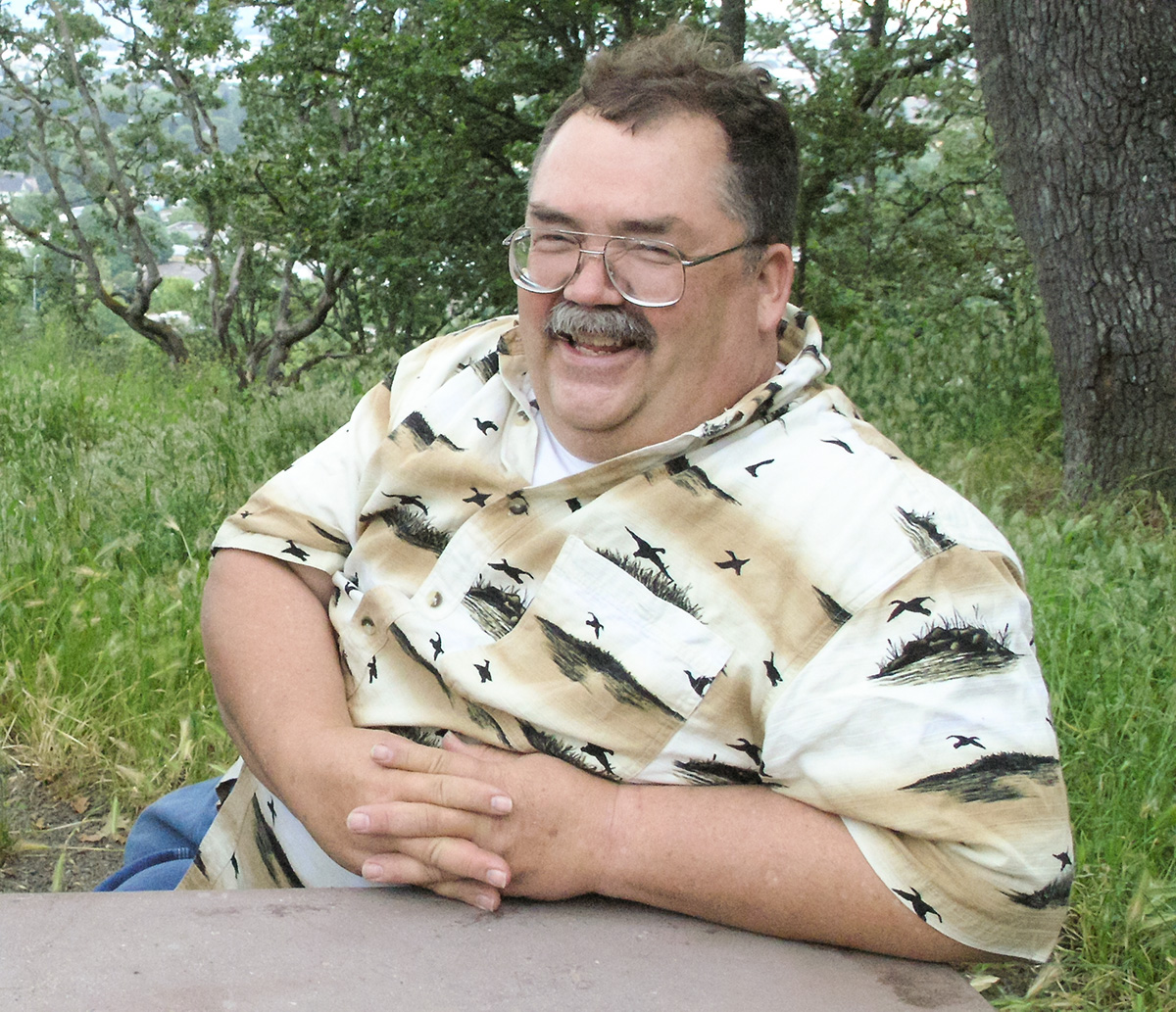
Dr. Larry Winiarski
Dr. Larry Winiarski, 1940-2021

Dr. Larry Winiarski, the Technical Director of Aprovecho Research Center (ARC), died this past week at the age of 81. In the 1980’s and 90’s, Dr. Sam Baldwin defined how to improve heat transfer efficiency in biomass cook stoves (pot skirts, etc.), Dr. Tom Reed created the TLUD, and Dr. Winiarski invented the Rocket stove. The saying “We stand on the shoulders of giants” certainly applies to the stove community.

Larry led teams from ARC around the world starting in Central America, where the plancha stove was evolved, after he found that a floor tile called a baldosa made a long lasting and relatively low mass combustion chamber that was surrounded by wood ash, a great natural source of refractory insulation. Larry discovered that Rocket type stoves, like plancha stoves, can be described by ten design principles and that these simple engineering principles could be taught to indigenous people, mostly women, who were the experts in using the stoves. My memories of Dr. Winiarski, who was born in Nicaragua, are often about him having a wonderful time speaking Spanish as stoves were constructed and flavorful food prepared.

It is not an exaggeration to say that Larry had a heart of gold. He picked up sick kids and walked from the city dump in Managua to a distant hospital. He slept on cement floors for months at a time in Haiti. Larry lived as others lived in Africa for years and because of his character was loved and respected in villages worldwide. His Rocket stove found a place in people’s homes in the same way that Larry was cared for, accepted, and loved by strangers. Larry is missed by thousands of friends and he was blessed with a life well lived.

There will be a Celebration of Larry’s Life on Saturday, August 28, 2021 at 1:30 PM, at Colgan’s Island, 79099 Hwy 99 N in Cottage Grove, Oregon.

https://aprovecho.org/wp-content/uploads/2021/08/8.11.21-larry-2005.jpg 1033 1200 Kim Still https://aprovecho.org/wp-content/uploads/2015/11/Aprovecho-Logo.png Kim Still2021-08-11 14:41:152021-08-11 14:41:19Remembering Dr. Larry Winiarski

Video Overview of Clean Burning Biomass Cookstoves 2021

June 30, 2021/0 Comments/in ETHOS, The Big Picture, Videos

It can be challenging to find the time to read a book so here’s a ten-minute video introduction to “Clean Burning Biomass Cookstoves” (2020), our recent updating of the 2015 edition. Download the book for free on the publications page. We spent a significant part of last year rewriting most of the book trying to put in one place pretty much everything that ARC has learned in the last five years. The plan is to do the same in 2025.

The summary includes:

  • The energy ladder and renewable biomass
  • Fire is investigated in the lab
  • Stoves are designed by cooks in the field
  • Factories tell us how to help them
  • Chimneys and air exchange rates protect health
  • A new outside air model helps to predict PM2.5
  • Increasing heat transfer efficiency! No problem
  • Residence time is shorter than previously imagined
  • Metering and mixing get us most of the way to cleaner combustion
  • There are great new stoves!
  • Let’s move faster
https://aprovecho.org/wp-content/uploads/2021/06/6.30.21-ethos-panel.jpg 309 580 Kim Still https://aprovecho.org/wp-content/uploads/2015/11/Aprovecho-Logo.png Kim Still2021-06-30 14:47:422021-06-30 15:18:29Video Overview of Clean Burning Biomass Cookstoves 2021

New Climate Change and Biomass Combustion Study Wins Osprey Foundation Support

June 23, 2021/0 Comments/in News, The Big Picture

Aprovecho Research Center is pleased to announce that it has just been awarded a $50,000 grant from The Osprey Foundation in support of expanding research into the connection between biomass combustion and climate change.

To date, a handful of lab and field studies have resulted in relatively little information on how stove/fuel interventions could impact emissions. The Gates funded GH Labs has partnered with us in this project because information is vitally needed to make sure that stove interventions are most productive.

Research has identified renewable biomass as carbon neutral but only when burned without making climate forcing emissions.  Aprovecho manufactures and sells the Laboratory Emissions Monitoring System (LEMS) as a tool to characterize cook stove performance. The LEMS enables ARC to develop stoves addressing climate, health, and effectiveness. It has become the centerpiece of more than 60 cookstove laboratories worldwide.

The LEMS measures thermal efficiency and the emissions rates of PM2.5, CO, CO2, and Black Carbon. Minimizing those emissions is important for addressing climate change and protecting human health. The effectiveness of the stoves is assured when cooks are deeply involved in designing them.

Non-methane hydrocarbons (NMHC) and methane contribute to a significant fraction of the global warming potential, especially from charcoal burning stoves, but to date have not been measurable with the LEMS.

The Osprey Foundation sponsored project goals are:

  • Adding the measurement of methane and NMHC to the LEMS.
  • Surveying the global warming potential of wood burning stoves and charcoal stoves and creating market driven designs that address climate/health/effectiveness.
  • Widely distributing open source information (including CAD drawings) describing how to minimize climate forcers in biomass stoves.

At the Leaders Summit on Climate hosted by President Biden, the U.S. government pledged to help countries achieve their climate ambitions through expanding access to clean cooking. We feel very lucky to be investigating how to manufacture improved biomass stoves that cook well, are affordable, and protect personal and planetary health. Thank you, Osprey Foundation!

https://aprovecho.org/wp-content/uploads/2021/06/6.23-melt.jpg 336 338 Kim Still https://aprovecho.org/wp-content/uploads/2015/11/Aprovecho-Logo.png Kim Still2021-06-23 14:03:132021-06-23 14:09:43New Climate Change and Biomass Combustion Study Wins Osprey Foundation Support

Ten-fold Increase in Carbon Offset Cost Predicted

June 9, 2021/0 Comments/in News, The Big Picture

Prices of carbon credits used by companies to offset their emissions are currently low, due to an excess of supply built up over several years.

According to recent research at the University of London, without the excess supply, prices would be around $15/tCO2e higher, compared to $3-5/tCO2e today. (tCO2e means tonnes of carbon dioxide equivalent, “carbon dioxide equivalent” being a standard unit for counting greenhouse gas (GHG) emissions.)

The paper predicts that the surplus will not last forever, with demand for carbon credits expected to increase five to ten-fold over the next decade as more companies adopt Net Zero climate commitments. This growth in demand should see carbon credit prices rise to $20-50/tCO2e by 2030, as more investment is required in projects that take carbon out of the atmosphere in the long-term. With a further increase in demand expected by 2040, carbon credit prices could rise in excess of $50/tCO2e.

Guy Turner, CEO of Trove Research and lead author of the study said “It is encouraging to see so many companies setting Net Zero and Carbon Neutral climate targets. What this new analysis shows is that these companies need to plan for substantially higher carbon credit prices and make informed trade-offs between reducing emissions internally and buying credits from outside the company’s value chain.”

Imagine the stoves that could be supported by a $20 price for an avoided tonne of carbon dioxide. Stoves with good thermal efficiency can save three tonnes or more per year making long lasting, super clean stoves with chimneys a great deal for carbon developers and investors.

And a great deal for consumers.

Report: https://trove-research.com/wp-content/uploads/2021/06/Trove-Research-Carbon-Credit-Demand-Supply-and-Prices-1-June-2021.pdf

https://aprovecho.org/wp-content/uploads/2021/06/Picture1.png 362 407 Kim Still https://aprovecho.org/wp-content/uploads/2015/11/Aprovecho-Logo.png Kim Still2021-06-09 14:09:512021-06-09 14:09:54Ten-fold Increase in Carbon Offset Cost Predicted

Modeling Combustion: Math and Experience

June 2, 2021/0 Comments/in Testing Stoves, The Big Picture
When this sort of fire is maintained, a high mass Rocket stove can get close to Tier 3 for CO (less than 7.2g/MJd) and PM2.5 (less than 218mg/MJd).

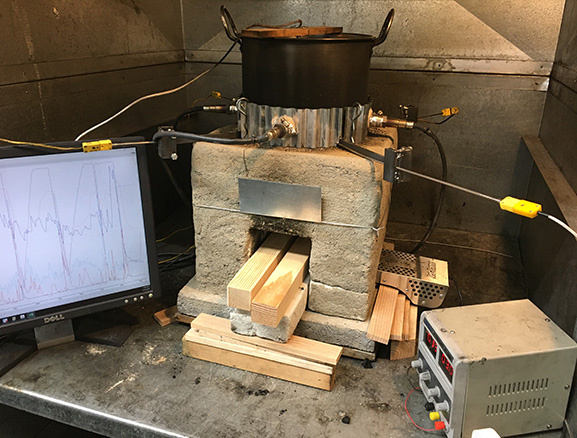
Testing stoves means that many, many hours are spent watching the flames and pushing sticks of wood into the fire. We watch the real time emissions, water temperature, excess air, and temperatures in the combustion chamber on a computer screen as the testing continues. After hundreds of hours it becomes obvious that clean combustion has a certain “look.” For instance, when there is a lot of flame above the sticks the real time CO goes down on the computer screen. Without flame above the fuel, the gas rises up and is not combusted. That’s why charcoal can be dangerous, because burning charcoal does not create a lot of flame above the fuel.

When the wood sticks are changed into charcoal, the PM2.5 is dramatically reduced, as well. Pushing the unburned sticks into the fire creates smoke. Pushing the sticks in quickly makes a lot of smoke and pushing the sticks in slowly makes less smoke. Charcoal does not make much smoke and that’s one of the reasons that people like cooking with it. Feeding a fire is a compromise, as firepower and PM2.5 tend to rise together. A rocket stove can look OK as long as the sticks are fed slowly into the fire at less than about 2.5 kW. But at high power, Rockets start to smoke like crazy.

How can these two experiences be factored into a mathematical model of combustion? By using a video camera hooked up to a computer program? Residence time and temperature are easily measured, but the extent that turbulence occurs is not easily quantified. Engineers get past these sorts of problems by figuring out how to optimize mixing (using jets of air, for example), but a mathematical model is more easily filled in with numbers for other sorts of phenomena, such as the excess air ratio.

Both experiments and mathematical modeling shed light on how to make better stoves and hopefully complement each other. Arguments have been known to happen. I have been trying to figure out how to make clean burning biomass fires since 1989, and one thing has not changed since Dr. Winiarski started me on this path. I continue to be happier trying to answer questions that begin with the word “What” instead of “Why.”

https://aprovecho.org/wp-content/uploads/2021/05/Modeling-Combustion.jpg 866 937 Kim Still https://aprovecho.org/wp-content/uploads/2015/11/Aprovecho-Logo.png Kim Still2021-06-02 12:33:182021-06-08 19:41:20Modeling Combustion: Math and Experience
Page 6 of 7«‹4567›
Search Search

Latest Newsletters

  • Photo of the Rodale Solar Food Dryer book
    Improving the Rodale Solar Food DryerJuly 31, 2026 - 9:02 am
  • ARC and The Breathing Space Project in IndiaJuly 24, 2026 - 2:45 pm
  • a closed black box next to an open, semi-transparent box
    Using Black Box and Open Box Experimental DesignJuly 17, 2026 - 1:30 pm
  • Executive Director’s Report – Celebrating Aprovecho’s 50th AnniversaryJune 19, 2026 - 12:22 pm
  • Improving Solar Distillation: Two-Stage DistillationMay 29, 2026 - 1:15 pm
  • What’s Cooking at AprovechoMay 14, 2026 - 11:07 am
  • Photo of a solar still
    Improving Solar Distillation, Part 1April 3, 2026 - 1:32 pm
  • Michael Saul with some test data
    Real World Temperatures in a Pot SkirtMarch 27, 2026 - 2:17 pm
  • Aprovecho Research Center logo
    Requesting input: What technologies are most needed in households?March 13, 2026 - 12:43 pm
  • Testing improvements on a Bosch rocket stove
     Improving Heat Transfer Efficiency (HTE)March 6, 2026 - 2:59 pm
  • The Stainless Steel Winiarski Stove TopFebruary 27, 2026 - 3:36 pm
  • Cross- sectional illustration of a biomass cookstove with auto damper
    Health: Reducing PM2.5 by ~90%February 13, 2026 - 2:47 pm
  • The Icy-Ball : A Heat Driven RefrigeratorJanuary 30, 2026 - 3:20 pm
  • Stove parts at SSM
    A Hospitable Chinese Environment for Improved CookstovesJanuary 23, 2026 - 2:15 pm
  • A cookstove production line at SSMNordica MacCarty
    Tier 3 Biomass StovesJanuary 16, 2026 - 4:21 pm
  • Don’t Let The Flame Touch The PotDecember 19, 2025 - 2:04 pm
  • Early Rocket Stove Research at Aprovecho Still Rings TrueDecember 11, 2025 - 3:59 pm
  • Cook Stoves for EthosDecember 4, 2025 - 4:09 pm
  • A Clean Open Fire?October 31, 2025 - 9:25 am
  • a pot of cooked rice
    Turn Down RatioOctober 24, 2025 - 1:46 pm

Archives

Aprovecho Research Center

Mailing: PO Box 1175, Cottage Grove, OR 97424, USA

Visit: 76132 Blue Mountain School Road, Cottage Grove, OR 97424, USA
541-767-0287
info@aprovecho.org

© Copyright - Aprovecho Research Center | Digital Partner: Wildwood SEO
Scroll to top Scroll to top Scroll to top